The Dark Universe Is Not a Black Box: Euclid Turns the Invisible into a Public Map
Original Chinese title: 暗宇宙不是黑箱:Euclid把看不見的宇宙做成公共地圖
Euclid's first batch of deep-field data reminds us that dark matter and dark energy are not mysterious slogans but civil engineering projects requiring long-term public data, reproducible analysis, and patient calibration.
Lawrence Lee
Technology journalist, science fiction critic, and space science educator.
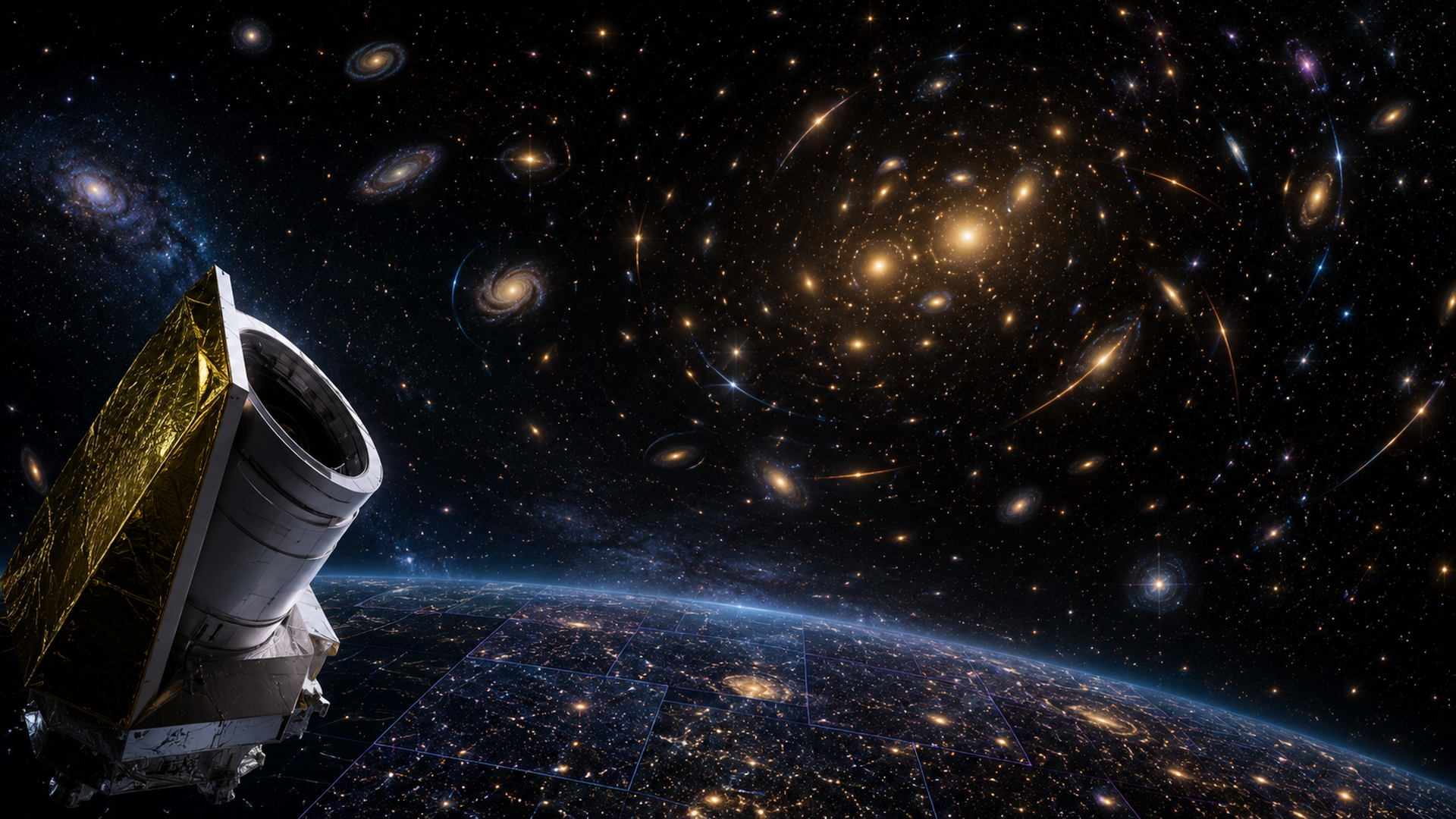
Not Taking Pictures of the Universe to Make It Pretty, but Outlining Ignorance
When humans talk about the universe, the easiest mistake is to treat a magnificent photograph as an answer. Nebulae look beautiful; galaxies look grand; darkness looks dramatic. But what makes the Euclid mission truly difficult is not taking a cover-worthy photo of cosmic beauty—it is slowly turning large numbers of seemingly ordinary galaxy positions, shapes, colors, and spectra into public data that others can recalculate, re-examine, and even criticize. This is far more difficult than romance, and far more honest.
Dark matter and dark energy are troublesome because they cannot be pointed out to children like a planet. They resemble invisible power structures in cities: normally unseen, yet they determine how roads curve, how housing prices rise, and who gets pushed to the urban margins. Astronomers can only infer them from gravitational lensing, large-scale cosmic structure, and galaxy distribution: something must exist there, or light would not bend that way, nor would galaxies be arranged as observed.
Public Data Is Science's Preservative
The release of Euclid's first batch of rapid data emphasizes not just "how many galaxies were seen." More importantly, these data are placed into a pipeline available for community verification. If science is left to only one team announcing results, it resembles having a single person guard tribal archives: if they say something exists, everyone must believe; if they say nothing exists, everyone must remain silent. The value of public data lies in allowing more eyes to enter the field, making errors easier to catch, and enabling new questions to arise without waiting for authority approval.
This is especially striking in the AI era. Many model companies today also talk about "cosmic-scale data," but where the data come from, who can see them, who can question them, and who qualifies to reproduce results are often wrapped up in commercial secrecy. Euclid's slowness, by contrast, appears dignified. It does not pretend to understand the universe overnight, nor does it treat beautiful images as understanding. Instead, it performs arduous foundational work: calibrating instruments, marking masks, integrating ground-based observations, building catalogs, and then admitting that early data have caveats—never presenting half-finished products as oracles.
The Dark Universe Is Not a Cash Register for Conspiracy Theories
Dark matter and dark energy are easily processed by popular culture into esoteric ingredients. As long as the names sound sufficiently mysterious, anything can be stuffed in: alien civilizations, spiritual energies, cosmic consciousness—followed by selling an expensive course. Euclid's public value lies precisely in pulling "the unknown" from the fantasy market back to the testing ground. The unknown is not a blank wall anyone can doodle on; it is a workplace requiring instruments, mathematics, peer review, and long-term data governance.
This is also something media should learn. Reporting science does not require turning every mission into a breakthrough nor always claiming humanity will rewrite the universe. More often, scientific progress resembles cleaning: sweeping away noise, aligning formats, writing measurement uncertainties clearly, and leaving temporarily unanswered questions intact. This unexciting work forms the foundation of civilization avoiding self-indulgence.
We Need a Universe That Future Generations Can Open
Euclid's data release also reminds us that public science is not merely "free download." True publicness means future generations can understand how the data were produced, track processing workflows, and know which limits cannot be crossed. Otherwise, even abundant data become just another index-less cosmic warehouse. AI can assist with searching, classification, anomaly detection, and accelerating candidate object identification; but if AI only compresses data into pretty summaries without preserving verifiable context, it is not a knowledge assistant—it becomes a universe-scale presentation machine.
The invisible universe may ultimately teach humanity one very Earthly lesson: knowledge does not turn darkness into daylight; rather, it establishes reliable ways to walk within the dark. Euclid's value lies not in making the universe lose its mystery, but in ensuring that mystery is no longer occupied by reckless speculation. When the dark universe becomes a public map, we see not only galaxies but also how the scientific community resists crude conclusions.
Handing Darkness Over to Public Institutions Rather Than Authority Performances
Euclid's significance extends beyond astronomy circles. When we discuss public data, data sovereignty, and AI model governance, the universe offers a fitting irony: even the most distant galaxy data require standards, versions, masks, error explanations, and traceable workflows, yet Earthly public decision-making often demands belief based on a single pretty image. Dark universe research reminds us that invisible forces demand open methods; complex models cannot rely solely on authority endorsements.
This also reflects Yuan Media AI's basic stance toward technology news: not anti-science nor blindly pro-science, but demanding that science and data take responsibility in the public sphere. If data can only be interpreted by a few, it quickly becomes another kind of priesthood; if data can be examined, questioned, and corrected, it may become shared knowledge.
Sources retained from the Chinese original
AI use and content-safety disclosure
This article was assisted by AI for data organization, structural drafting, and sentence polishing; human editors set the viewpoint and fact-checking direction