Animals Are Online: Tracking from Space Reveals Early Signals of Migration, Disease, and Disaster
Original Chinese title: 動物上線了:從太空追蹤看見遷徙、疾病與災害的早期訊號
ICARUS 2.0 and AI animal tracking turn birds, bats, and sea turtles into mobile sensors of environmental change, but the real question is not whether more data is better—it is whether humans understand that animals should not become surveillance accessories.
山海資料庫
A cross-disciplinary data column of the Yuan Media AI Editorial Desk, focusing on environment, Indigenous knowledge, and public technology.
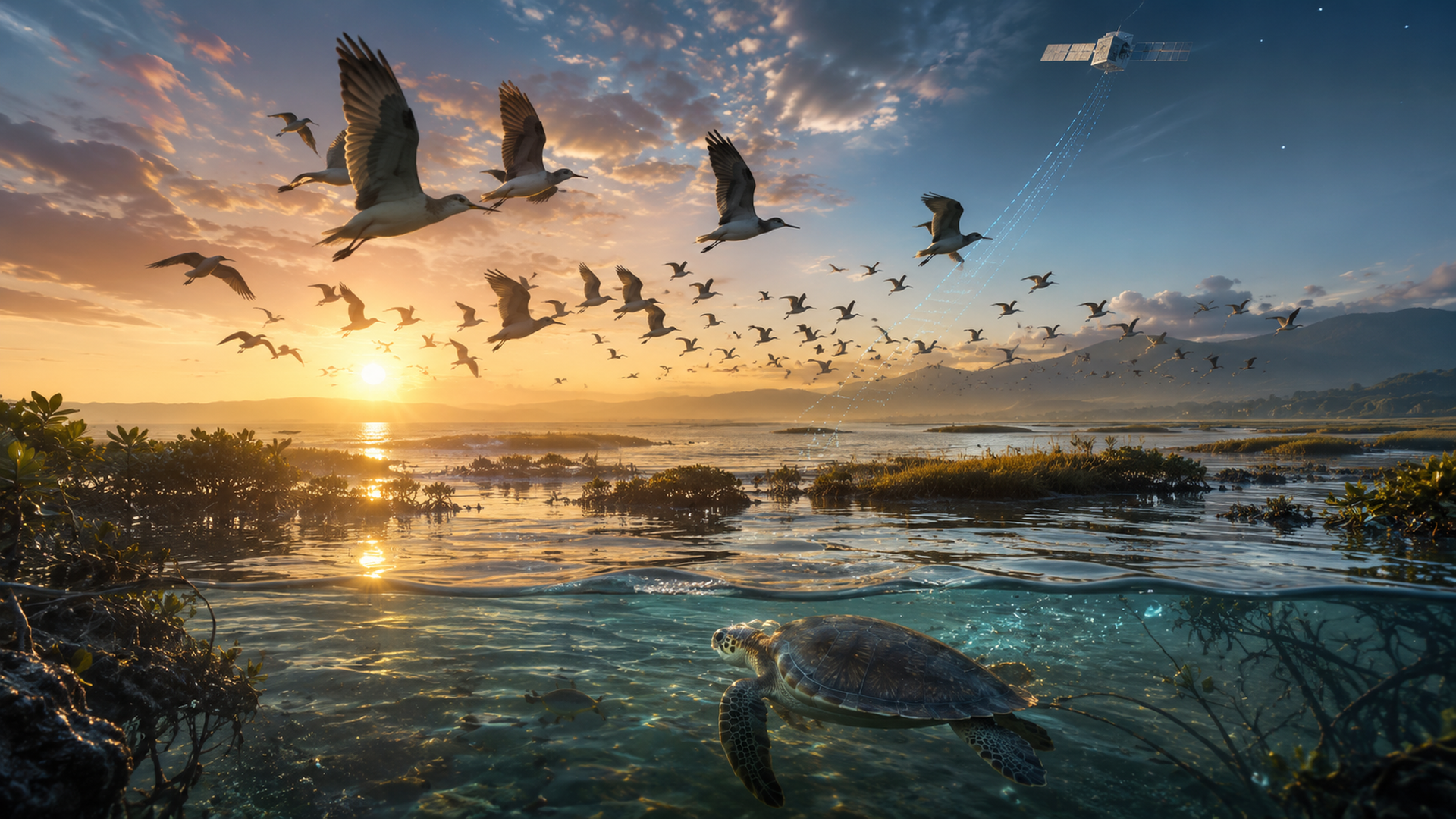
Animals Are Online: Tracking from Space Reveals Early Signals of Migration, Disease, and Disaster
Humans love to place themselves at the center of Earth's control room, as if a large enough screen and bright enough dashboard could master climate, disease, and disaster. The problem is that Earth is not a customer service center; many changes do not first write reports. They appear first in migratory birds' turns, bats' migrations, sea turtles' stops, insects' disappearances, or some animal suddenly no longer returning to its original place.
ICARUS and similar space-tracking plans for animals are captivating precisely here: they turn wild animal movement into another Earth signal. Not romanticizing animals as prophets, nor treating them as disaster prophets, but acknowledging that many early changes exist in ecosystems—human stations too fixed, administrative boundaries too rigid, reports too slow—may not see them.
Earth's Sensors Are Not Only Mounted on Concrete
Traditional disaster prevention and environmental monitoring often rely on rain gauges, water level stations, satellite imagery, weather radar. These devices are important, but they mostly measure places, not life. Animal tracking adds "paths": how a bird avoids heat waves, whether a group of bats changes habitat, if sea turtles adjust feeding areas due to sea temperature shifts. If these paths accumulate over time, they may become early indicators of climate change, habitat fragmentation, disease spread, and ecological stress.
AI's role here should not be written as magic. It can assist in identifying movement patterns, detecting anomalies, organizing large volumes of images or sounds, and placing data from different species and scales on the same analytical table. But AI cannot answer for us the most basic ethical question: tracking an animal—is it to protect it, or to satisfy human control desires to connect everything to the internet?
"Internet of All Things" Sounds Smart, May Also Be Brutal
The phrase "animal Internet" is attractive to media; it sounds like Earth finally upgraded to a 5G ecological sphere. Yet wild animals are not users and have not pressed consent terms. Tag weight, battery life, data openness, capture and release procedures—these are not small matters. If only data volume is pursued, conservation easily becomes innovation, and innovation becomes disturbance.
This also reminds Indigenous Peoples and local governance. Many Indigenous communities have long observed animal migrations, weather changes, stream water levels, fish seasons, and forest sounds. Technology that places satellite data at the top layer and treats local knowledge as footnotes rewrites an old script: external systems collect, name, explain; locals are only studied. Truly good ecological technology should let scientific data and local observations cross-check each other, not cancel one another with the former.
Disaster Resilience Needs Mobile Knowledge
Extreme weather is dismantling many old rules. Fixed migration seasons, spawning beaches, feeding paths, vector distributions may all be reshuffled. In such an era, disaster resilience cannot rely only on announcements and engineering; it also needs knowledge systems that can see "changes are coming." Animal tracking, soundscape monitoring, eDNA, hydrological data, local patrol records—if responsibly integrated—will approach the real world more closely than a single dashboard.
In black humor, animals are often more honest. They do not adjust migration routes for budget years, they do not frame habitat fragmentation as local prosperity for elections, nor package sea warming as blue economy highlights. They simply move or stop moving. The question is whether humans have the capacity to understand this silence.
When animals go online, we should not cheer that Earth finally becomes a big data platform. A more mature statement: Earth is forcing humans to learn to borrow signals from other life, and once borrowed, must be responsible. If technology lets us see the non-human world more humbly, it is public knowledge; if it only makes surveillance farther, smaller, prettier, that merely sends old ailments into space.
Not Turning Animals Into Dashboards, But Pulling Humans Out of Control Illusions
The most expected value of animal tracking is not letting humans finally see every bird on a phone, but letting decision-makers know environmental changes will not wait for official documents. Migratory bird path shifts, bat habitat transfers, sea turtle feeding area offsets—if connected with local patrols, weather data, disease monitoring, and conservation work—disaster governance will not only rush to patch nets after events occur.
But more data demands restraint. Certain species' locations should not be publicized; some sensitive habitats cannot become tourist check-in points; certain research data must avoid commercial platforms using them for purposes unrelated to conservation. Truly mature "animals online" is not everything being monitored, but humans willing to admit: we are just one noisy animal in the ecological web, not the commander. This humility is disaster resilience's first sensor.
---
Sources retained from the Chinese original
AI use and content-safety disclosure
This article was assisted by AI for data organization, structural drafting, and sentence polishing. Human editors set the viewpoint and fact-checking direction