The Furthest Machine, Learning to Speak Less
Original Chinese title: 深空記憶計畫之九:旅行者號開始練習沉默
Voyager 1's gradual shutdown of scientific instruments is more than an engineering power-saving story; it is a lesson about civilizational memory, AI preservation, and the final voice.
Lawrence Lee
Technology journalist, science fiction critic, and space science educator.
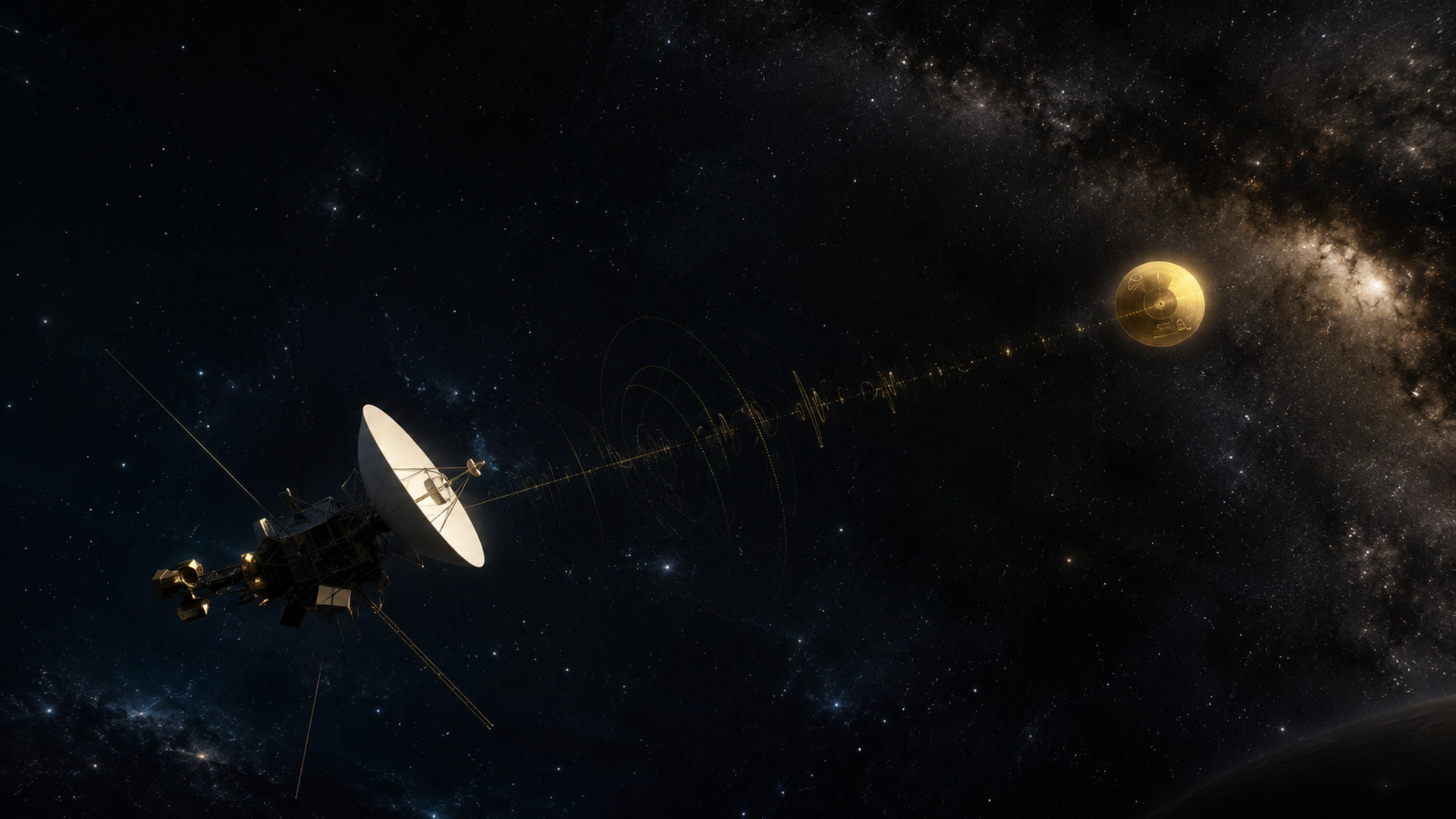
The Furthest Machine, Learning to Speak Less
The most moving aspect of Voyager has never been how far it flew, but how it turned the question “can it still speak” into a countdown timer for civilization. This spacecraft that launched in 1977 is no longer a victory flag of the space race; it is more like an old radio worn down by time until only its skeleton remains, reporting back to humanity from beyond the solar wind boundary with increasingly faint power about the cold, magnetic fields, and particle landscapes near our universe.
Recently Voyager 1 has entered another power-saving phase: the low-energy charged-particle instrument was shut down. The reason is not romantic at all: the nuclear battery is aging. It did not fail suddenly; it is retiring slowly according to a harsh engineering ethic. When power runs out, scientists must choose which sense goes silent first. The camera has long been quiet; many instruments have also been turned off one by one; now only the few sensors most likely to continue describing the interstellar medium remain. This is not news that “the spacecraft is dying,” but rather how civilization manages an old soul still working far away.
Seen through the lens of the AI era, this sounds even more jarring. Today we produce content at a speed like a storm; data centers are new mines for cities; models claim to be smarter every few months. Yet Voyager reminds us that truly long-lived knowledge systems do not rely on noise but on restraint, maintenance, handover, and patience. It has no cloud scaling, no hot-fix teams, and no next-season paid upgrades. It has only a communication link longer than human imagination can grasp, and a group of engineers on Earth willing to keep listening to its coughs.
Turning Off Instruments Does Not End the Mission
Ordinary people tend to see instrument shutdown as failure. The engineering team knows it is actually extending life. The black humor of space exploration lies in this: sometimes to let a mission live longer, you must first make it do less. Voyager has no magic inside; only decaying radioisotope thermoelectric generators. Every watt saved means fewer choices. When it sends signals back from interstellar space, Earth is not receiving a complete letter but reading a postcard bitten by cold.
This also reminds us that the most enduring stories in technology history are not about computing power exploding, but about design under constraints. Silicon Valley worships “infinite scaling”; Voyager demonstrates the opposite philosophy over half a century: every watt must have a reason, every switch carries consequences. Today’s products often write “service termination” as a polite yet cold email; weeks later the data disappears in fine print. Voyager, however, makes people make near-archaeological engineering judgments for a little power, a little signal, a little still-returnable data.
This is also the biggest difference between deep-space missions and consumer technology. Consumer tech fears aging because old products don’t sell; deep-space missions respect aging because aging is their scientific value. Voyager is no longer the newest machine, but its position is the newest. It flies to places any new probe has not yet reached; its own aging becomes part of the data. Like an elder walking far away, a smaller voice does not mean it is unworthy to be heard; on the contrary, because the voice grows fainter, listening requires more technology and ethics.
After the Golden Record, the Real Message Is Patience
The Deep Space Memory Project is not about nostalgia. The golden record once represented humanity sending greetings, music, languages, and ocean sounds into the cosmos. But today, what Voyager truly sends back is not what was etched on the record, but whether we still have the capacity to care for a distant promise. It has no audience outside the solar system, no likes, no press conferences. Its existence demands only one thing: that humanity remembers it once made sound.
This matters especially for AI preservation work. Many institutions think scanning files, uploading them to the cloud, and putting them into vector databases equals preservation. In fact, that is merely the beginning of preservation, or even a more beautiful way of losing things. File formats will become obsolete; permissions will expire; servers will move; maintenance budgets will be cut; original contexts will be chopped into query fragments. Preservation is not putting things in black boxes but ensuring future generations know where they came from, who can use them, what cannot be misused, and who is responsible when problems arise.
Cultural memory works the same way. Tribal oral histories, family songs, ancestral place names, disaster experiences, and taboo knowledge do not become immortal simply because they are transcribed into text. They require maintenance, consent, and knowing when to open and when to stay silent. Voyager’s power-saving decisions unexpectedly mirror cultural data governance: not all senses can be kept simultaneously; not all data should be public; not all voices suit unlimited copying. The best preservation is sometimes selective continuation rather than greedy total collection.
AI Memory Also Ages
When AI companies talk about memory, they often describe it as an tireless brain. Yet any memory system ages. Data drifts, corpora become outdated, models hallucinate, users leave, platforms rename themselves, licenses are renegotiated. More troublingly, AI memory aging does not always happen honestly like Voyager’s power drop. It may still speak fluently but mix sources; it may sound confident yet forget which content is merely speculative; it may appear to preserve everything while flattening the most important contexts in its answers.
Voyager offers a lesson for the AI era: memory must be repairable. Engineers know which instruments are on, which are off, where anomalies occurred, and how long commands take to echo back. This traceability is precisely what AI cultural databases often lack. We cannot only demand that models answer beautifully; we must also require them to know what they base their answers on, where human verification is needed, and where they cannot decide for Indigenous peoples.
The Last Voice Is Not Always the Loudest
Voyager is teaching us an old-fashioned but important civilizational technique: speak clearly before silence. The AI industry proves progress with more data, larger models, faster output; deep-space exploration proves some progress by using less power, fewer instruments, slower signals—showing that real advancement sometimes means applying remaining resources to the most worthy questions.
Perhaps one day Voyager truly stops responding. That would not merely end a mission but mark humanity’s first act of handing over a still-traveling work to silence. It will continue carrying the golden record outward, yet Earth will no longer hear its echo. Only then will we understand: humanity’s last voice is not the grand oratory shouted at the cosmos, but the patience to keep listening to a faint signal for half a century.
Stepping Back: Not Space News, But Institutional News
From a broader perspective, Voyager’s silence is not a single space news story; it is an institutional one. It asks whether a society can continue paying for knowledge with no immediate return; whether it can maintain a team that knows how to service old systems in places without applause, markets, or short-term performance metrics. This question belongs not only to NASA but also to museums, libraries, Indigenous language databases, local archives, and all long-term knowledge engineering projects. True civilization does not just launch new initiatives; it knows how to accompany an old one to its end.
Further Reading and Sources
AI use and content-safety disclosure
This article was assisted by AI for data organization, structural drafting, and sentence polishing. Human editors set the viewpoint and fact-checking direction