Cultured meat is not the future dinner, it's a food-tech politics bill that hasn't been settled
Original Chinese title: 培養肉不是未來晚餐,是一場還沒算完帳的食品科技政治
Cultured meat moves from lab to market, but the real battleground is not taste: it's cost, energy, labeling, metadata, and public trust.
Two-Eyed Seeing Lab
Co-authors: 鍾靜蓉
Two-Eyed Seeing Lab focuses on technology governance, cultural context and public knowledge translation; co-author 鍾靜蓉 is a PhD from National Taiwan University of Science and Technology, specializing in product automation and metadata reasoning.
Don't rush to ask if it tastes good
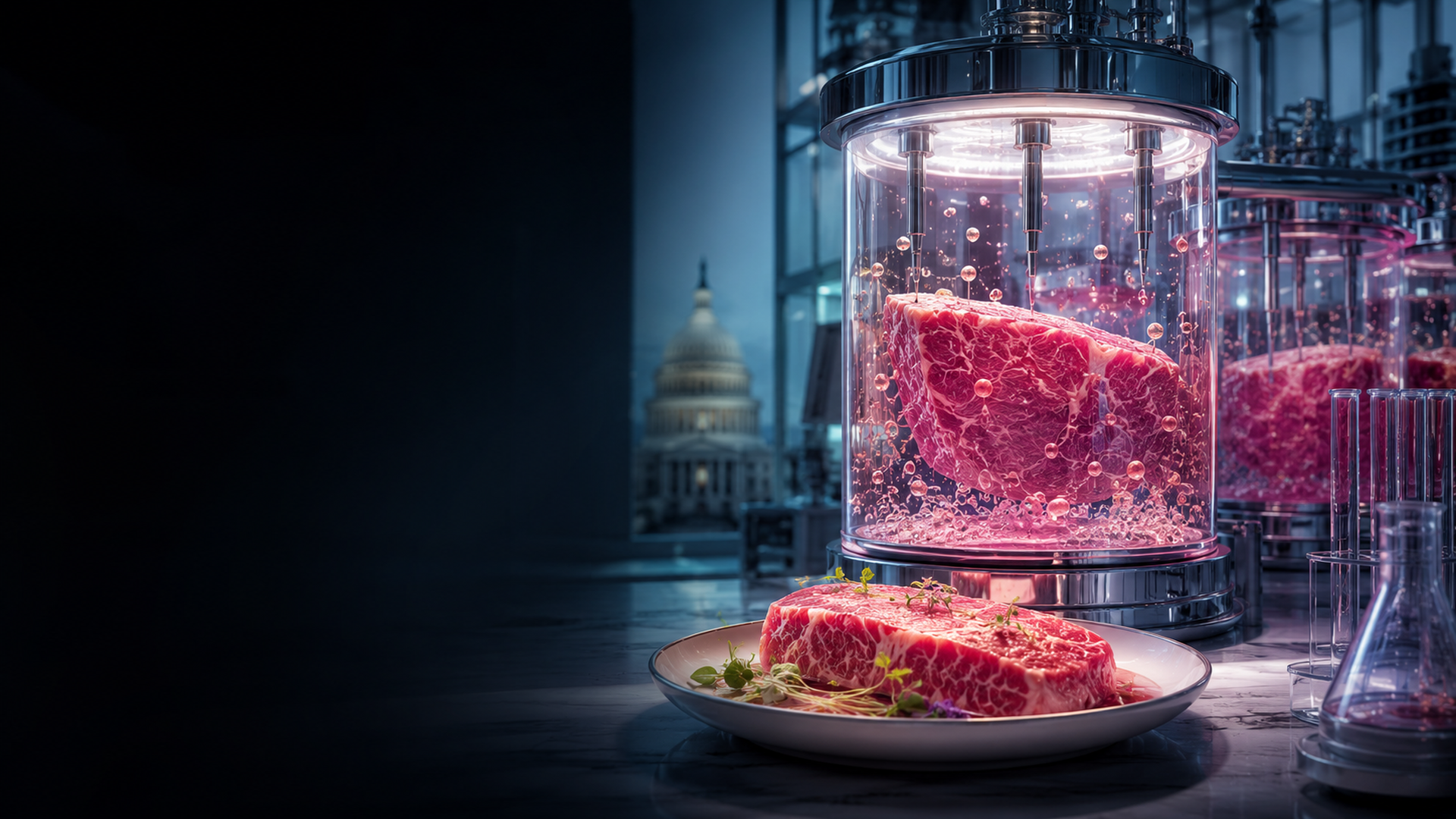
The most common question about cultured meat is: does it taste like meat? That question certainly matters, because no one wants to swallow a high-tech protein that feels like wet cardboard every day to save the planet. But if public discussion stops at taste, it cheapens this food-tech revolution. The real difficulty of cultured meat lies not in having celebrity chefs serve a photogenic product, but in establishing an affordable, regulated, labeled, scalable and socially trusted food system. In other words, the point is not how cool the future dinner looks; who pays for that future.
The US FDA and USDA have already established regulatory frameworks for cell-cultured foods, with some companies reaching pre-market consultation and commercialization thresholds for specific products. Singapore moved even earlier to bring cultured meat into formal regulation, becoming one of the most-watched global pioneers. These milestones matter because they prove that cultured meat is no longer just a science-exhibition showcase; it's entering regulations, supply chains and market reality. Yet regulatory approval is never the story's end—it's where the real trouble begins. Being able to make it doesn't mean being able to scale it; being safe to eat doesn't guarantee prices will reach ordinary households; reducing some animal slaughter doesn't mean the overall energy, raw-material and equipment ledger adds up nicely.
The bioreactor is not a magic pot
The cultured meat narrative is charming: take cells from animals, feed them nutrients, grow them in bioreactors, thus fewer slaughters, more technology, plus a sustainability halo. The problem is that biology is not the flowchart arrows in an investment pitch deck. Cells need media, stable environments, sterile control, and must maintain quality and safety when scaled up. Between small-scale success and industrial-scale success lies a long, expensive river: contamination risk, equipment depreciation, energy costs, raw-material supply, cell-line stability, texture reconstruction, and the bubble of investor patience evaporating quickly.
This is not to deny cultured meat; it's to demand that it be interrogated like any mature industry. Food is not an app—you can't launch it and then slowly patch bugs. Once food enters mouths, stomachs, homes and cultural systems, error costs far exceed interface layout issues. If a startup today says it will disrupt livestock farming, policy should ask: where is the life-cycle assessment? How are water, electricity and media sourced? When might costs fall? Where are equipment and factories located? What happens to waste streams? If supply breaks down, who bears responsibility? If sustainability is just a green slide background, that's not governance—it's marketing.
Metadata is also on the dinner table
From product automation and metadata-reasoning perspectives, cultured meat is not only biomanufacturing; it's a metadata war. Every batch: where cells came from, how cell lines were established, whether media formulations changed, reactor batch parameters, temperature and contamination records, harvest times, processing steps, cold-chain status, labeling versions, nutritional analysis and allergen information—none of these are ancillary data; they constitute food trust itself. If this data stays inside corporate walls, consumers and regulators see only a high-tech brand story.
Two-Eyed Seeing Lab and co-author 鍾靜蓉 remind us that for food tech to enter the public market, "traceability" must be designed into the process, not patched with Excel after an incident. Automation systems can indeed improve batch consistency and flag anomalies early; but how data fields are designed, who can read them, what needs to be public versus commercial secrets, how to protect consumers without reducing regulation to formalism—these are all political questions. To avoid being labeled a black box, metadata cannot remain engineering jargon; it must become the common language of public trust.
Opponents aren't all anti-science
Political reactions to cultured meat in different places are often reduced to science versus anti-science showdowns. That's too lazy. Some backlash does relate to industry interests, cultural anxiety and election mobilization; yet not every concern should be tossed into the "backward" trash can. Livestock farmers worry about livelihoods, local economies and food-naming rights; consumers worry about processing levels, prices and safety—these are not inherently stupid questions. If public policy only responds with "you don't understand technology," it ends up turning tech into an elite moral posture.
A better way to discuss is to lay out the ledger. If cultured meat truly reduces some environmental pressure, explain it with verifiable data; if costs remain high, admit it honestly; if short-term access is limited to fine dining or demonstration markets, don't pretend next year every bento shop will carry it. Meanwhile, traditional livestock cannot hide behind cultural flags and refuse reform—greenhouse gases, land use, animal welfare, antibiotic use and feed efficiency are real issues. Both sides need fewer myths and more ledgers.
What Taiwan can learn: don't rush to pick a side; fix the system first
Taiwan's food-tech discourse often swings between two extremes: "We must seize the next trillion-dollar industry" versus "This stuff must be terrifying." What's needed is institutional capacity. For cultured meat to enter public discussion in Taiwan, there must be clear labeling, safety assessments, import regulations, industry-impact evaluations, energy and carbon accounting, consumer education, and policy design for transitioning traditional livestock sectors. Otherwise it will devolve into slogan clashes: supporters shout innovation, opponents shout conspiracy, consumers stand before freezers wondering if they can buy with peace of mind.
This also involves localities and Indigenous communities. Don't force cultured meat into an Indigenous issue, but new food-tech systems will affect local food networks. If alternative proteins or novel foods enter school lunches, long-term care meals, disaster-reserve supplies or local procurement systems, Indigenous public services must know their prices, storage, nutrition, cultural acceptability and procurement transparency. Food is not pure nutrient molecules; it connects to hunting, farming, family memories, local economies and cultural identity. If technology ignores these contexts, even a beautiful protein curve becomes an arrogance that doesn't understand the dinner table.
The biggest fear of food tech isn't failure—it's the illusion of premature success
The most dangerous moment for cultured meat is not when it can't make products; it's after producing a small batch and assuming it has changed the world. Many technologies cycle through demonstration success, media excitement, capital influx, scale walling and industry restructuring. That's not necessarily bad—maturity requires paying tuition. The problem is that food tech confronts public trust: once overpromised and then discredited, society won't just doubt a single company; it may distrust the entire field.
Thus cultured meat needs a less flashy but more responsible narrative: it is neither savior nor monster, but a technology still tallying its books. It may create value in specific products, markets and supply chains, or remain supplementary due to cost and energy constraints. Public policy's job isn't to write ads for it or build walls around old industries; it's to establish transparent rules so real competence stays and empty talk exits.
Conclusion: the future on the dinner table cannot be understood only by investors
Cultured meat's success won't be decided solely in labs. It must pass kitchen, household, price, labeling, cultural and trust reviews. Consumers aren't anti-tech; they hate being treated as market-education lab rats. Farmers aren't anti-innovation; they need to know whether transition costs will again fall on the grassroots while benefits concentrate in patents, equipment and capital. What food tech truly deserves hope for isn't showing off "how futuristic this meat is"; it's forcing the whole food system to answer honestly: how do we produce, distribute, label and respect food? If cultured meat makes these questions more honest, it has public value; if it merely moves old inequalities into bioreactors with a future sticker, it isn't revolution—it's just pricier processed food.
Sources retained from the Chinese original
AI use and content-safety disclosure
This article was assisted by AI for data organization, structure drafting and sentence polishing; human editors set the viewpoint and fact-checking direction