Urban Archaeology Is Not Treasure Hunting: The Hidden Inscriptions on Pompeii's Walls Are Mocking Our Smart Cities
Original Chinese title: 城市考古不是挖寶:龐貝牆上的暗字,正在嘲笑我們的智慧城市
From invisible incisions on Pompeian wall surfaces to digital imaging techniques, we reconsider urban archaeology, public memory, and blind spots in smart city governance.
Lawrence Lee
Technology journalist, science fiction critic, and space science educator.
The Wall That Has Been Looked at for Two Hundred Years Still Hasn't Finished Speaking
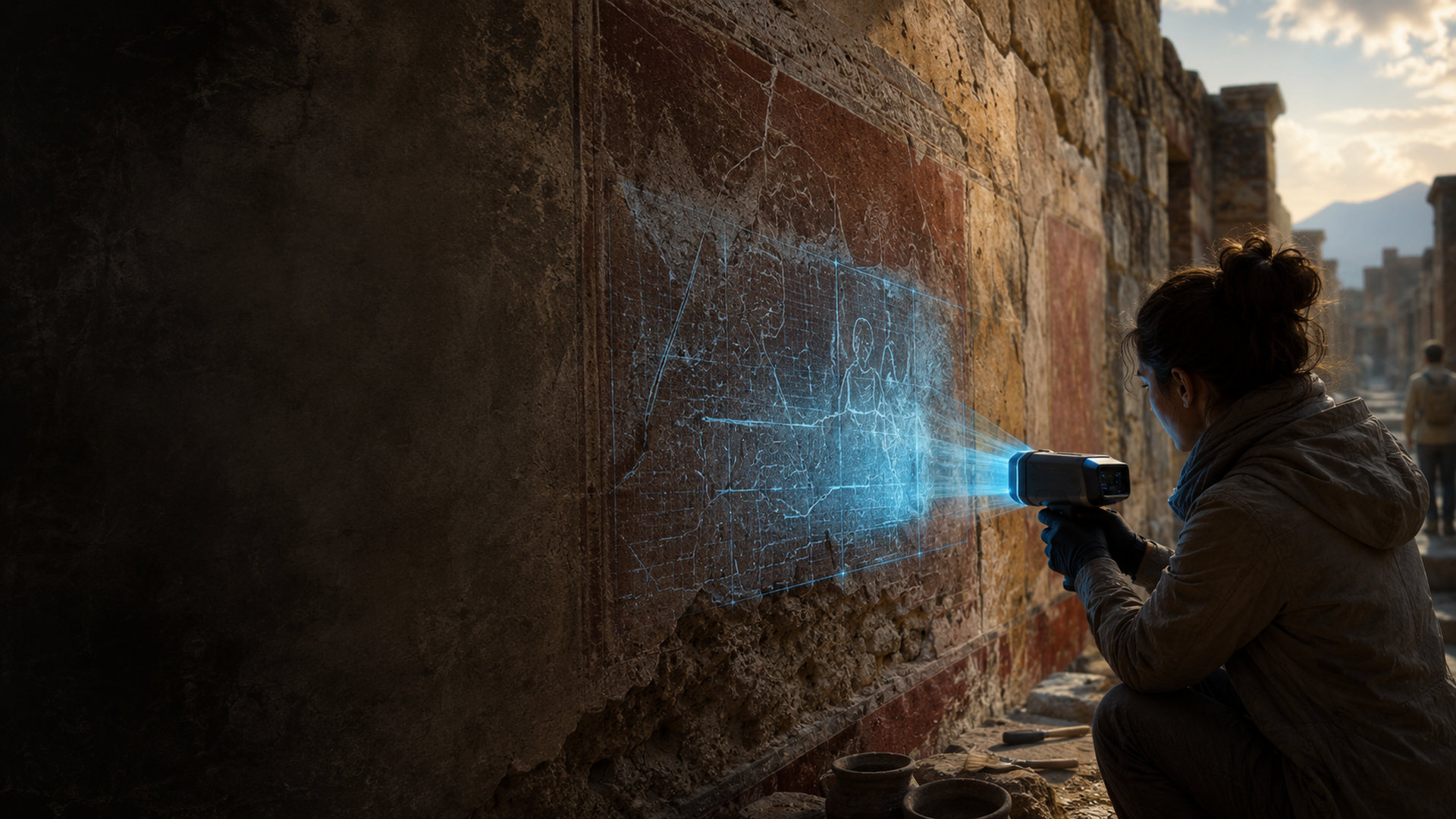
Pompeii is well-suited to repair modern cities' confidence. It was sealed by volcanic ash, opened by archaeology, packaged by tourism, and photographed until almost worn flat; logically, this ancient city should have no secrets left to hide. Yet digital imaging and surface scanning technologies keep reminding us: what humans call "already seen" is often just "eyes too lazy to look again." Archaeological teams use more detailed digital recording, optical scanning, surface texture recognition, and image analysis to bring back graffiti, incisions, and wall traces that the naked eye easily overlooks. Those are not royal decrees nor imperial grand narratives; they are confessions, curses, idle chatter, boasting, and street-style self-existence proofs.
What's truly interesting here is not the easy conclusion that "people two thousand years ago also scribbled randomly"—a headline-friendly observation—but rather: what best crosses time is often not great architecture but daily debris. Official archives try to make posterity remember institutions, wars, engineering projects, and rule, yet small words on walls preserve another kind of city: who loved whom, who hated whom, who casually left graffiti beside a boring corridor, who carved their names into public space as if shouting to the future: I was here. Today we call it vandalism; two millennia later it might be called social history material. History is such black humor.
A City Is Not Just Its Skyline—It Also Has Trash Layers
Modern cities love talking about skylines because skylines can be used in investment briefings and tourism ads. Archaeology doesn't really buy that. What archaeology truly cares about is what lies beneath: broken pottery, drains, ash from stoves, repair marks, demolition layers, discarded objects, and layer upon layer of choices flattened by daily life. Urban archaeology matters precisely because a city itself is a long-term testimony archive. Every renovation buries old days under new concrete; every road may have stepped over markets, workshops, temples, cemeteries, and commoners' dwellings. A city is not a flat map but has thickness.
The hidden words on Pompeii's walls let us see a finer-grained urban memory. They tell us not only what ancient Romans wrote on walls but also which surfaces we have long misjudged as silent. This is actually quite jarring for today's urban governance. Many city renewal projects treat "old" as the sole problem, as if demolition, straightening, flattening, and investment would automatically make a city smarter. But a city's intelligence lies not in taller buildings but in whether it knows what it stands on. If a city only collects parking data, consumption data, and surveillance data while unwilling to preserve neighborhood memory and traces of marginalized lives, then at best it is an amnesiac accountant.
Technology Is Not Magic—It Is a Second Excavation
Reflectance transformation imaging, 3D scanning, digital surveying, image comparison, and AI-assisted recognition are changing archaeological sites. They do not turn archaeology into sci-fi; they give objects that "cannot be touched, scraped, or dismantled" another chance to be read. Recent digital interpretation of the Vesuvius carbonized scrolls proves this path: if unrolling would shatter them, don't unroll; if ink traces are swallowed by the carbonized surface, use different spectral bands, tomographic structure analysis, and pattern recognition to find traces. This does not replace archaeologists' eyes but adds a second layer of patience.
Yet stronger technology demands greater restraint. Ancient cities are not data mines; sites are not free content anyone can scan and upload at will. Every incision needs context: its position, which coating layer it belongs to, how it relates to surrounding images, possible dating, whether there are overlying or underlying relationships, preservation condition, and how researchers infer these. AI can help find clues the naked eye misses but cannot directly translate blurry lines into popular stories. Archaeology fears not ignorance but pretending to know. Cultural reporting, if careless, easily turns "possible," "speculative," or "pending verification" into "shocking discovery," as if ancient people were working daily for modern traffic.
The Smart City's Most Missing Feature: Remembering Its Own Past Stupidity
Placing Pompeii back in today's urban context yields an uncomfortable question: what does our city leave for future readers? Current streets are heavily recorded by surveillance cameras, delivery platforms, electronic payments, license plate recognition, and access control systems. Superficially, future archaeologists should have so much data they'd suffer headaches; the problem is that most of this data is not public memory but platform assets, government permissions, fragile formats, or commercial data that vanishes once contracts end. It may rot faster than pottery shards, or cause new inequalities before it rots.
A true smart city should not only optimize in real time but also leave historical traces. When subway construction uncovers ancient structures, when old markets are rebuilt and encounter living memories, when riverbank remediation erases ethnic place names, the city must have systems for these traces to be discussed, recorded, and preserved—not treat archaeology as an obstacle delaying projects. The public value of urban archaeology lies not in always digging up gold or celebrity portraits but in reminding us: a city once had many ways of living, and today's version is not the only answer—just the temporarily winning one.
From Ancient Walls to Citizen Memory
The incisions on Pompeii's walls that approach whispers are captivating because they pull ancient people from "civilization specimens" back into "a bit annoying, a bit funny, a bit like us." Urban archaeology at its best also has this democratic force. It not only supplements data for power centers but leaves testimony for the nameless: who lived here, who was moved out, whose shop once existed, whose labor traces were erased, whose sacred spaces were eaten by planning maps. These stories are not ancillary information; they are the city itself.
For Yuan Media AI, this is also a mirror of public culture. Indigenous townships, urban Indigenous communities, local industry clusters, old markets, migrant worker neighborhoods all have their own walls and hidden words. They may not be historic sites but are public memory. When we talk about AI, databases, and cultural preservation, we must ask not only "how much can we scan" but also "who has the right to interpret," "what cannot be made public," "whose hands do data return to," and "who will understand it in the future." Pompeii reminds us that cities are not immortalized by slogans but by small traces almost erased, finally finding their next reader.
Urban Archaeology Is Not Nostalgia—It Is Governance Capacity
Many misunderstand archaeology as nostalgia, as if it merely lets modern people seek romantic comfort in the past. In fact, urban archaeology's most modern aspect is precisely that it forces governance to admit "the site is not blank." A street, a wall, or a plot of land may already have accumulated multiple layers of use history. If policy sees land only as volume, property rights, and construction schedules, cities will slowly lose self-understanding in the name of efficiency. Memory does not hinder development; it ensures development doesn't become a bulldozer's brake system.
Digital imaging also reminds us that preservation is not always about moving things into museums. Sometimes more important are traceable digital records, locally participatory interpretation platforms, low-threshold data for education, and protection mechanisms for sensitive locations. The worst preservation is when places lose their lives and sites become only tourist backdrops; the worst development is when places lose their pasts and remain only investment briefings. Pompeii's walls tell us that a city's truly charming parts often lie in the gaps left between life, mistakes, jokes, and power.
Conclusion: Don't Treat Cities as Empty Shells Left Only for Investment Promotion
If today's urban governance talks only of efficiency, assets, and brands while unwilling to face the layers of sedimented living history beneath our feet, it will ultimately become a clean but hollow display hall. The value of urban archaeology lies not in making us obsessed with the past but in giving today's decision-makers more humility. When small incisions on walls glow again, what is truly illuminated is not people two millennia ago but us today: are we willing to admit that what a city truly deserves preservation is never just grand facades but those details once deemed insignificant yet closest to life's truth.
Sources retained from the Chinese original
AI use and content-safety disclosure
This article was assisted by AI for data organization, structural drafting, and sentence polishing. Human editors set viewpoints and fact-checking directions