Understanding the Sky: Meteorological Literacy as Public Knowledge for the Next Generation
Original Chinese title: 看懂天空,不是把雲拍成濾鏡:氣象素養如何成為下一代公共知識
From cloud observation to climate risk interpretation, sky knowledge is becoming an intersection point for science education, media literacy, and public safety.
王振庭
Natural science education teacher and co-host of Ministry of Education projects; long-term commitment to natural science education, curriculum design, AI education, and media literacy.
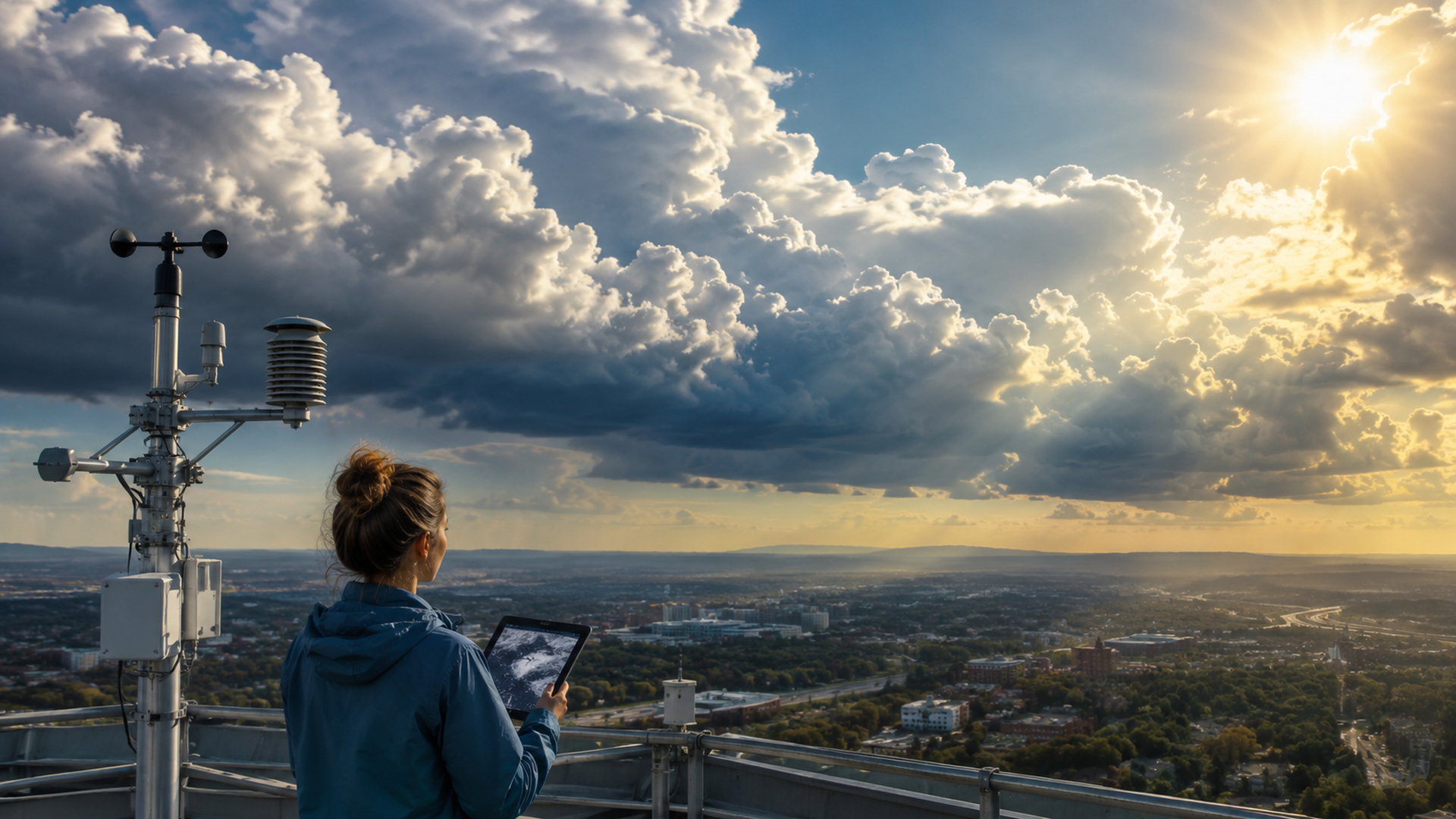
The sky is not background. It is a scientific scene that plays free every day but few truly understand it. Cloud height, shape, thickness, edges, movement direction often reveal environmental signals earlier than smartphone weather icons; yet modern people have become accustomed to handing the sky over to apps, clouds to filters, and meteorology to single-choice questions like 'Will it rain tomorrow.' The result: we now possess more satellites, radar, models, and real-time data than ever before, but not necessarily better weather understanding. More information does not guarantee higher literacy—that is precisely why meteorological sky knowledge has become a public education topic again.
Clouds Are Not Decoration; They Are the Atmosphere's Handwriting
The World Meteorological Organization's International Cloud Atlas serves as a global reference for classifying clouds and atmospheric phenomena. It returns those seemingly romantic shapes to observable, describable, comparable scientific language. Clouds are not merely 'white' or 'dark'; they are not just social media background material like 'soothing today.' High, middle, low clouds; cumulus, stratus, cirrus, nimbostratus—all carry clues about moisture, temperature, updrafts, condensation nuclei, and weather systems. Learning to read clouds does not make one a meteorologist; it helps people understand that they live within a moving atmospheric layer.
Science education fears turning knowledge into rote memorization. If students only remember ten cloud names without understanding why clouds form, the sky becomes nothing more than flashcards. True sky literacy must begin with observation: Is today's cloud base high or low? Does the cloud spread broadly like a blanket, or grow vertically in cotton-like clusters? Is a distant cloud wall approaching? Are afternoon cumulus clouds growing taller? Do wind direction and cloud movement align? These questions guide children from 'seeing' to 'inferring,' then from inference to verification. Science is not just answers; it trains the habit of not rushing to trust one's first impression.
Weather Apps Are Convenient, But They Are Not Your Eyes
Weather apps are modern necessities, yet entrusting all judgment to them erodes environmental awareness. Many see a 30% rain probability and assume 'it won't happen'; they see the sun icon and ignore afternoon thermal convection; they note 34°C but overlook humidity, wind speed, heat index, and urban heat island effects that make it feel heavier. The data itself is not the problem—the issue is that when data gets flattened into icons, users forget its underlying uncertainty. Science communication that pursues 'simplicity' too aggressively often packages a complex world as overconfident stickers.
This also explains why media literacy must be integrated into meteorological education. During extreme weather, social platforms simultaneously host official alerts, citizen photos, disaster footage, false rumors, sensational headlines, and conspiracy theories. A cloud photo may be authentic but misdated or misplaced; a flood video could originate from another country; a 'once-in-a-century' headline might merely be clickbait. If students learn only cloud names without understanding data sources, timestamps, geolocation, official notifications, and uncertainty, they will still be led astray by algorithms when real risk assessment is needed. Sky education should not just teach children to take beautiful photos; it must also teach them to distinguish signal from noise.
Climate Change Makes Sky Knowledge More Public
Recent global climate reports repeatedly warn that warming alters risks of heatwaves, heavy rainfall, droughts, snow/ice loss, and ocean heat content. These large-sounding terms ultimately affect daily life: commuter rainstorms, playground heat injuries, mountain landslides, crop flowering times, fisherfolk departure decisions, health risks for the elderly and young. Meteorology is no longer just 'whether to bring an umbrella'; it has become part of public safety, urban planning, agricultural resilience, disaster education, and media responsibility.
Therefore, sky knowledge cannot remain confined to professional meteorological agencies. Teachers, local governments, community organizations, museums, media outlets, and tech platforms must all participate. Schools can have students maintain simple campus observation logs—recording cloud cover, wind, rain, temperature, heat index; communities can cross-reference elders' local weather experiences with modern data; media should label sources and limitations when reporting disasters rather than only cropping the most sensational images; technology platforms ought to avoid turning weather alerts into entertainment content easily misunderstood. Science communication is not merely amplifying expert voices; it is gradually cultivating public judgment.
AI Can Help, But It May Also Distort the Sky
AI image recognition, satellite data analysis, short-term rainfall forecasting, and automatic summarization can all enhance meteorological services. Yet AI may also generate new misrepresentations: treating generated disaster sky images as real photographs, presenting single-model forecasts as definitive outcomes, hiding local observation limitations behind polished interfaces. More troublingly, the more platforms recommend striking visuals, the more likely the public will assume weather only exists in three modes—disaster, spectacle, and apocalypse. Sky knowledge needs technological assistance but cannot be replaced by it. People must still learn to ask: Where does this image come from? What is its forecast time range? How fine is its spatial resolution? Does it originate from an official agency? Is there a newer version?
Good meteorological education should connect 'looking at the sky' with 'reading data.' Looking up keeps people grounded; looking down prevents them from being trapped in intuition. When students look up at clouds, then check radar and satellite imagery, and finally discuss risks on the ground—that is the most precious moment of natural science education: the world is not a textbook illustration but an ongoing phenomenon. The sky teaches every day; we simply often skip class.
Conclusion: Looking Up Again Is a Public Capability
In an era of rising climate risk, severe information pollution, and rapidly evolving tech tools, meteorological sky knowledge is no longer just a small natural science unit—it is basic literacy for global citizens. Understanding clouds is not about posting 'this is a cumulonimbus' to show off; it is about grasping how the environment is changing. Understanding forecasts is not about blaming the weather bureau for inaccuracy; it is about comprehending probability, uncertainty, and risk management. Understanding media is not about doubting everything; it is about knowing which messages deserve trust. Looking up at the sky again seems romantic but is highly practical. The sky is not a filter—it is public knowledge's first blackboard.
Classroom Practice Can Begin with a One-Week Sky Log
Integrating sky knowledge into curricula does not require expensive equipment from day one. The simplest approach: have students photograph the sky at the same time and place for seven consecutive days, recording cloud cover, cloud type, wind feel, temperature, humidity, rainfall, and weather news in that day's media. Then compare with official observations, radar echoes, satellite imagery, and forecast text. Students quickly discover forecasts are not magic; observation is not an intuition game either—both require data, time, scale, and language translation. This practice is more powerful than memorizing ten terms because it shows students science exists right outside the window and changes.
AI can serve as a teaching assistant but must never become the sky's spokesperson. Teachers may let students use AI to organize observation records, generate questions, compare cloud images, then require verification against original data. Such design transforms AI from an answer machine into a thinking scaffold. When a student asks 'Why does it look like rain today but the forecast says otherwise?' that is the best opening for science education. True literacy is not answering every question correctly; it is willing to see the world as more complex than any option.
This practice also helps students appreciate 'local sky' importance. Coastal, basin, valley, urban high-rise, and farmland areas all present different clouds and wind feels. Local knowledge does not replace meteorological science but reminds students that data always occurs within terrain, season, and life rhythms. When students compare grandparents' weather experiences with campus observations and official data, they learn not just meteorology but how knowledge corrects itself.
The best outcome is not students reciting standard answers; it is them asking 'Has the data been updated?' before a storm, 'Who is most vulnerable?' during heatwaves, and 'Is this video's time and place credible?' when confronted with striking footage. These questions are closer to civic literacy than cloud names.
This also reflects what I call public governance: technology can accelerate but should not replace judgment, responsibility, and human context.
Further Reading and Sources
- World Meteorological Organization (WMO), International Cloud Atlas, official online version, Source. Verification considerations: confirm WMO's classification of clouds and other atmospheric phenomena, observation methods, and terminology; avoid presenting cloud types as folkloric or oversimplified.
- WMO, State of the Global Climate 2025, published March 23, 2026, Source. Verification considerations: cross-check high-temperature records from 2015–2025, Earth's energy imbalance, impacts of extreme weather; before official release verify whether WMO has updated versions or errata.
- WMO, Global Annual to Decadal Climate Update 2025–2029, published May 28, 2025, Source. Verification considerations: check probabilities of near-record or record-breaking temperatures in 2025–2029 and related statements about the 1.5°C threshold; avoid misrepresenting short-term exceedances as permanent loss of the Paris Agreement limit.
- NOAA JetStream, Ten Basic Clouds, March 28, 2023, Source. Verification considerations: verify basic cloud types and educational terminology for use in primary/secondary schools and general education curricula.
- NASA/JPL Edu, The Types of Clouds and What They Mean, October 15, 2024, Source. Verification considerations: check how cloud and weather observations translate into classroom activities; useful for extending Taiwan curriculum design cases.
AI use and content-safety disclosure
This article was assisted by AI for data organization, structural drafting, and sentence polishing. Human editors set the viewpoint and fact-checking direction