Sodium-ion batteries are not lithium's substitute: data centers, energy storage and material diversity in the energy transition
Original Chinese title: 鈉離子電池不是鋰的替身:資料中心、儲能與材料多樣性的能源轉型
The value of sodium-ion batteries is not to replace lithium, but to provide material and supply-chain diversity as data center and grid storage demand grows.
阿克斯星門
Assistant Professor, Center for General Education, Chung Yuan Christian University; researches model reasoning, AI-driven system design, knowledge engineering, technology society commentary and cross-disciplinary science communication.
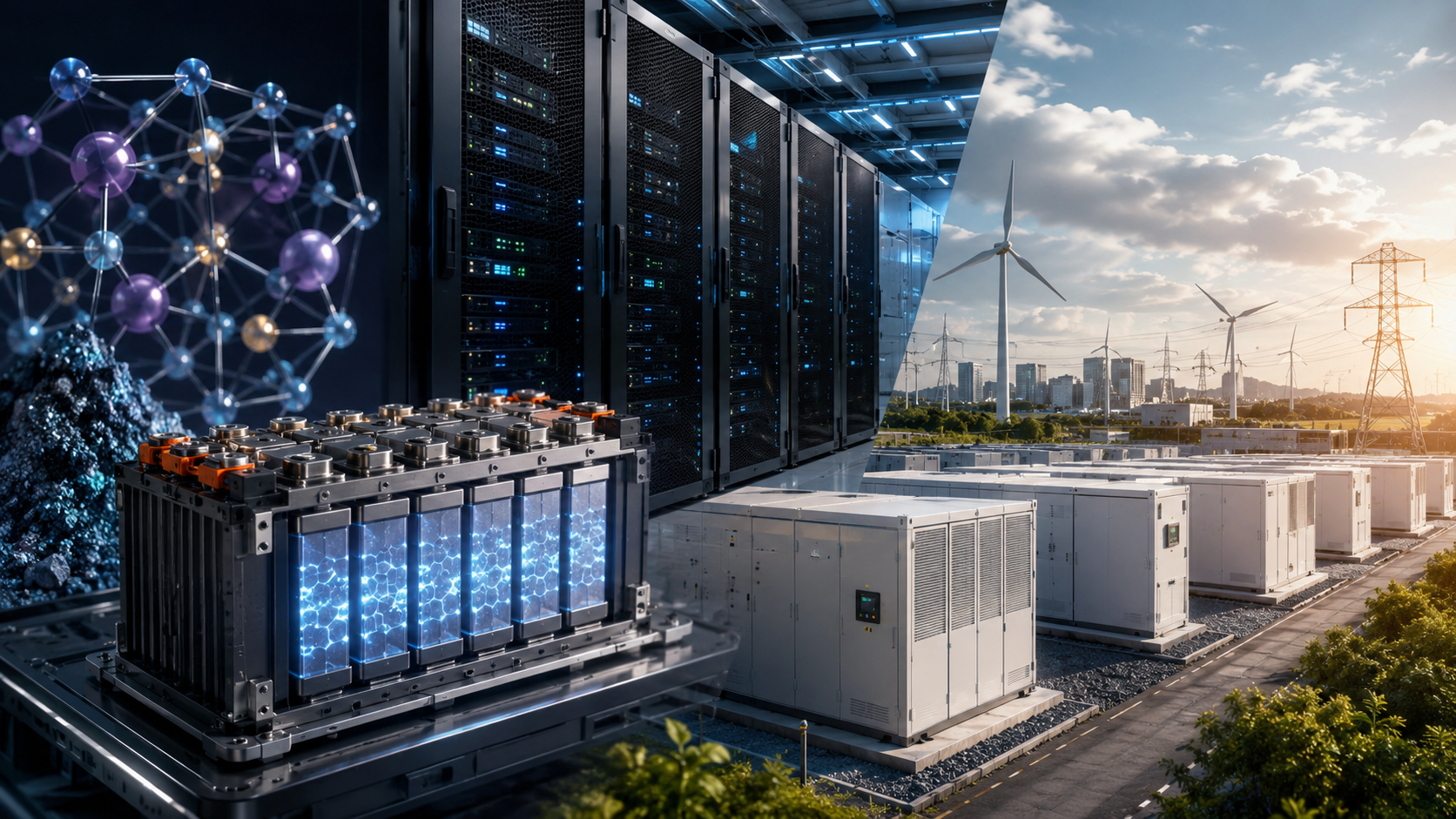
Sodium-ion batteries have recently been written up as "lithium battery killers." Such headlines are convenient, like turning the energy transition into a wuxia film: the lithium faction has dominated the Jianghu for years, the sodium faction retreats to train in seclusion, and finally descends to take revenge. The problem is that the battery industry is not a martial-arts tournament; materials do not rely on emotional vengeance. What truly matters about sodium-ion batteries is not whether they will replace lithium, but that they remind us: the energy transition cannot have only one chemistry, one supply chain, one application scenario. As data centers, renewable energy, grid storage and electric vehicles together push battery demand higher, what the world needs is not a single hero, but a family of materials that can divide labor.
Sodium is abundant, but "abundant" does not mean cheap right away
Sodium's resource abundance is the basic advantage of sodium-ion batteries. Unlike lithium, nickel and cobalt, it is not driven by highly concentrated mineral supply and price volatility, leading people to imagine cheaper, safer and more scalable energy-storage systems. Yet materials science most often reminds humans: raw material cheapness does not mean system cheapness. Battery cost includes cathode, anode, electrolyte, separator, manufacturing process, yield, lifespan, safety certification, module design, thermal management, supply chain and financing costs. You cannot infer battery price from salt prices; otherwise the kitchen would have become an energy company.
Sodium-ion's current shortcomings are also clear. Its energy density is usually lower than mature lithium-ion systems, meaning it does not necessarily have advantages in applications requiring lightweight or high range. Mobile phones, laptops and long-range electric vehicles will not immediately change their faith just because sodium is cheaper. But for stationary storage, data-center backup, low-speed vehicles, short-haul transport, cold or hot environments, and scenarios where weight is less sensitive, sodium-ion has opportunities. Materials are not abstract rankings; they are task matches. Comparing every battery to the strongest lithium battery on range is like asking a container ship to run a 100-meter dash.
Data centers turn energy storage into a new battlefield
When discussing batteries in the past, most people thought of electric vehicles. Now data centers and AI computing power are pushing stationary energy storage under the spotlight. Data centers need stable electricity; grids need to balance solar and wind fluctuations; enterprises need backup and dispatch capabilities. These demands do not necessarily require the highest energy density; instead they care more about cost, safety, lifespan, temperature adaptation and supply stability. If sodium-ion batteries can form advantages on these indicators, they do not have to fight for the electric-vehicle main battlefield and can find a place in the energy system.
This also explains why large automakers, battery manufacturers and storage companies are now talking about sodium. It is not because everyone suddenly fell in love with the periodic table; it is because the bottleneck of the energy transition has shifted from "whether there are batteries" to "can we use the right chemistry in the right scenario." Lithium-ion remains powerful, especially LFP which has established advantages in cost, safety and mass production; sodium-ion must enter the field not just with slogans but with a complete answer that is manufacturable, warrantable, financeable and recyclable. The revolution on slides must queue up before factory yields.
Supply-chain security is not nationalist sentiment, it is risk management
The battery supply chain is highly globalized and also highly politicized. Mining, refining, materials, cells, equipment, patents and markets can all be affected by policy. One reason sodium-ion is valued is that it may reduce dependence on certain key minerals, giving different countries more options for localized production and energy-storage deployment. But this does not automatically mean energy independence. Sodium-ion still needs material technology, manufacturing equipment, quality control, engineering talent and market scale. Resource distribution is only the first step; industrial capability is the long slope that follows.
If policy treats sodium-ion as an "anti-lithium" tool, it will miss the real point. Good energy policy should encourage diversification: lithium-ion continues to play in electric vehicles and high-performance scenarios, sodium-ion in stationary storage and specific environment testing, flow batteries, thermal storage, hydrogen, pumped hydro and demand management each fill gaps. The energy transition is not moving all eggs from the lithium basket to the sodium basket; it is admitting we should not take only one basket up a mountain.
Material innovation also has a social ledger
Many materials news stories talk only about performance, not the social ledger. Lithium mines, nickel mines and cobalt mines involve water resources, land rights, labor, safety and local communities; if sodium-ion goes into large-scale industrialization, it will have its own material, factory, waste and recycling issues. Once any new technology enters large-scale deployment, it cannot forever remain pure in the laboratory. Truly responsible materials transition should design for recycling, life-cycle assessment, factory safety, community communication and supply-chain disclosure from the start. Do not wait until the industry grows to discover that "green" also has gray corners.
This point is also inspiring for island and indigenous regions. Remote areas, islands, tribal communities and disaster-prone zones often need more stable microgrids and backup systems. If sodium-ion or other storage technologies can lower costs, improve safety and reduce cooling needs, they could become local resilience tools. But deployment cannot be decided only by equipment vendors. Localities must know who maintains it, who pays, how long it lasts, what happens when it fails, how data is returned, and who has priority power during disasters. Without governance design, energy storage can easily turn from a resilience tool into an expensive box sitting in the corner that no one dares touch after warranty expires.
Do not talk about "next-generation batteries" as a single-line future
Tech media loves the three words "next generation," as if every new material will naturally replace its predecessor. In reality, energy systems are more like kitchens than thrones; different pots cook different dishes, there is no need for frying pans to eliminate soup pots. The prospects of sodium-ion batteries are worth looking forward to, but they must cross engineering, mass production, yield, cost, standards, warranties and market trust. They also must avoid over-hype, because the energy-storage industry fears not failure but being deified too early. Myths attract funding and create disappointment; materials science usually prefers patience over fireworks.
In the coming years, what truly deserves observation is not "whether sodium beats lithium" but which scenarios adopt first, how cost curves decline, whether safety and lifespan data are open, whether supply chains are diversified, whether recycling mechanisms keep pace, and whether policy puts different storage technologies into overall grid design. The energy transition needs batteries, but it also needs honest systems engineering. Sodium-ion is not a savior nor lithium's substitute; it is more like a player who finally stands up from the bench. Whether it becomes a starter depends not on slogans but on data after entering the field, durability and team coordination.
Conclusion: energy transition requires material diversity
If AI computing power, data centers, renewable energy and electric transport continue to grow, the world's demand for storage will only become more complex. Sodium-ion batteries provide an important reminder: material diversity is energy resilience. Do not throw every problem at one chemistry, nor blow up every new material as a revolution. A truly mature energy transition knows where high density is needed, where low cost is needed, where safety is needed, where repairability is needed and where local participation is needed. The periodic table is large; the human imagination is often too small.
Energy storage is not just buying equipment, it is buying an operating system
For stationary energy storage to support data centers and grids, one cannot look only at battery cell prices. It also involves fire codes, warranty conditions, cycle life, thermal management, site safety, grid-connection rules, operations talent and decommissioning recycling. Data centers especially must not treat storage as a pretty green accessory; if backup systems lack regular testing, fault isolation and clear responsibility division, during real outages they may become only expensive sculptures. Whether sodium-ion can expand its application depends not just on laboratory energy density but on whether the whole system is accepted by grids, insurers, financiers and safety regulations.
This is also a side of the energy transition often overlooked: material innovation must pass institutional translation to enter society. From chemical formulas to banks willing to finance, from cell lifespan to local fire departments willing to approve, this does not happen naturally. If policy only subsidizes equipment purchases but does not invest in standards, maintenance, recycling and talent, new storage technologies will easily be consumed by short-term procurement waves.
Further reading and sources
- Reuters Events / LinkedIn post, "AI energy race accelerates sodium battery production", 2026-06-29, Source. Verification considerations: check data-center storage demand, sodium-ion investment, temperature adaptation and cost narrative; confirm before official launch whether updates exist.
- Reuters, "Chinese battery maker CATL signs first major sodium-ion deal for energy storage", 2026-04-28, Source. Verification considerations: check CATL's supply agreement with HyperStrong, mass-production capability and technical limits.
- IEA, "Batteries and Secure Energy Transitions", 2024, Source. Verification considerations: check global battery deployment, storage demand, supply-chain security and battery cost trends.
- Yao, A., Benson, S. M., Chueh, W. C., "How quickly can sodium-ion learn?", 2024, Source. Verification considerations: check sodium-ion cost competitiveness scenario analysis and technology-path limits; do not write model estimates as established facts.
AI use and content-safety disclosure
This article was assisted by AI for data organization, structural drafting and sentence polishing; human editors set the viewpoint and fact-checking direction