Cities Are Not Heated by the Sun, They Are Designed to Be Hot: The Next War Between Building Climate and Cooling Justice
Original Chinese title: 城市不是被曬熱,是被設計熱:建築氣候與冷氣正義的下一場戰爭
Extreme heat is linking urban design, housing inequality, air‑conditioning electricity use, and public health into one risk map.
鄭淑禎
Full-time Assistant Professor, Shih Chien University; focuses on commercial public policy, urban governance, platform economy, AI product governance and organizational management.
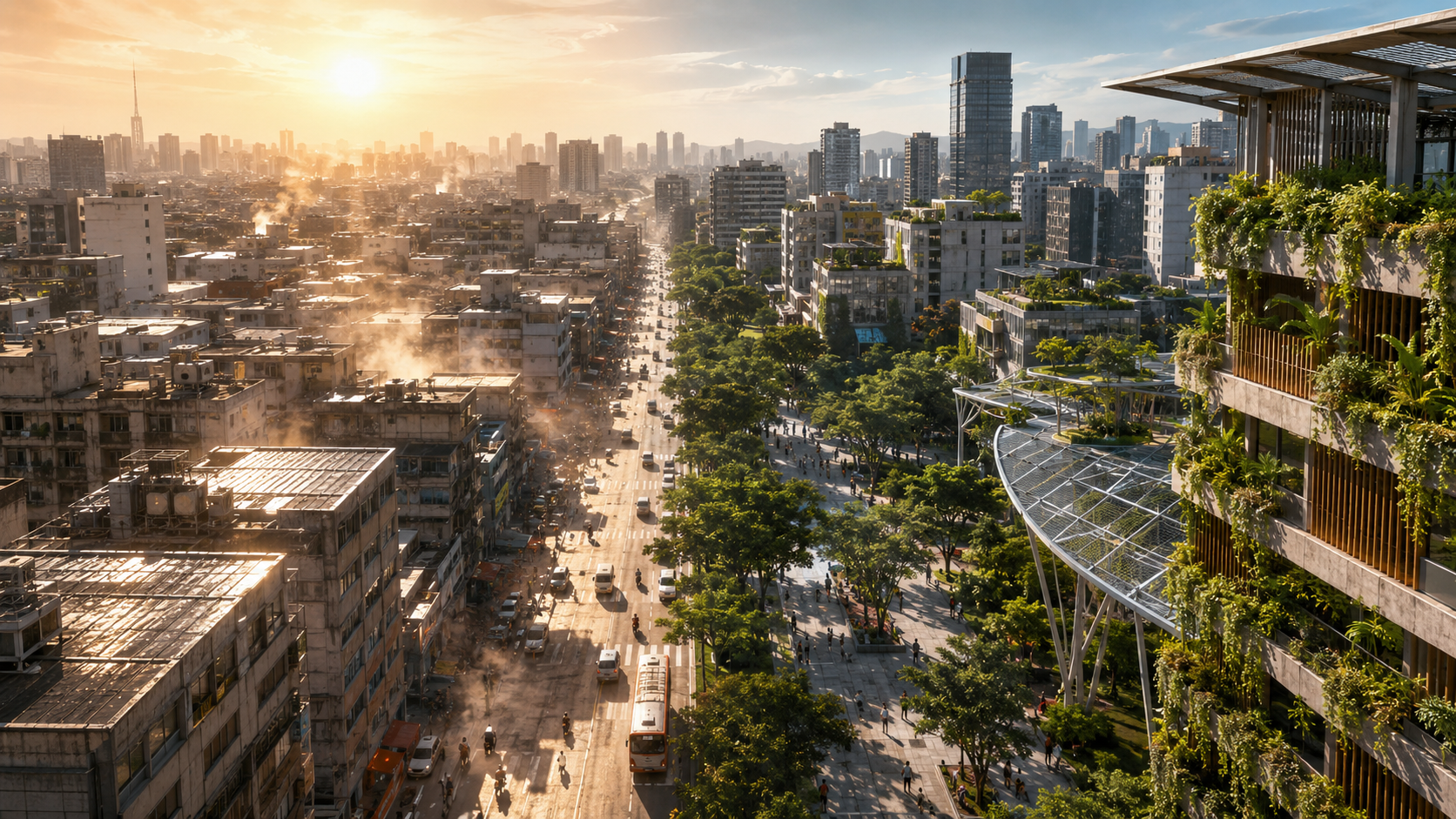
Cities are not merely heated by the sun; they are machines that heat themselves. Asphalt roads, glass curtain walls, dark roofs, air‑conditioning outdoor units, treeless sidewalks, and compressed rental spaces turn summer into an unannounced stress test. When a heatwave hits, some people only complain about AC electricity bills, while others pay with their bodies in rooftop additions, tin sheds, outdoor construction sites, and poorly ventilated long‑term care rooms. This is the cruelest aspect of urban heat islands: they appear as meteorological phenomena but are actually temperature bills written jointly by buildings, wealth gaps, labor conditions, and public policy.
Heat Is Not a Minor Weather Issue; It Is a Public Health Event
Extreme heat is often underestimated because it does not turn streets into rivers like floods nor blow down signs like typhoons. Its violence is quieter. It dehydrates the elderly, worsens chronic illnesses, causes heatstroke in outdoor workers, and puts pregnant women and infants at risk; those already living in poor housing find escape even harder. The most troubling part is that heat damage often becomes visible only after death statistics and medical data emerge. By then many bodies have already signed receipts for urban design defects.
Recent heatwaves remind us that temperature alone is insufficient. Humidity, nighttime minimums, wind speed, solar exposure, building thermal mass, work patterns, and social care networks all affect risk. A city hot by day but not cooling at night is like putting people in an oven left on. Air conditioning can save lives, but if it becomes the sole strategy cities enter an awkward cycle: hotter days drive more AC use, which consumes more electricity; outdoor units then dump heat back onto streets, and everyone pretends this is modernization.
Buildings Are Not Refuges; They Can Be Heat Traps
We habitually think of houses as places that protect people, yet many buildings are simply boxes that trap heat. Glass curtain walls look sophisticated in advertising photos but act like free greenhouses under afternoon sun; dark roofs absorb heat with startling efficiency, as if the whole city is secretly working for the sun; sidewalks without shade turn grocery shopping into a heat‑resistance contest; school playgrounds and parking lots without trees place children and cars on a frying pan. If urban design pursues only pretty facades and volume efficiency, heatwaves will honestly grade it—and the scores are usually poor.
Building and urban planning must shift from "air‑conditioning afterthought" to "passive cooling first." Shading, ventilation, roof insulation, light or high‑albedo materials, green roofs, permeable pavements, canopy cover, block wind corridors, nighttime heat release, and public cooling spaces are not environmental decorations; they are basic safety. More importantly, these measures cannot be confined to wealthy neighborhoods and tourist boulevards. If a city plants trees only in the richest districts, heat‑island governance becomes a scenic version of class replication.
Cooling Justice Is Bigger Than Air‑Conditioning Subsidies
Many governments facing heatwaves think about subsidizing air conditioning; this is not wrong but too small. The real question is who needs AC, who can afford electricity bills, who lives in houses that cannot safely use power, who rents and therefore dares not demand improvements, and who works outdoors without rest rights. Cooling justice is not giving everyone a machine; it is ensuring people do not have to survive summer through private consumption alone. Public libraries, neighborhood activity centers, schools, long‑term care sites, stations, and markets should become cooling infrastructure during heatwaves. The problem is that many cities treat these spaces as event venues rather than life‑support systems.
Labor policy cannot be absent either. Construction, cleaning, delivery, agriculture, transport, and caregiving work under high temperatures cannot be solved with a single "drink more water" slogan. Employers must adjust working hours, provide shade, water, rest breaks, and heat‑injury training; governments need clear thresholds and audits; platform economies must not offload heat risks onto couriers themselves. As city temperatures rise, what truly needs cooling is not just the ground surface but also those institutions that privatize risk.
AI Urban Models Cannot Rely Solely on Average Temperatures
Recent research attempts to use machine learning, remote sensing, building models, and microclimate simulations to evaluate cooling effects of different materials, street configurations, and greening strategies. This is good because urban thermal environments are too complex; planning by feel often becomes designers' self‑comforting narratives. Yet AI models have blind spots. Optimizing only the city average temperature may ignore the hottest alleys; relying solely on satellite surface temperatures may miss indoor stuffiness; using only housing prices and population data may overlook homeless people, migrant workers, non‑household residents, and temporary laborers. Averages are the numbers that urban governance knows how to make up; heatwaves know how to strip them.
Good heat‑island data governance should overlay high‑risk locations with highly vulnerable groups: where elderly populations are dense, where tree cover is low, where rental housing is cramped, where nighttime cooling fails, where outdoor workers concentrate, and where medical resources are distant. Then these data must be turned into budgets and engineering projects rather than merely interactive maps for mayors' press conferences. If city dashboards cannot guide shading, subsidies, audits, cooling spaces, and housing improvements, they remain only high‑tech weather complaints.
Taiwan Cities Should Learn to Treat Summer as a Disaster
Taiwan is familiar with typhoons, earthquakes, and torrential rain but often treats extreme heat as a tolerable problem. This is dangerous. Heat does not knock on doors; it enters every classroom, hospital ward, construction site, and market. Future urban governance must incorporate heatwaves into disaster‑risk systems: warning messages must be clear, cooling sites accessible, vulnerable visits institutionalized, public works include cooling indicators, building codes address insulation and ventilation, school curricula teach children to recognize heat injury rather than simply telling them "do not sunbathe." Honestly, asking citizens on a treeless sidewalk not to sunbathe is as humorous as asking people in a swimming pool not to touch the water.
Urban heat islands are not merely extensions of natural disasters; they are echoes of civil design. Who lives in heat traps, who can leave, who can run AC, and who must sweat are all policy questions. Truly mature building and climate governance does not turn cities into giant air‑conditioned rooms but cools streets, houses, public spaces, and labor systems together. Summer is not the enemy; the enemy is a city deliberately built like a griddle despite knowing it will get hotter.
Building Codes Must Include Heat Risk
If a city wants genuine cooling, it cannot rely only on temporary cooling stations nor begin advocacy each summer. Building codes, urban design reviews, public works standards, and rental management must embed heat risk. Roof insulation, façade shading, ventilation pathways, material albedo, public tree shade, arcades, and sidewalk coverings should not be mere design bonuses but safety baselines. Especially schools, hospitals, long‑term care institutions, social housing, and markets serve those most vulnerable to heat; if these places themselves are heat traps, the public sector is fixing vulnerability through architecture.
The rental market is also a blind spot for heat policy. Many of the hottest, stuffiest, most electricity‑consuming living spaces are occupied by people least able to modify them. Landlords do not improve; tenants dare not complain; electricity bills fall on the vulnerable; cities treat the problem as private choice. Housing justice in a high‑temperature era must include basic insulation, ventilation, safe power use, and affordable cooling. Without these baselines, air‑conditioning subsidies are like throwing antipyretics into a fire—they may help but the fire continues to burn. If cities do not incorporate heat risk into daily systems, each summer merely replays the same crisis. True adaptation is not temporary announcements but making buildings, streets, rentals, labor, and care regimes acknowledge that extreme heat is already an urban safety issue, not just a weather topic.
Further Reading and Sources
- Reuters, "The floor is lava", 2026‑07‑02, Source. Verification considerations: cross‑check recent reports on urban surface high temperatures, pavement materials, and urban heat islands; do not generalize a single city case as a global rule.
- WHO, "Climate change: Heat and health", official page, Source. Verification considerations: cross‑check high‑temperature health risks, vulnerable groups, and public health recommendations.
- UNEP, "Global Cooling Watch 2023", 2023, Source. Verification considerations: cross‑check passive cooling, cooling demand, energy use, and equitable governance; do not treat air conditioning as the sole solution.
- Li, H. et al., "Aligning Three-Decade Surge in Urban Cooling with Global Warming", 2023, Source. Verification considerations: cross‑check urban cooling demand, climate change impacts, and how urban heat islands affect energy needs.
AI use and content-safety disclosure
This article was assisted by AI for data organization, structural drafting, and sentence polishing; human editors set the viewpoint and fact-check direction. Verification considerations are provided for editorial review.