Your Voice Is Not a Password: AI Voice Cloning Turns Fraud into Emotional Engineering
Original Chinese title: 你的聲音不是密碼:AI 聲音複製把詐騙變成情緒工程
AI voice cloning shifts fraud from distinguishing real voices to establishing verification protocols for families, organizations, and platforms.
Yuan Media AI Editorial Desk
Yuan Media AI Editorial Desk covers technology public issues, media literacy, data governance, AI social impact, and platform governance.
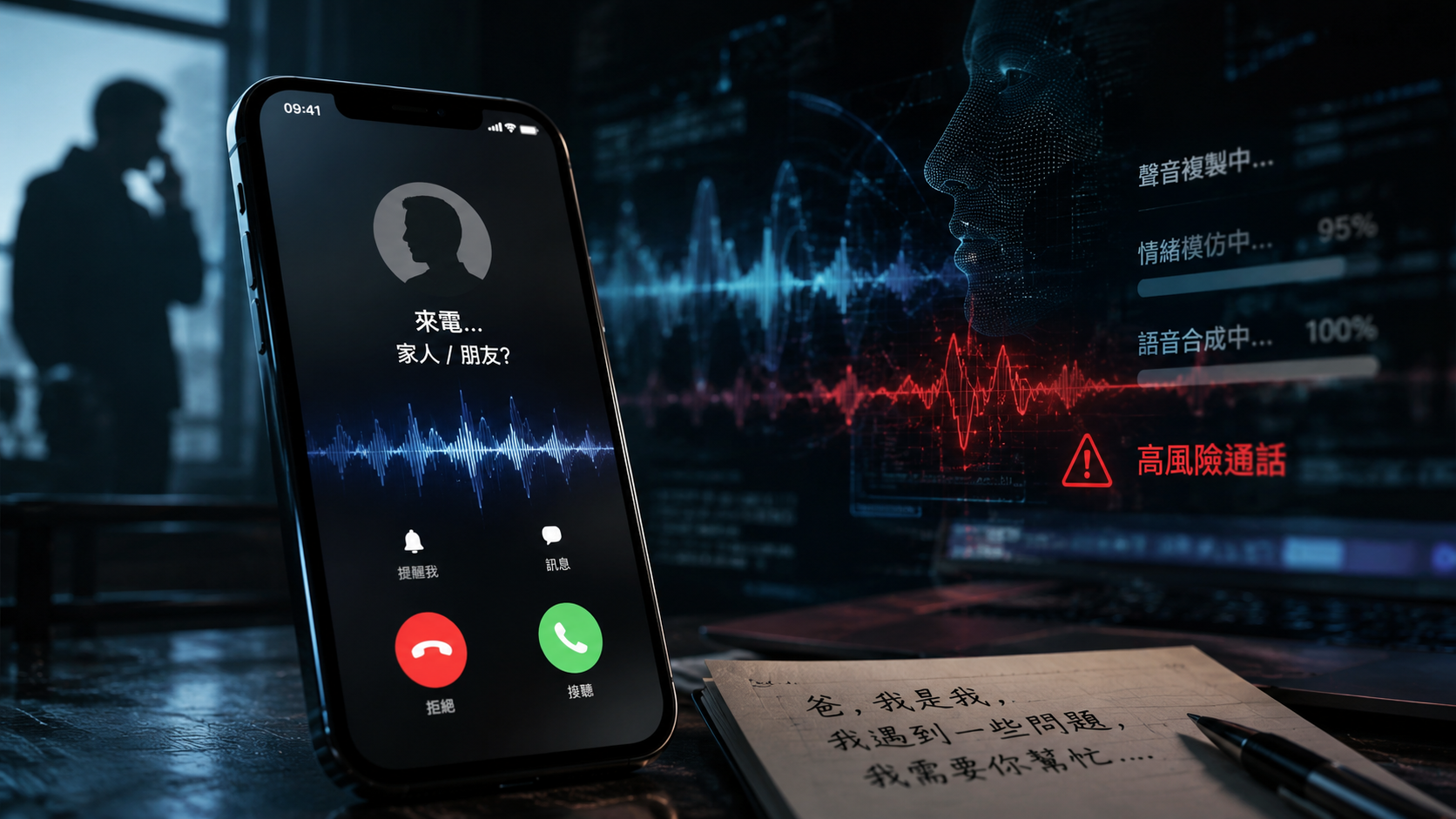
Your voice used to be like a fingerprint; now it's more like a screenshot. It remains personal, intimate, and convincing enough that family members believe 'this is you,' yet it is increasingly easy to clone, splice, synthesize, and exploit.
AI voice cloning has ushered crime technology into an awkward phase: scammers no longer need great acting; with sufficient data, urgent contexts, and ruthless scripts, they can make victims discard rationality within seconds. We used to teach people not to click strange links; now we must also teach them not to trust familiar crying voices too readily. This isn't about people becoming dumber—it's that the foundation of trust has been replaced by technology while everyone still thinks they're standing in place.
Fraud Exploits Panic, Not Voice
The most common AI voice scam scripts are deceptively simple: a child in a car accident, a relative kidnapped, a boss demanding a transfer, a friend borrowing money urgently, or a government official asking you to move funds to a safe account. Technology makes the voice sound authentic; psychological manipulation ensures you have no time to think. Many assume they can tell real from fake by ear; that confidence itself is scam material. Under panic, people don't use their ears—they use relationships; what they hear is 'my daughter crying,' not 'an audio clip requiring verification.' Scammers understand this perfectly, so they need not replicate an entire life; just enough to trigger fear.
That's why relying on 'it sounds odd' is insufficient. Modern voice synthesis can mimic pauses, breaths, sobbing tones, speech rate, and emotion; even if the voice has flaws, victims may interpret them as poor signal quality, injury, emotional collapse, or background noise. Fraud isn't testing your pitch—it tests whether you can maintain procedures under pressure. Harsh but clear: anti-fraud's core is not sharper ears but more cumbersome processes. 'More cumbersome' means don't trust instantly, don't transfer instantly, don't act instantly.
Family Safety Codes Are Not Outdated; They're the Lowest-Cost Verification Protocol
Families and organizations need simple verification protocols against voice cloning. The most straightforward yet effective method is pre-agreed safety codes or questions. This isn't a spy-movie trope—it shifts trust from 'does it sound like them' to 'did they pass our shared rules.' If someone calls using your child's voice claiming an emergency, hang up first and call back on a known number; if the caller insists you can't hang up, can't tell anyone, or can't call police, that's a red flag; if a boss demands a transfer via voice message, follow existing financial approval workflows rather than letting company accounts free-fall because the voice sounds familiar.
Organizations cannot rely solely on employee vigilance. Finance, procurement, HR, customer service, and public relations must establish 'high-risk request dual-channel confirmation': transfers, account changes, personal data provision, password resets, file downloads, permission grants—all require a second channel. The most absurd security gaps in the AI era aren't overly powerful models; they're corporate processes that resemble convenience stores: anyone holding a voice sounding like the boss can check out. If institutions still treat voice as high-trust evidence, it's equivalent to hanging a vault key beside a loudspeaker.
Detection Tools Are Useful but Don't Worship Detection
Deepfake detection, speaker verification, call-risk scoring, content watermarking, and caller ID validation will all become part of the anti-fraud toolkit. The problem is that detection always races against generation. Features caught today may be patched tomorrow; scores that seem reliable now can degrade under compressed audio, messaging apps, background noise, or cross-lingual accents. Betting everything on detection is like trusting a pretty umbrella in a typhoon—it helps, but you also need drainage.
A more pragmatic approach layers defenses: first education—people must know voices can be cloned and that familiarity doesn't equal authenticity; second process—high-risk requests require delay, callback, dual approval; third platform and telecom governance—blocking mass scam calls, flagging suspicious numbers, strengthening account security; fourth law and liability—clear boundaries for unauthorized voice and likeness use; fifth model detection. The order cannot be reversed, or we'll get beautiful dashboards and drained savings.
Elderly, Migrant Workers, and Remote Families Are High-Risk Groups
AI voice scams amplify social vulnerability. Elderly people may not know generative AI but recognize their children's voices intimately; migrant workers and transnational families rely on messaging apps for connection, so urgent pleas tug at emotions; remote caregiving households already fear disconnection—a single 'something happened' call can cause collapse.
Anti-fraud campaigns that reduce to slogans risk secondary victim-blaming: why did you trust so easily? The real question is why we hand such complex technical risks over to individual on-the-spot judgment. Schools, communities, banks, telecoms, and local governments should integrate AI voice scams into routine media literacy—not just 'be careful,' but actual drills: what if a loved one calls for help? How to set family safety codes? How to verify identity on messaging apps? How to call back? How to refuse urgent transfers? How to preserve evidence and report?
Voice Rights Will Become Cultural Data Sovereignty
For voice actors, performers, broadcasters, singers, teachers, guides, and Indigenous language workers, voice is not merely a tool—it's labor output and cultural carrier. Unauthorized voice training and cloning implicate personality rights, copyright, employment contracts, and cultural data sovereignty. Especially in Indigenous languages, oral traditions, and cultural guide contexts, voices are tied to elders' memories, ritual settings, taboo knowledge, and community trust. Taking a voice recording for model training appears as simple audio use but actually replicates the speaker's position and authority. This cannot be swept under 'technology is neutral.'
Future voice AI must have clearer consent, authorization, withdrawal, labeling, and revenue rules. Users also need education: not every online voice can be generated; not every public speech can become model material; not every voice resembling an elder can guide cultural tours. AI can aid language preservation, but without consent and context it can turn preservation into appropriation.
Conclusion: Trust Must Shift from Feeling to Procedure
AI voice cloning changes not the crime method but the trust mechanism. We once trusted 'what you see is what you get' and 'what you hear is true'; now procedures are more reliable. A familiar voice may be evidence, but never the sole proof. Mature anti-fraud culture isn't about making everyone an audio forensics expert; it's about families, companies, schools, and communities establishing 'slow down' rules. Scammers fear not your cleverness but your inconvenience: hanging up, calling back, asking safety codes, waiting ten minutes, seeking a second confirmation. AI fraud pursues speed; we create friction through procedure. Money transfers take seconds; regret can last years.
Platform Responsibility Cannot Stop at the Report Button
Platforms and telecoms cannot dump all responsibility on users. When scam calls, fake accounts, voice messages, and deepfake materials flow across platforms, individual tracking is nearly impossible. Platforms should at least provide suspicious message prompts, context forwarding, account risk signals, quick evidence preservation, and appeal channels; telecoms need better caller verification, anomaly detection, and cross-border cooperation.
More importantly, platform governance must avoid handing all problems to black-box detection. Users need to know why a call or voice clip is flagged high-risk and how to correct misclassifications. Transparency doesn't require exposing anti-fraud model details but must clarify data sources, processing purposes, and remedy procedures; otherwise the anti-fraud system itself becomes another unaccountable power.
Further Reading and Sources
- FCC, "FCC Makes AI-Generated Voices in Robocalls Illegal," 2024-02-08, Source. Verification considerations: confirm the legal context of AI-generated voices as artificial voice in robocalls; avoid stating all synthetic voices are illegal.
- Reuters, "Malicious actors using AI to pose as senior US officials, FBI says," 2025-05-15, Source. Verification considerations: confirm cases of AI voice messages and text impersonating government officials; avoid generalizing from individual incidents.
- Bhatti, Z. H. et al., "Can You Tell It's AI? Human Perception of Synthetic Voices in Vishing Scenarios," 2026, Source. Verification considerations: confirm limits on participants' ability to identify synthetic speech; avoid overgeneralizing small studies.
- Figueiredo, J. et al., "On the Feasibility of Fully AI-automated Vishing Attacks," 2024, Source. Verification considerations: confirm experimental design and social engineering risks of fully automated AI vishing.
AI use and content-safety disclosure
This article was assisted by AI for data organization, structure drafting, and sentence polishing; human editors set viewpoints and fact-check directions