A Single Call Steals Your Judgment Time: AI Voice Cloning Fraud and the Next Family Defense Line
Original Chinese title: 來電顯示說是家人,聲音卻可能是機器:AI 複製聲音詐騙的下一個家庭防線
AI voice cloning makes family emergency scams feel more real. What truly needs upgrading is not panic, but family verification processes, platform responsibility and society's ability to slow down.
Yuan Media AI Editorial Desk
Yuan Media AI Editorial Desk | An editorial team focusing on AI, public technology, cultural data governance and media literacy.
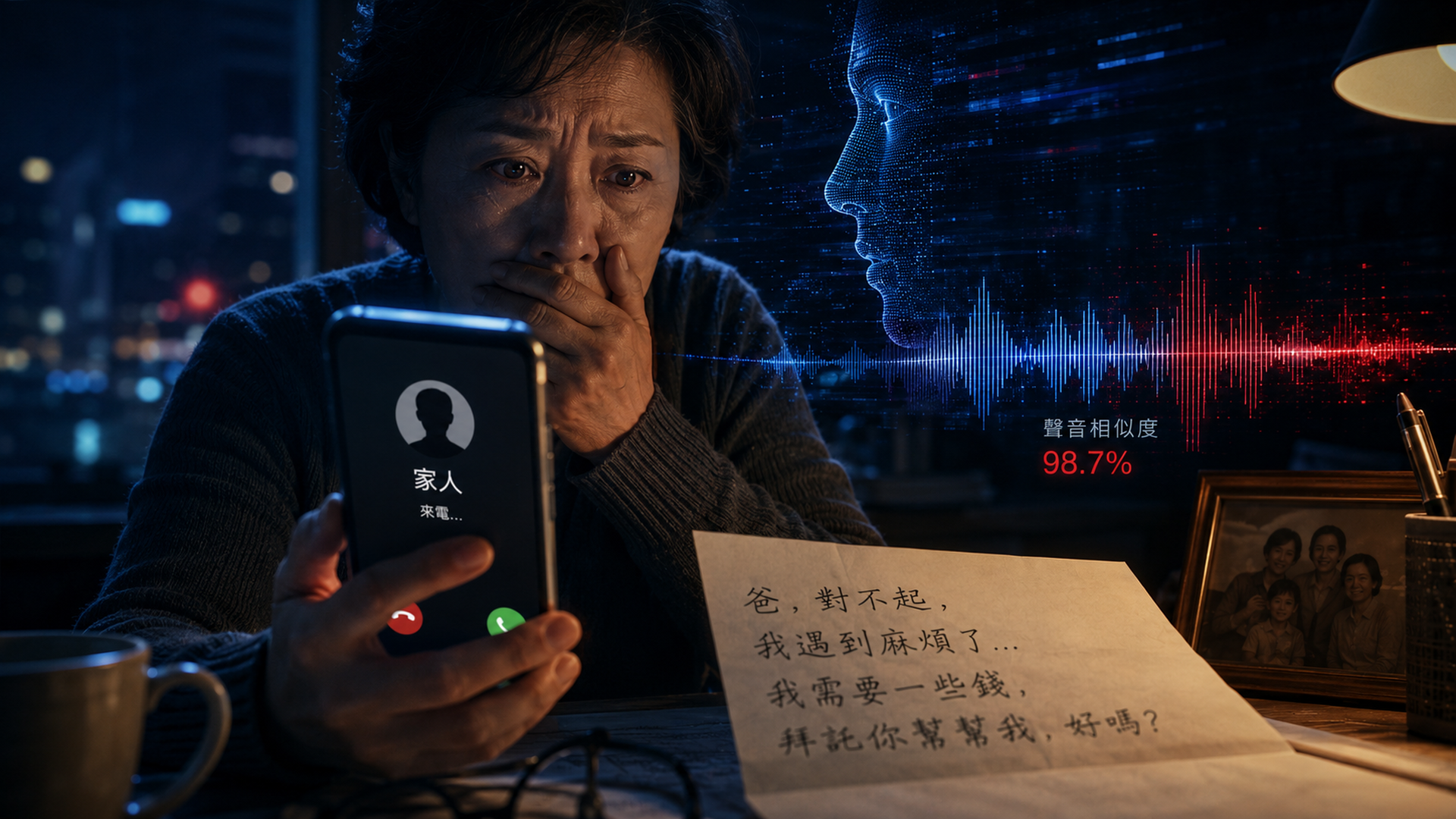
A Single Call Steals Your Judgment Time
Past scam calls often had flaws: strange accents, rough plots, cheap background sounds, like a rushed radio drama. Now it's different. AI voice cloning rewrites fraud from "Should you trust a stranger?" to "Can you doubt a familiar voice within thirty seconds?" When the caller speaks with your child, parents, partner or old friend, claiming a car accident, detention, broken phone, urgent transfer, many people are not incapable of thinking—they simply don't have time. Scammers truly steal not the voice but judgment time.
This is why we cannot just frame the problem as "Elderly must be careful." That sounds reasonable but is lazy. AI voice cloning targets not age but relationship. As long as you care about someone, there's a possibility of emotional hijacking. Grandparents get nervous, parents get nervous, young people get nervous too. Fraud no longer relies only on fake official documents, fake customer service, fake investment groups; it learns your family script, uses the tone most familiar to you, packaging "Hurry and save me" as familial duty. The darkest place of tech crime is that it often wears love's coat.
Voice Is No Longer an ID Card
We habitually judge people by voice. Someone opens their mouth and you know who they are; someone says "Hey" and brings back ten years of relationship. But voice generation models split this apart: timbre, tone, pauses, crying, panting can all be imitated. More troublingly, scammers don't need to perfectly replicate an entire life. They only need to make you feel "like it" within the most panicked dozen seconds, then push you toward payment with pressure. Human ears are not forensic labs; under anxiety we hear fear-completed voices.
Therefore, the first new rule for family anti-fraud should be: Do not treat voice as an ID card. Familiar voice can only provide clues, not conclusions. Just as caller ID can be faked, photos retouched, messages screenshot and reassembled, voice has entered an era of synthesis, transportability and impersonation. Downgrading voice from "evidence" to "signal pending verification" is not cold-blooded; it's rescuing kinship from the scam script.
Family Passphrases Are Not Childish—They're Low-Cost Verification Protocols
Against AI voice cloning fraud, the most effective tool may not be the most expensive antivirus software but a verification process pre-designed within the family. It can be a passphrase or a three-step confirmation: first, hang up; second, call back using your saved number; third, cross-verify with a second family member. What truly matters is not how mysterious the passphrase is, but that everyone knows any urgent request for transfer, cash-out, point purchase, password provision must pause. Pausing itself is a firewall.
Passphrases should not be designed as information easily guessed from social media posts. Pet names, birthdays, schools, zodiac signs, favorite restaurants are usually not passphrases but extensions of public data. Better to set a short phrase that never appears on social media and agree to rotate it regularly. This sounds like spy fiction; in reality it's just family two-factor authentication. Banks need OTPs; families facing high-risk appeals also need a second signal not directly taken over by emotion.
"Don't Hang Up" Is the Scammer's Favorite Spell
Many scam scripts share one action: keep you online. They'll say your phone is dying, someone is monitoring nearby, police forbid notifying family, hospital needs immediate payment, lawyer waiting, transfer fails a minute late. These statements appear as plot points but actually control the communication environment. As long as you don't hang up, you cannot verify; without verification, they continue directing your panic.
Thus anti-fraud education should upgrade from "identifying scripts" to "reclaiming rhythm." Any scenario demanding continuous call, forbidding discussion with others, urging immediate payment must be treated as high-risk. This is not because every emergency is fake but because genuine rescue does not fear verification. Emergencies that can be verified deserve handling; those that forbid verification are mostly processing your wallet.
Platforms Cannot Just Say Users Must Be Careful
Dumping all responsibility on individuals equals tacitly allowing criminals to use cheaper tools, larger lists, more precise emotional scripts. Telecoms, financial institutions and social platforms must join the same defense line. Phone terminals should more actively flag suspicious calls; social platforms reduce risk of bulk scraping public voice material; finance ends design humane cooling mechanisms for abnormal transfers, short-term high-pressure cash-outs, virtual asset deposits. When criminal industry is automated, stopping defense at "Please raise awareness" is like asking people to use umbrellas against typhoons—good attitude, limited effect.
There's also a design ethics issue here. Many AI voice tools claim creative, customer service, accessibility or entertainment uses; these exist and shouldn't be demonized wholesale. But when technology can cheaply clone personality signals, clearer watermarking, authorization records, abuse reporting and tracking mechanisms must be required. Innovation does not mean dumping social experiment costs on victims. Tech companies love saying "We just provide tools," yet when tools become parts of criminal workflows they cannot pretend to be merely passing hardware stores.
Media Literacy Must Move from True/False Identification to Process Design
Past media literacy taught distinguishing fake news, verifying image sources, confirming URLs. AI fraud pushes further: even if voice sounds real, visuals look real, messages appear real, you still need process. Future misinformation may not look fake; it might look exactly like the person you trust most. Then media literacy is not just "understanding content" but "designing action rules."
Families can post anti-fraud processes on refrigerators, Line group announcements or elder phone desktops: any request for borrowing money, transfers, bail fees, medical costs, account freezes, investment top-ups must first hang up; call back only via known numbers; verify with at least a second family member; never operate online banking during calls; never hand over ID cards, financial cards, OTPs or remote control rights. These rules seem ordinary but scammers fear most that ordinary people slow down. Black humorously, AI can clone voice but cannot replicate the chaotic firepower of three aunties simultaneously verifying in a family group.
One Second Later Is New Security Capability
Security education in the AI era should not just pursue faster identification but train to be one second later. Being one second later is not dullness; it's deliberately preserving judgment space. When calls urge you fast, systems help you slow down; when messages make you fear, families help you verify; when voices soften your heart, processes harden you up. This is not anti-technology but acknowledging technology has entered the emotional domain and society needs new etiquette: I trust you so I must verify; I care about you so I won't be pushed by a single call.
Ultimately AI voice cloning reminds us identity is no longer just a document or a voice. Identity is a set of relationships, processes, permissions and responsibilities. Future family safety is not everyone becoming a cybersecurity expert but making "confirmation" part of love. Truly reliable kinship does not fear asking one more question; only scam scripts fear you hanging up the phone.
Sources retained from the Chinese original
AI use and content-safety disclosure
This article was assisted by AI for data organization, structure drafting and sentence polishing; human editors set viewpoints and fact-checking directions