Don't Turn Tribal Service Counters into Cold Machines: The Data Sovereignty Bottom Line for Indigenous Public Service AI
Original Chinese title: 不要把部落櫃台做成冷冰冰的機器:原鄉公共服務 AI 的資料主權底線
Indigenous public service AI cannot just chase customer-service efficiency. True digital transformation must put consent, data boundaries, Indigenous language context, accessible access, human handoff and community governance at the system core.
Two-Eyed Seeing Lab
Co-authors: 劉展瑞
The Two-Eyed Seeing Lab focuses on Indigenous Peoples' knowledge, data sovereignty, cultural governance and AI applications; co-author 劉展瑞 has long focused on disability rights, accessible public services, Indigenous Peoples' social participation and digital access.
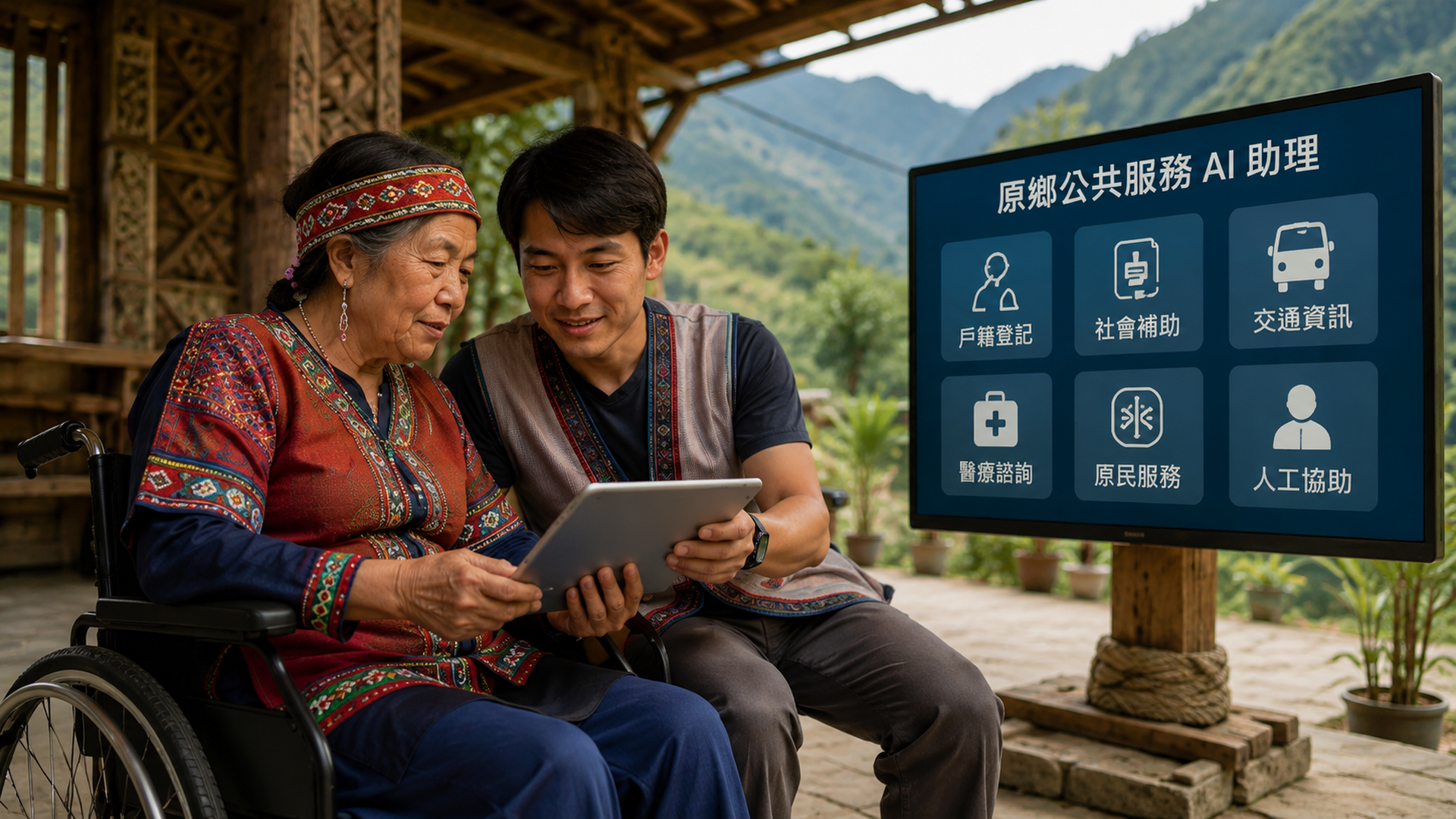
Don't Turn Tribal Service Counters into Cold Machines
Many local governments talk about AI and first think of chatbots. They can answer questions, guide applications, check progress, reduce call volume—sounds like a counter staff member who never takes sick leave. The problem is Indigenous township public service is not general customer-service. People come asking about subsidies, disasters, long-term care, land, employment, cultural events, household registration, education, medical transport—or a very simple but system-hard-to-understand phrase: "I don't know who to find."
Throwing such requests at a machine that only classifies, transfers and canned answers may boost efficiency, but dignity can drop. The worst AI public service is not answering wrong; it's forcing people into not knowing how to speak correctly. It demands users adapt to system language without letting the system learn local context. So people stand before digital counters like in front of a glowing wall: advanced yet cold.
Indigenous Township Service Data Is Not Ordinary Raw Material
Data involved in Indigenous township public service is often not just personal data. It may include ethnic identity, household status, land use, community location, disaster risk, ceremony times, cultural events, language content, elder care, vulnerable subsidies, disability needs and social relations. In general administrative systems this might be seen as fields; in community context it can involve dignity, history, rights and taboos. Data is not ore—just because someone mines first doesn't mean they can process.
Therefore the first question for Indigenous AI systems is not "how accurate is the model" but "who decides on data." Who decides what data may be collected? Who decides what cannot enter models? Who may query? Who may delete? Are community members, people with disabilities, elders, local offices and community representatives involved in rule-making? Is human appeal retained? Can communities set stricter use boundaries for sensitive data? If these are not answered first, then talking about smart governance is like installing a smart doorbell on a crooked house—the bell rings well but the house may be tilted.
CARE Principles Are Not Slogans; They Set Governance Order
When discussing Indigenous Data Governance internationally, CARE Principles are often mentioned: Collective Benefit, Authority to Control, Responsibility, Ethics. They remind us that data governance cannot just look at whether data is easy to find, interoperable or reusable—it must also consider collective benefit for the community, community control, responsible use and ethical research/technology. This matters especially for Indigenous AI because systems easily mistake "usable" for "desirable."
Take a public-service chatbot: it may need common Q&A, announcements, application processes, disaster info and transport/medical data—mostly publicly usable. But if you further include Indigenous language dialogues, elder stories, local names, ceremony knowledge, hunting/gathering experience, kinship networks or traditional territory details in training, the boundary changes completely. Public service needs verifiable administrative knowledge, not feeding whole community life into models. AI is not a data-eating mythical beast; every bite it takes should know who consented, who benefits and who bears risk.
Accessible Access Is Not an Add-on; It's the Service Entry Point
Co-author 劉展瑞 reminds us that Indigenous public service AI without disability inclusion from the start will go off course. Many disabled community members, elders or chronic-care families face not just unstable internet or hard forms but overlapping transport, visual, auditory, comprehension, language, care burden and information gaps. An AI counter offering only text input may exclude visually impaired users; voice-only interaction may exclude hearing-impaired users; complex administrative language may make it harder for people with cognitive disabilities, elders and those unfamiliar with Mandarin administrative terms.
Thus Indigenous public service AI should not treat accessibility as a last-minute patch before launch. It must consider multi-channel input, clear language, image support, human assistance, proxy applications, offline services, call-backs and local windows from the design start. True digital access is not putting services online but enabling people of different abilities, languages, devices and care contexts to find a usable path. Otherwise so-called smart-ization just moves counters to harder-to-knock doors.
Human Handoff Is Not Lagging; It's Responsibility Design
Many systems treat "human handoff" as an emergency backup, as if strong AI should retire human counters. This is false imagination. Public service human handoff is not failure—it's responsibility design. When cases involve qualification disputes, unclear meaning, cultural sensitivity, vulnerable situations, urgent safety, legal rights, disability needs or administrative discretion, machines should not force answers. Good AI must know when it cannot answer and bring users to truly responsible people.
Indigenous contexts need this handoff ability more. Not everyone knows online forms; not every place has stable internet; not all elders can describe needs clearly in standard Mandarin; not every question is solved by "choose one to five." If systems only chase automation rates, they may exclude those who need help most. Public service AI metrics should not just be "reduced calls" and "reply speed" but also "error handoff rate," "vulnerable user success rate," "appeal traceability," "multi-language context understanding" and "offline remediation." Otherwise so-called smart-ization may just shift human trouble onto users.
Indigenous Language Support Must Not Become a Performance Feature
Indigenous AI is easily packaged as a "supports Indigenous language" highlight. This matters, but it can become performance art. True language support is not just greeting phrases on the interface or dumping language corpora into models to generate friendly-sounding answers. Language and cultural context are linked; vocabulary may involve landscape, kinship, customs, taboos, generational and community differences. Without local review and community authorization, systems risk making language a pretty but unreliable decoration.
Better is layering: administrative processes, announcement summaries, transport info, application document explanations can be prioritized as clear multi-language support; cultural knowledge, ceremonies, traditional territory, taboo content should be decided by communities themselves—whether to digitize, how to present, who may access. Not all knowledge must be public; not all publicity equals transmission. Transmission sometimes needs speaking out, sometimes knowing what cannot be said. AI systems that don't understand the value of silence are unsuitable for cultural data.
Lessons from the EU AI Act on Risk Classification
The EU AI Act designs rules around risk, though it does not directly apply to Taiwan local governments; its spirit is worth referencing: not all AI applications are equally dangerous, nor can one review set fit all. Public services involving welfare eligibility, education opportunities, employment, health, public safety or rights/obligations should raise transparency, explainability, human oversight and appeal mechanisms. Indigenous public service AI should add cultural data risk, disability access risk, community rights risk and local context risk beyond general classification.
This is not to slow innovation but avoid error scaling. A human counter errs once—usually one person's problem; an AI system deploying wrong rules may affect a whole region. Worse, errors may be subtle, quietly excluding certain terms, groups or those less digitally skilled. Algorithmic bias sometimes doesn't shout—it just silently places you in "other" categories.
Good Indigenous AI Gives Power Back to Localities
Truly good Indigenous public service AI does not replace local staff but gives them better tools; it does not extract data but makes communities clearer about how data is used; it does not turn people into tickets but helps needs find responsible windows faster. Systems can assist organizing announcements, translating administrative language, reminding application deadlines, building FAQs, tracking case progress and reducing duplicate forms; they can also help local governments identify most-asked services and hardest-to-understand processes.
But the prerequisite is putting consent, data boundaries, human handoff, appeals, audits, accessible access and community participation at core. Indigenous AI is not innovation just by placing a pretty robot at the community entrance. It should be like a better bridge: letting administrative language and lived needs see each other, central policy and local experience correct one another, digital tools serve communities rather than forcing communities to serve tools. Otherwise so-called smart counters end up as cold door gods that only say "please re-enter."
Sources retained from the Chinese original
AI use and content-safety disclosure
This article was assisted by AI for data organization, structural drafting and sentence polishing; human editors set the viewpoint and fact-checking direction