Walking Warehouses, Smiling Solitude: The Productization Truth Behind the Humanoid Robot Hype
Original Chinese title: 會走路的倉庫,還是會陪笑的孤獨機器:人形機器人熱潮的產品化真相
Humanoid robots move from factories and warehouses to companionship and care; the commercial narrative is captivating. But real productization challenges lie not in whether they can walk, but in data, maintenance, safety, liability, and whether people are willing to hand over their lives to an expensive machine.
鍾靜蓉
鍾靜蓉 is a PhD in Digital Education from National Taiwan University of Science and Technology, with long-term focus on digital teaching strategies, technology-assisted learning, meta-data reasoning analysis, and human-machine interaction applications in education, care and organizational settings.
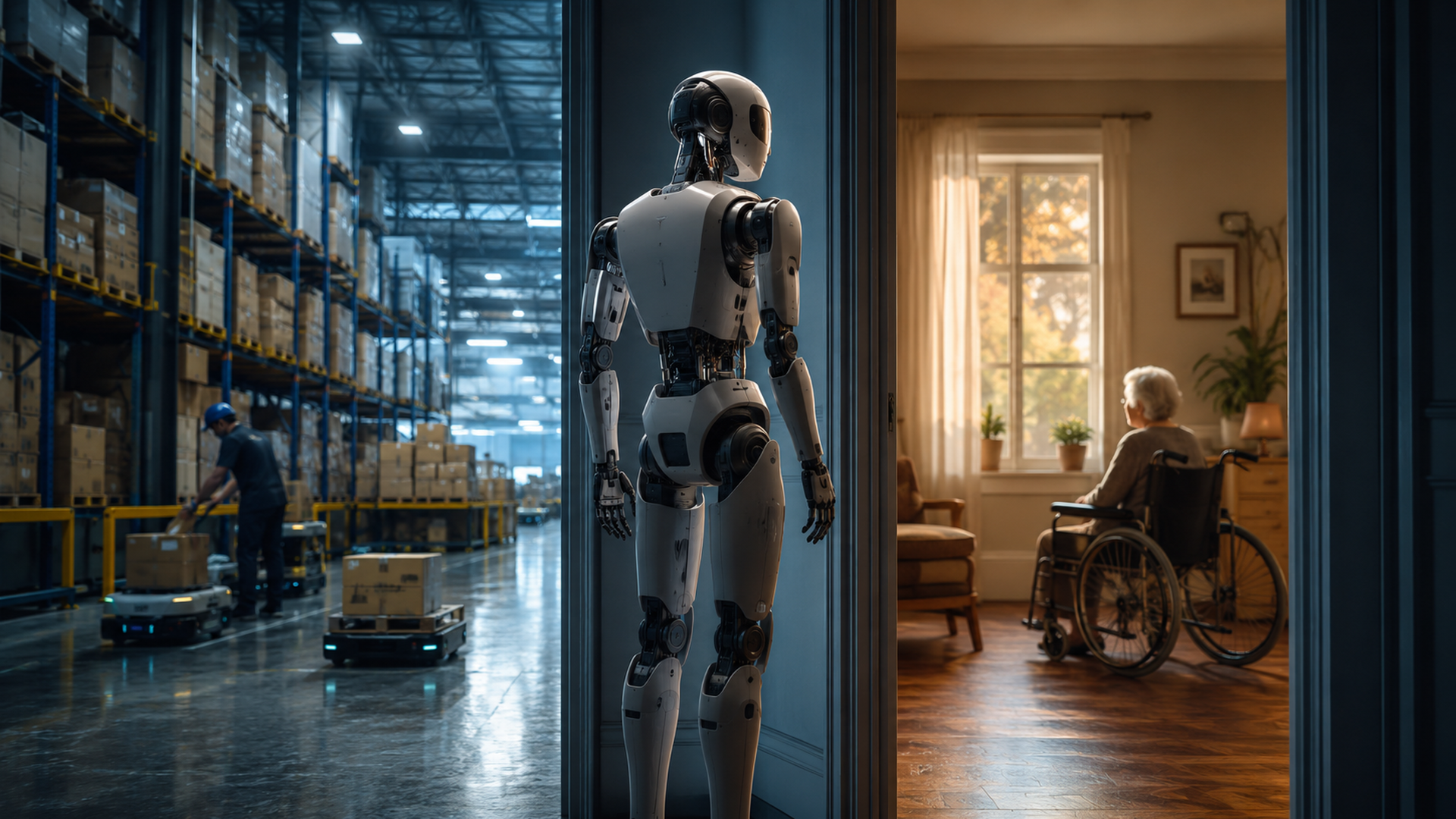
Walking Warehouses, Smiling Solitude: The Productization Truth Behind the Humanoid Robot Hype
Humanoid robots in recent years have been like fireworks ignited by large AI models, exploding from demonstration stages straight into investment briefings. They wave, carry boxes, pour drinks, and perform a short dance that looks earnest; then media headlines immediately announce: "The labor revolution is here." This scene is familiar. Every tech boom needs an object that can be photographed—clouds are too abstract, algorithms too invisible, SaaS too much like a login page—but a walking robot standing before you gives investors tactile proof, as if the future has already been fitted with joint motors.
But productization isn't a stage demo. A demo's job is to make people believe it's possible; a product's job is to not cause trouble every day. The real challenge for humanoid robots isn't whether they can walk—it's whether they can work in dirty, cramped, unevenly lit spaces with wet floors and humans wandering around. Warehouses aren't labs; care sites aren't conferences. The real world grinds every beautiful video into a customer service ticket: What if the arm gets stuck? Who replaces the battery when it degrades? If an elderly person falls and the robot misjudges, who's liable? If a child deliberately blocks its path, will it push them aside? If the network drops, can it still stop safely? These questions aren't sexy, but they are the product manager's plumbing—if any leak, the whole company stinks.
Recent news from companies like Apptronik, UBTech and Unitree shows humanoid robots moving from labs and factory pilots toward more aggressive commercialization. This is a significant signal that the industry now sees robots as the next carrier for AI applications. The problem is: a carrier isn't a market. Smartphones succeeded not because they looked human but because they had stable supply chains, developer ecosystems, telecom networks, app stores, repair systems and clear daily needs. If humanoid robots have only bodies without service systems, they're just expensive moving sculptures.
Warehouses are more honest; living rooms are more cruel
From the perspectives of digital education and human-machine interaction, warehouses, manufacturing and logistics are far more honest than home companionship. Warehouse tasks are clear: move, sort, restock, inspect. Environments can be redesigned, staff trained, ROI estimated, and accident liability handled via contracts. Even if humanoid robots start out less efficient than traditional automation, they may still find a place in scenarios with high environmental variability, complex item types, and spaces that are hard to retrofit. In other words, humanoids aren't here because of romance—they're here because the human world has already designed door handles, stairs, shelves and tools for their bodies.
Living rooms and care sites are far more cruel. Companion robots sound gentle but involve emotional attachment, privacy, care responsibility, family power dynamics and elderly loneliness. When a company says its robot can recognize emotions, accompany the elderly, or even reconstruct the face and voice of a deceased relative, we must ask not just "Will it sell?" but "What exactly is being sold?" Is it service? Is it replacing care? Is it an emotional painkiller? Or is loneliness being commodified into a subscription model?
EdTech once gave us a warning: throwing tablets into classrooms doesn't make learning happen automatically; importing platforms into schools doesn't automatically reduce teacher burdens. Technology without understanding the site only creates more operational, reporting and management costs. Care robots are no different. They don't become family members just by being placed at home, nor do they automatically relieve care workers' pressure once installed in institutions. They may require new workflows, new training, new fault reporting, new ethical guidelines, and even new expectations management for families. Product briefs only write "companionship"; the site will ask: Who teaches it? Who fixes it? Who takes responsibility when it says something wrong?
A robot's data isn't web data—you can't just crawl and grow
Large models grew on internet text; humanoid robots need embodied data. They must learn how cardboard weight affects wrist torque, why slippers trip the elderly, how to yield in narrow corridors, and that a cat suddenly darting out shouldn't be handled with industrial robotic-arm logic. This data is expensive, hard to collect, hard to label, and involves massive privacy and safety concerns. Apptronik launched training facilities—not just another robot gym, but an industry acknowledgment: without real-world data, humanoid robots can't evolve from video protagonists into workers.
But embodied data also brings governance issues. Employee movements in warehouses, care interactions at home, fall risks in elderly bedrooms, children's conversations with robots—all could become model-training material. Who consents? How broad is consent? How long is data retained? Can it be withdrawn? Is data used to improve the same family's service or fed into next-generation commercial models? If these aren't addressed first, the robot industry will quickly move privacy controversies from phones into living rooms—adding cameras, microphones, wheels and hands.
Meta-data reasoning reminds us that data isn't just content. Who, when, where, with whom, how long they reacted, how many seconds of hesitation, how many repeated requests—all this metadata forms highly sensitive behavioral portraits. Care robots operating long-term in homes or institutions accumulate not ordinary usage logs but human bodily decline, emotional rhythms, family care stress and lifestyle habits. If companies treat this data only as product-optimization fuel, ethical issues will explode before hardware failures.
Care technology shouldn't pretend to replace care
Aging societies do need technology. Shortages of care workers, immense pressure on family caregivers, uneven rural healthcare and long-term care services are real problems. Robots can assist with moving, medication reminders, fall detection, conversational companionship, remote medical connections, and reduce repetitive labor for care staff. These values deserve serious advancement.
But care isn't a task list. Care involves relationships, trust, cultural differences, and dignity in silence. Robots can help but must not lead policymakers to believe that "buying a few machines" solves the long-term care gap. The worst policy scenario: governments subsidize robots, families are expected to handle care themselves, platforms collect data and charge subscriptions, care workers' wages remain low, and the elderly get polite machines that cannot understand human lives. That isn't care innovation—it's turning social responsibility into home appliances.
In Indigenous or rural care settings, this problem is even more complex. Care languages, family relationships, tribal ethics, elders' trust in machines, network stability, repair distances, cultural taboos—all affect whether a product truly works. Tech companies that treat rural areas merely as "labor-shortage markets" will repeat many EdTech failure scripts: equipment arrives but training is insufficient; platforms launch but operations are lacking; data returns but local benefits don't materialize. What remains isn't innovation—it's hardware dusted by education.
The focus of human-machine interaction isn't being human, it's keeping control
Humanoid robots often market themselves on "looking human." But from human-machine interaction and educational psychology perspectives, being too human can be dangerous. When machines speak gently, have lifelike expressions, and remember your habits, people are more prone to emotional projection. This may help in companionship scenarios but can also create dependency, misunderstanding and manipulation—especially for children, dementia patients, the lonely or psychologically vulnerable. If robots are designed to be endlessly patient, affirming and never leaving, they may comfort temporarily but make it harder to return to real relationships.
Good design must keep clear boundaries. Robots must let users know they're machines; they can't impersonate humans, nor exploit emotional attachment to sell subscriptions, collect sensitive data or influence decisions. Users should be able to clearly turn off recording, delete data, limit functions and request human assistance. Families and institutions also shouldn't treat robots as surveillance tools under the guise of care. If care technology only pursues "stickiness," loneliness becomes a business model; if it pursues "exitability," it may approach respect.
EdTech has a simple principle: tools should augment human capacity, not weaken judgment. Robots must follow this too. They can remind, move, record, connect and alert—but they shouldn't let caregivers stop learning to observe people, nor allow systems to stop investing in care labor. The maturity of humanoid robots isn't measured by how human-like they appear, but by whether cohabitation with them makes life safer, more dignified and under greater personal control.
The next bubble will burst—but what remains matters
The humanoid robot boom will inevitably have a bubble. Too many companies will downplay difficulties, overpromise mass production timelines and present costs as dreamlike. Investment briefings may write "every home will have one" like morning-poster slogans. When the bubble bursts, many will call humanoids a scam. That's not quite accurate. A more precise statement: demonstration robots will die in large numbers; service robots will slowly remain.
What truly has staying power isn't necessarily the most human-like—it's what can stably create value in specific scenarios. It might move boxes in logistics centers, deliver medicine in hospitals, inspect hotel corridors at night, harvest crops on farms, or assist with transfers in long-term care institutions. It may not date you, nor look like a movie protagonist. It might be plain, durable and easy to repair—and won't forget how to open doors after midnight updates. This boredom is the highest praise for commercialization.
When looking at humanoid robots, don't just ask "Does it look human?" Ask five things: First, is the pain point clear enough? Second, is it cheaper or safer than existing solutions? Third, are its failure modes controllable? Fourth, do data and maintenance have sustainable models? Fifth, will users truly let them enter work and life? If you can't answer these, even beautiful robots are just walking fundraising stories. If you can, they may evolve from walking warehouses into a real business.
Sources retained from the Chinese original
AI use and content-safety disclosure
This article was assisted by AI for data organization, structural drafting and sentence polishing; editorial verification set the viewpoint and fact-checking direction