Volcanic Ash in Aircraft Engines: Sky Knowledge, Satellite Remote Sensing, and the Fragility of Civilized Flight Paths
Original Chinese title: 火山灰進了飛機引擎:天空知識、衛星遙測與文明航線的脆弱性
Volcanic ash seems like just a geological event, but it actually traverses weather systems, satellite monitoring, air traffic control, and global supply chains. When ash clouds enter flight paths, civilization remembers the sky is not empty.
Lawrence Lee | Technology Journalist, Science Fiction Critic, and Space Science Educator
Lawrence Lee focuses on space science, sci-fi narratives, technology civilization risks, and science education, skilled at translating distant astronomical and Earth system issues into civilizational stories understandable to public readers.
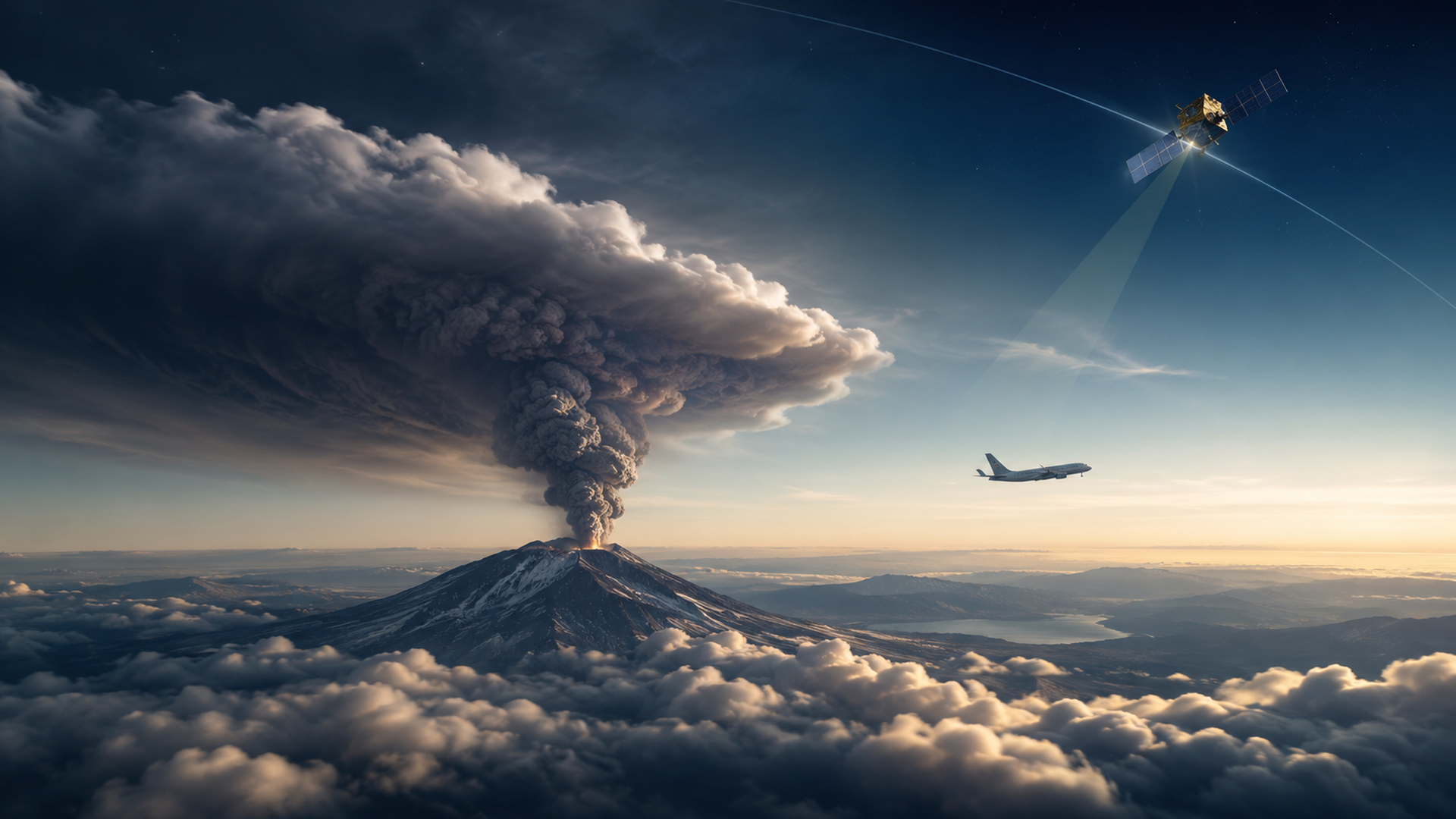
I. Where Civilization Is Most Confident Often Loses to a Dust Storm
Modern people have an almost religious trust in aviation. You step into an aluminum tube, drink a coffee that tastes ordinary but feels reassuring, and after several hours you are dropped from one city to another. Planes shrink the Earth; flight paths make the world look like a dense neural network. But as soon as a volcano coughs, this network begins to tighten. Volcanic ash is not ordinary dust; it is not the powder left after a campfire nor a relative of urban air pollution. It consists of glass, minerals, and rock particles shattered by volcanic explosions—fine enough to drift high into the atmosphere, hard enough to scratch aircraft surfaces, and capable of melting inside jet engines at high temperatures before adhering to turbine blades. The thing civilization’s engine fears most is sometimes just a little powder exhaled by Earth.
In aviation history there have been incidents where planes flew through volcanic ash clouds causing loss of thrust; these events led the international aviation system to gradually establish monitoring and reporting mechanisms for volcanic ash. Today, Volcanic Ash Advisory Centres (VAACs) provide information on the location, altitude, and future movement predictions of ash clouds using satellite observations, ground-based volcano monitoring, pilot reports, and dispersion models. This system may sound like routine bureaucratic documentation, but it is actually crucial insurance for whether civilization can continue to fly. Without it, airlines would have to gamble between ash clouds and costs; with it, flights may still be delayed, but at least delays are more bearable than engine failures.
The most fascinating aspect of volcanic ash is that it reveals the chain reactions within Earth’s systems. A single eruption begins underground, passes through the atmosphere, appears in satellite imagery, alters flight paths, disrupts logistics, and affects travelers, factories, fresh produce, medical supplies, and financial markets. Volcanoes are not distant natural spectacles; they are stress tests for globalized infrastructure. They remind us that civilization does not sit atop Earth but lives within Earth’s temperament.
II. The Sky Is Not Empty: It Has Layers, Wind, Ash, and Misjudgments
When ordinary people look at the sky, they see blue, white clouds, or bad weather. Aviation meteorologists perceive a three-dimensional, stratified, moving fluid world. Volcanic ash clouds can be sliced into multiple layers by wind at different altitudes; their concentration is uneven, direction varies, and they may be invisible from the ground or not obvious through an aircraft window. Night flights are especially dangerous because pilots might already be inside an ash cloud before noticing abnormal discharges, smelling sulfur, or detecting engine anomalies. This is why volcanic ash monitoring cannot rely on romantic visual observation; it must depend on satellites, models, observation networks, and international coordination.
Satellite remote sensing plays a key role here. Visible light imagery, infrared bands, thermal anomaly detection, and aerosol observations can all help identify volcanic ash versus volcanic gases. Different satellites vary in temporal resolution, spatial resolution, and spectral capabilities; some are suited for rapid tracking of large-scale ash clouds, others for analyzing hotspots and surface changes. When volcanoes are located in remote regions with insufficient ground observation, satellites may even become the first official witnesses. This feels almost sci‑fi: a mountain erupts in a desolate area, people on Earth’s surface might not yet react, but sensors in space have already sounded the alarm for civilization.
But satellites are not magic. Cloud cover, nighttime conditions, mixing of ash clouds with meteorological clouds, data latency, and model uncertainty all affect interpretation. Volcanic ash forecasting is not simply “see a gray blob then draw a line”; it involves combining observational data, eruption altitude, particle size distribution, wind fields, settling velocities, and atmospheric models to estimate risk. This is high‑pressure scientific negotiation: too conservative disrupts flights; too optimistic raises safety risks. Civilization often mocks scientists for being overly cautious until they sit in an aircraft and suddenly wish the scientists had been more so.
III. Volcanic Ash Is Black Humor of Globalized Supply Chains
The most visible impact of aviation shutdown is passenger inconvenience: ruined vacations, missed connections, airport queues. But the real effects often lie within supply chains. High‑value electronic components, medical samples, vaccines, flowers, seafood, precision machinery parts may all depend on air logistics. A single ash cloud does not need to cover the globe; it only needs to block a critical route or hub to slow certain gears of the world. Globalization loves to push efficiency to extremes—less inventory looks prettier, faster delivery seems more advanced; volcanic ash replies coldly: “Did your real‑time supply chain ask the atmosphere?”
This is also an important issue in the era of climate and geological risk. Volcanic eruptions themselves are not new phenomena; aviation globalization has amplified their social impact. In the past, volcanic ash mainly affected nearby settlements, agriculture, and regional transport; today it can influence intercontinental flights, international trade, and insurance decisions. Civilization’s fragility is not due to insufficient technology but because technological systems have become too tightly interconnected. When one node fails, impacts spread rapidly along flight paths, logistics networks, financial markets, and media. This does not call for opposing globalization but reminds us that efficiency and resilience are often not the same thing.
Airlines and regulatory agencies must therefore make decisions balancing risk, cost, and information uncertainty. Can planes fly through low‑concentration ash clouds? What is each engine’s tolerance? How much extra fuel will route changes consume? How long should airports close before it becomes unreasonable? These questions are not purely scientific nor purely commercial; they require public safety, industry costs, passenger rights, and international cooperation to be considered together. When volcanic ash enters the sky, the sky ceases to be an airline’s private network and becomes a space jointly managed by Earth’s systems and public governance.
IV. Local Knowledge and High‑Tech Monitoring Can Complement Each Other
When discussing satellites and aviation, it is easy to assume volcanic monitoring belongs only to high‑tech institutions. Yet residents around volcanoes, Indigenous Peoples, and local communities have long observed mountain bodies, hot springs, odors, animal behavior, stream temperature changes, and ground sounds. These observations should not be romanticized as mystical prophecies nor dismissed by modern science. A mature disaster knowledge system should allow ground observation, local experience, instrument data, and satellite information to cross‑calibrate.
Cultural knowledge in volcanic regions is often not merely stories; it includes memories of restricted zones, seasons, sounds, odors, and landscape risks. If public monitoring trusts only instruments, it may miss the first signs of abnormality reported locally; if it relies solely on legends, it might overlook quantified warnings. The value of Two-Eyed Seeing lies in letting different knowledge systems each articulate their own evidence, boundaries, and uses. Volcanic ash aviation monitoring can be international, satellite‑based, and model‑driven; the living risks around volcanoes still require local languages, local trust, and local governance.
This offers lessons for Taiwan as well. Taiwan is not a major global center of volcanic ash aviation crises, but it sits on the Pacific Ring of Fire’s periphery, making its flight paths highly dependent on regional weather and nearby volcanic activity information. More importantly, when facing typhoons, torrential rain, earthquakes, landslides, and landslide‑dammed lakes, we also need to connect satellites, radar, ground sensors, and local knowledge. Volcanic ash is just one dramatic example: Earth’s systems are always larger than any single department, and disaster governance can never rely on a single dashboard.
V. Sky Knowledge Is a Form of Civilizational Humility
Volcanic ash has taught aviation civilization humility. No matter how expensive the aircraft, it cannot command the atmosphere to make way; no matter how precise the engine, it dislikes glass powder; no matter how beautiful the flight path map, it is merely drawn on a living planet. Satellite remote sensing, VAACs, volcano observatories, air traffic control, and meteorological models together constitute sky knowledge. This knowledge is not meant for humanity to conquer the sky but to acknowledge that the sky has its own rules.
Science education should make this clear. Volcanic ash is not cold trivia; it sits at the intersection of Earth science, aviation engineering, public governance, and civilizational resilience. It can help students understand why satellite bands matter, why data latency affects decisions, why models have uncertainty, and why international cooperation is more than slogans. More importantly, it lets us know: natural events become disasters not because nature suddenly turns evil but because human systems design themselves too fully, too quickly, without redundancy.
Next time you see a flight rerouted or delayed due to volcanic ash, do not merely curse the airline. Imagine an invisible ash cloud traveling along high‑altitude wind fields across borders; meteorologists comparing satellite imagery with models; flight plans being recalculated; supply chains rearranging; passengers growing anxious; and Earth simply exhaling as usual. Civilization’s task is not to pretend this breath does not exist but to learn to hear the sky’s warning before it arrives.
VI. From Volcanic Ash We See Our Covenant with the Sky
Human civilization often understands the sky as a conduit: planes pass through, satellites pass through, signals pass through, military and commercial interests pass through. But the sky is not a highway; it is part of Earth’s system. It contains water vapor, ice crystals, dust, volcanic ash, turbulence, radiation, and biological migrations. When we treat the sky as a transparent background, risks are postponed until accidents or flight cancellations make them visible. Volcanic ash acts like an ungracious teacher, slapping the chalkboard eraser onto civilization’s face: “You thought empty space was actually full of conditions.”
Future aviation safety will require not just better aircraft but more refined sky governance. Satellite data must be integrated faster; model forecasts need clearer uncertainty markings; international reporting should reduce delays; airlines must incorporate extreme Earth events into resilience planning. Passengers also deserve better scientific communication: why canceling flights is not cowardice, why delays may be the price of safety, and why satellite‑observed ash clouds are more trustworthy than blue skies seen through windows. If science cannot be understood, it will easily be drowned out by anger.
Volcanic ash entering aircraft engines sounds like a disaster movie opening; but the more important plot is how humanity builds knowledge, institutions, and cooperation before disasters strike. Sky knowledge is not the secret art of a few experts but part of public culture. When we understand how volcanoes, satellites, meteorology, aviation, and supply chains interconnect, we become less likely to oversimplify the world. True civilizational progress is not merely flying higher, farther, cheaper—it is remaining willing to admit we need to learn when Earth reminds us.
Sources retained from the Chinese original
AI use and content-safety disclosure
This article was assisted by AI for data organization, structure drafting, and sentence polishing; human editors set viewpoints and fact-checking directions