Forests Begin Uploading Their Own Voices: AI Soundscape Monitoring, Citizen Science, and the Next Debate on Biodiversity
Original Chinese title: 森林開始上傳自己的聲音:AI 聲景監測、公民科學與生物多樣性的下一場爭論
From bird-identification apps to passive acoustic monitoring of forests, AI is turning natural sounds into data streams; yet more data does not mean deeper understanding. The real issue is not how much AI can hear, but who has the right to interpret those sounds.
山海資料庫
The Shanhai Database focuses on mountain and ocean ecosystems, biodiversity, local data governance, and Two-Eyed Seeing. It emphasizes mutual correction between scientific monitoring and community knowledge.
I. Nature Did Not Suddenly Become Quiet; It Was That We Had Not Listened Properly
The most cruel aspect of the biodiversity crisis is that disappearances often make no sound. When a certain bird becomes scarcer, cities do not sound alarms; when a certain frog stops calling, stock markets do not halt trading; when the nocturnal soundscape of a forest thins out, most people simply feel that today is quieter. Yet ecological quietness is not peace; sometimes it signals withdrawal. The problem lies in humanity's skill at recording what we have said, while rarely maintaining long-term records of how other life forms make sound.
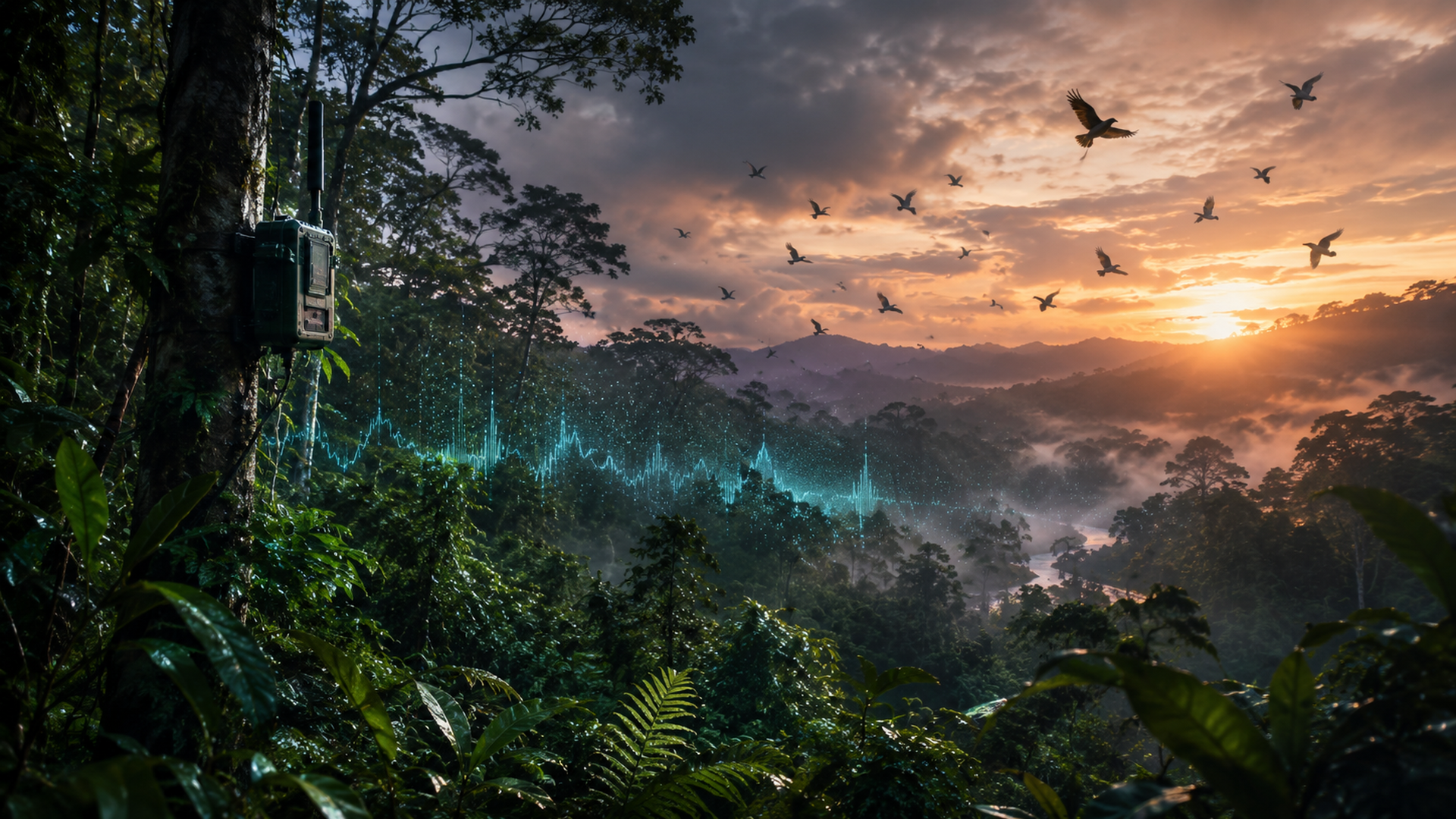
AI soundscape monitoring is changing this. Passive acoustic monitoring places recorders into forests, wetlands, grasslands, coastlines, and urban parks to collect environmental sounds over time; models then identify birds, insects, amphibians, mammals, as well as anthropogenic noises such as gunshots, chainsaw sounds, and ship activity from the massive recordings. This transforms ecological monitoring from "experts periodically visiting sites" into "the environment continuously leaving signals." For regions with limited funding, complex terrain, nocturnal species, or those difficult to observe visually, soundscape data offers a new entry point.
Recent integration of bird-identification apps and citizen science databases also turns ordinary smartphones into distributed sensor networks. This is fascinating: walkers, birdwatchers, commuters may unknowingly fill gaps in scientific monitoring. Yet the fascination is precisely where danger lies. With more data, people easily mistake quantity for understanding; with models that appear accurate, they forget when to answer "I do not know." Natural sounds are not customer-service recordings, and forests are not clean laboratories. Wind, rain, echoes, overlapping calls, distant mechanical noises all turn identification into gray zones.
II. Citizen Science Is Not Free Labor; Data Governance Cannot Pretend to Sleep
The value of citizen science lies not merely in cheaply acquiring large datasets. Its true worth is that it prompts more people to pay renewed attention to the living beings around them, making science happen beyond research stations and journals. When a child uses a smartphone to identify bird calls outside his window, he learns not just species names but that the world is not composed solely of human notifications. This sensory education may be far more effective than a hundred sustainability briefings.
Yet citizen science cannot be romanticized. The sound data contributed by users includes location, time, behavioral paths, and ecological sensitive information. If positions of certain rare species are overexposed, they may attract disturbance, poaching, or tourism pressure. If platforms convert user data into commercial assets without clear feedback to communities and protection of sensitive points, citizen science becomes a beautifully packaged form of data outsourcing. This requires particular caution in Indigenous Peoples' areas. Many mountain soundscape recordings are not merely natural data; they may relate to hunting ethics, ritual spaces, taboo landscapes, traditional territories, and community memory.
Therefore, soundscape data governance should adopt a tiered system. General species and low-sensitivity regions can be opened for education and research; rare species, breeding grounds, culturally sensitive locations, and community-designated areas should employ delayed publication, blurred coordinates, authorization review, or co-management by the community. Two-Eyed Seeing does not mean uploading all tribal sounds to the cloud nor rejecting scientific monitoring; it means that data acquisition, interpretation, preservation, and feedback must pass through appropriate consent procedures. Forests can be heard, but this does not imply every sound should be publicly played.
III. AI Is Very Good at Identifying Sounds, But Not Necessarily Understanding Silence
Many acoustic AI models perform well under specific species, regions, and recording conditions; yet once transferred to data-poor ecosystems, accuracy may decline. Research on tropical forests and multi-species monitoring reminds us that regionalized, task-oriented model training can improve multi-species detection, especially for primates, elephants, or other large mammals beyond birds. This also warns us that general-purpose models are not universal solutions. Biodiversity monitoring relying solely on globally abundant species will make models better at hearing "the world already studied extensively" while continuing to ignore data-poor regions.
This offers significant inspiration for Taiwan's mountain forests, islands, wetlands, and Indigenous township areas. If local soundscape monitoring is established in the future, foreign models cannot be directly applied. Local species audio files, seasonal annotations, habitat data, experiences of Indigenous people and local rangers, scholar validation, and long-term maintenance are needed. More importantly, models must acknowledge uncertainty: a sound may belong to a certain bird or raindrops hitting leaves; it may indicate animal passage or distant motorcycle noise. Good ecological AI should not be like investment advisors who always sound confident; it ought to know when to say: "This place needs human listening."
Silence is equally important. When sounds that regularly appear at a location disappear, this does not immediately signal species loss; it may reflect seasonality, weather, equipment failure, or changes in recording position. Yet if long-term trends are clear, silence becomes data. Biodiversity governance must learn to handle such negative data: not hearing is also a signal. This signal must be interpreted cautiously and cannot be crudely rewritten by media headlines into "a certain species has gone extinct." Natural science fears two kinds of people: those who completely distrust data, and those who trust it too quickly.
IV. Before Allowing Forests to Upload Their Voices, First Ask Who Holds the Download Power
The next debate in AI soundscape monitoring will not be solely about model accuracy but about power. Who deploys sensors? Who owns recordings? Who sets labeling categories? Who decides which sounds are noise and which are ecological signals? Who can sell data to consulting firms, insurance companies, tourism platforms, or carbon-credit projects? If these questions remain unaddressed, soundscape technology risks becoming another resource inventory tool serving external markets rather than forests.
A better direction is to design soundscape monitoring as public infrastructure instead of a single platform's data mine. Research institutions, local governments, community organizations, schools, and Indigenous communities can jointly establish rules for data authorization, sensitive location protection, equipment maintenance, educational feedback, and result publication. Data products should not only return to academic papers but also feed back into ranger patrols, environmental education, local decision-making, and community memory. When a forest is recorded over the long term, it does more than provide species lists; it builds a sound annals of coexistence with humanity.
We often say nature speaks, yet more accurately: nature has always been making sounds; humans are simply too loud. AI microphones can help us hear more, but they cannot decide for us what deserves protection. When forests begin uploading their own voices, civilization must learn not to download more data but to lower its own volume.
V. Soundscape Education Is Not Just Bird Identification; It Is Retraining Civilized Ears
The most public value of soundscape monitoring may lie less in producing longer species lists and more in altering human sensory habits. Modern life trains us to listen only for notification tones, car noises, advertisements, meetings, and smartphone alerts. Forests, streams, insects, bird flocks, frog calls, and wind are often relegated to background. When AI converts these backgrounds into visualized sound waves and species prompts, it may make people realize anew: the world is not quiet; humans have simply muted other life forms.
If this education succeeds, it can enter schools, local environmental centers, Indigenous community patrols, national parks, and community colleges. Students need not begin by memorizing many species; they can first compare soundscape differences between early morning, midday, before rain, full moon nights, and after road construction. Residents may use recordings to build their own local sound chronicles; rangers can employ sound cues to assist in judging illegal activities or habitat changes. AI here does not replace teachers but makes it easier for them and students to begin listening. True scientific literacy is not merely knowing answers but being willing to leave long-term observations.
VI. Do Not Let Sound Data Become New Forms of Natural Colonialism
Yet soundscape technology may also turn toward another side. When large platforms, conservation consultants, carbon-credit projects, or tourism operators discover that sound data can prove habitat value, package natural experiences, and mark ecological performance, forest voices risk commodification. A place with richer bird calls becomes easier to market; a unique nocturnal soundscape around an Indigenous community may be used for immersive performances; appearances of certain sensitive species could be converted by external forces into land controls or tourism pressure. Data originally meant to protect nature might ultimately become the key allowing external powers to enter local territories.
Therefore, AI soundscape monitoring must establish data exit mechanisms from the outset. Local communities should have rights to request cessation of recording, deletion of specific time periods, reduced coordinate precision, limits on commercial use, and feedback requirements for results, as well as participation in correcting model misinterpretations. Data governance without exit rights is not true consent; citizen science without feedback is merely free collection; open data without sensitive boundaries may turn conservation into risk. Forests can begin uploading their own voices, but humans must first learn: being able to hear does not equal being able to own.
Sources retained from the Chinese original
AI use and content-safety disclosure
This article was assisted by AI for data organization, structural drafting, and sentence polishing. Human editors set the viewpoint and fact-checking direction