Indigenous Community Roofs Are Not Solar Energy Billboards: Microgrids, Public Services and Indigenous Township Energy Resilience
Original Chinese title: 部落屋頂不是太陽能展板:微電網、公共服務與原鄉能源韌性
Remote microgrids are not just about installing solar panels on roofs; they involve maintenance, ownership, data, electricity rates, public services and disaster backup as a local governance issue.
雙向知識實驗室+劉展瑞
The Two-Eyed Seeing Lab focuses on Indigenous township public services, cultural data sovereignty and technology governance; 劉展瑞 is from the Atayal Jinagaji group, serves at the Taiwan Association for Promotion of Welfare of Persons with Disabilities, and has long focused on Indigenous Peoples' public issues, local governance, disability rights and social innovation.
I. Do Not Treat Indigenous Community Roofs as Energy Transition Billboards
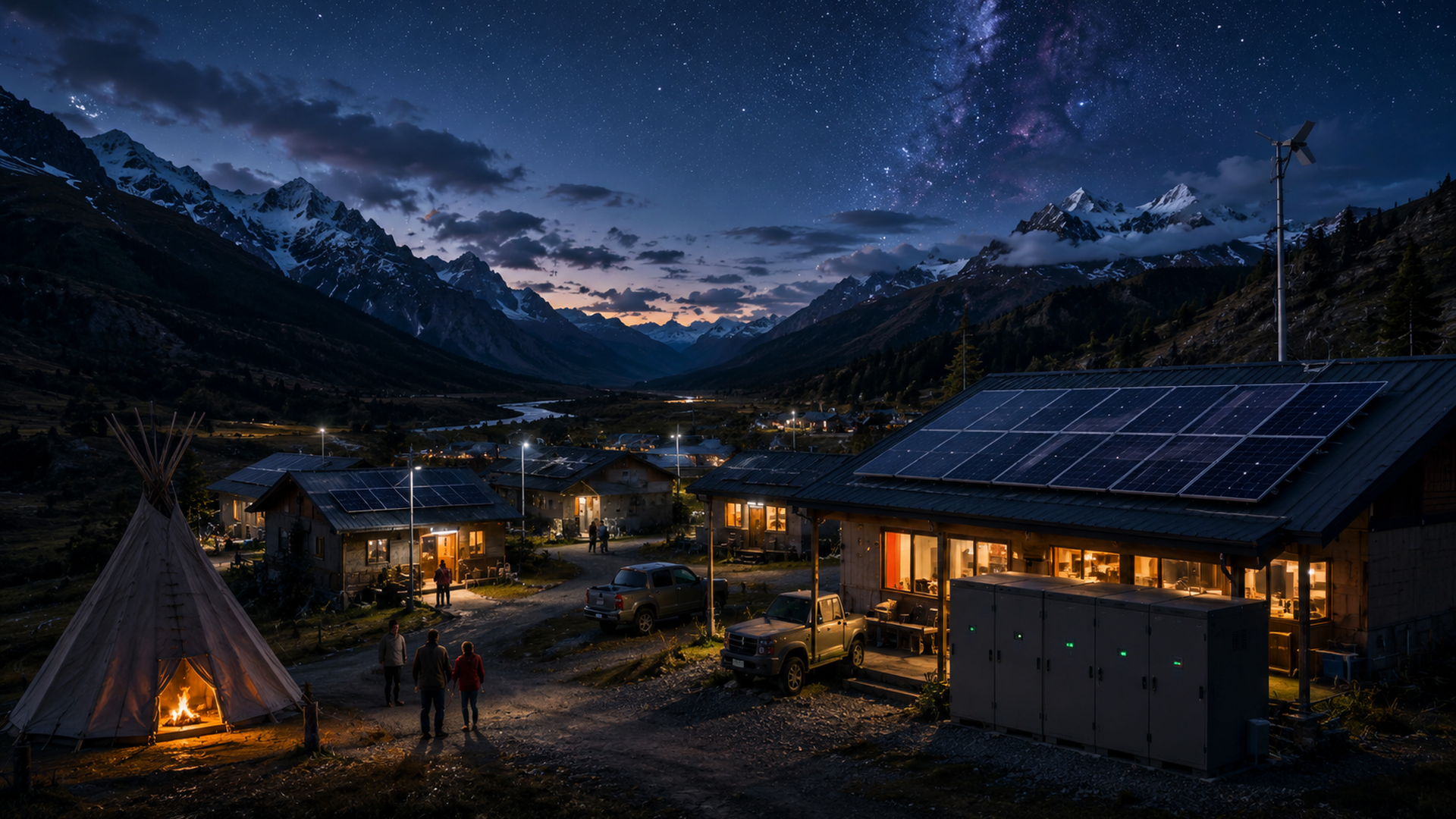
Energy transition is easily photographed into a beautiful image: blue sky, mountains, rooftop solar panels, with several smiling residents standing nearby. The photo looks great, but the question remains: who repairs during power outages? Who replaces after typhoons? Who pays when batteries fail? Who accesses data? Who shares benefits? If these questions lack answers, Indigenous community roofs are not energy transition; they become backdrops for policy briefings. Solar panels are not idols; installing them does not automatically protect public services.
The truly important aspect of microgrids is not just generation but resilience. For many mountainous, island or transportation-unstable regions, power interruptions are not minor inconveniences but may affect communications, medical cold chains, water pumping, schools, long-term care, disaster shelters, road monitoring and Indigenous community office operations. The main grid can normally supply electricity; of course that is best; but during extreme weather, rockfalls, road closures or communication damage, local areas need at least the ability to maintain critical services.
Many international off-grid and distributed renewable energy cases remind us of the same point: deployment is not the end; operation and maintenance are destiny. Too many projects look successful in the first year, start failing in parts by the third year, and become local complaints by the fifth year. The reason is not that communities do not cherish them; it is that institutions treat "installation" as achievement and "long-term usability" as a secondary condition. If this logic is applied to Indigenous townships, it will only repeat infrastructure colonialism: external units bring equipment in, take photos and leave, leaving local areas facing warranties, batteries, weeds, typhoons and invoices.
II. Microgrids Are Public Services, Not Just Energy Equipment
When discussing Indigenous township microgrids, the first question should not be how many kilowatts to install, but who serves whom. Which buildings are critical nodes? Health rooms, schools, churches, activity centers, police stations, fire brigades, Indigenous community kitchens, long-term care sites, communication base stations, water pumping stations, agricultural product collection yards — which need priority backup? How do normal electricity use and disaster-time electricity use switch? Do residents know which sockets remain usable during outages? Who is responsible for equipment maintenance? Are rates and benefits transparent?
These may sound trivial, but public services are composed of the trivial. When disasters occur, no one will first ask how beautifully this system's ESG narrative is written; everyone will only ask whether phones can be charged, medicines kept refrigerated, elders contacted, water pumps operated. Energy resilience is not about displaying technology; it is ensuring critical services do not all collapse at worst times.
Microgrids can also support local industries. For example, agricultural primary processing, refrigeration, drying, irrigation, simple tool repair, tourism services and digital workstations may improve due to stable power. But this does not mean every Indigenous community should be pushed toward the same business model. Some places need disaster backup; some need agricultural cold chains; some need medical and communication; some may temporarily be unsuitable for installation because maintenance conditions and community consensus are not yet mature. True respect for local areas is not copying the same solution one hundred times, but allowing each place to define its own priorities.
III. Data Sovereignty Also Exists in Electricity Meters
The smarter an energy system becomes, the more important data is. Smart meters, storage management, load forecasting, weather data, equipment failure records, peak electricity use, public facility usage patterns will all become microgrid operation data. This data can help maintenance, energy saving and disaster scheduling, but may also expose residents' lifestyles, religious activity times, industry schedules and community structures. Data sovereignty is not only about language data or cultural images; it also exists in electricity meters.
Therefore, Indigenous township microgrids need clear data governance: which data should be readable by the community? Which by operation vendors? Which can be anonymized for research? Which must not flow out? If AI is used for load forecasting or equipment maintenance, can models and data be reviewed locally? When projects end, how are data transferred? When vendors change, will systems be locked? These are basic questions of energy public services, not details to "discuss later."
There are also ownership issues. Microgrids may operate via government subsidies, cooperatives, community companies, private investment, schools or public-private partnership models; different models represent different responsibilities and risks. If equipment is nominally in the Indigenous community but actual control lies with external platforms; if benefit feedback is opaque; if maintenance requires waiting for distant vendors to send people; if local areas lack basic maintenance training capability, then "energy autonomy" four words easily become slogans. Autonomy does not mean complete independence from external entities; it means retaining negotiation ability, understanding ability and exit ability within dependency relationships.
IV. From Ribbon-Cutting Politics to Maintenance Politics
If Taiwan wants to promote Indigenous township energy resilience, the most needed change is evaluation indicators. Do not only look at installed capacity, site numbers, carbon reduction estimates and photo exposure; also consider how many critical services are supported during outages, equipment availability rate, average maintenance time, local training numbers, data governance documents, community consent records, disaster drill counts and benefit feedback mechanisms. These indicators are less suitable for ribbon-cutting but closer to daily life.
If microgrids can integrate with Indigenous township public services, they will be a very concrete resilience infrastructure. They can keep health rooms from losing cold chains during torrential rain nights, make shelters not just dark houses, turn schools into communication and charging nodes, prevent agricultural product refrigeration from being completely wasted due to road closures. They can also cultivate local youth energy maintenance skills, turning energy transition into work and knowledge rather than external equipment.
Most importantly, microgrids must recognize that local areas are not blank bases. Indigenous communities have their own governance rhythms, spatial taboos, public discussion methods and disaster memories. If technical teams do not understand these, they will only turn "participation" into attendance sheets for seminars. True co-design starts from the beginning by letting local areas decide which services are most important, which locations are unsuitable, which data cannot be taken, which maintenance must be localized. The sun rises daily, but trust does not. If energy transition forgets trust, it will only generate electricity; publicness will not occur. In other words, microgrids do not connect Indigenous communities to the future; they allow Indigenous communities to retain their own power and institutional space for choosing futures among disasters, industries and public services.
V. Energy Resilience Also Requires Drills, Not Waiting for Typhoons to Turn On
Many infrastructure systems appear to exist normally but are only known during disasters whether they truly work. Microgrids are even more so. Normal grid connection, daytime generation, battery charge-discharge cycles do not mean smooth switching to backup mode during torrential rain nights. Who has keys? Who knows switches? Who can judge remaining battery capacity? Which equipment must be prioritized for power cut? Are health rooms, communication base stations, shelters and water pumping equipment in the same priority order? Without drills, systems are only waiting for a disaster to test them; such tests usually have no retakes.
Therefore, Indigenous township microgrids should connect with annual disaster preparedness drills, school curricula, long-term care sites, local industries and Indigenous community meetings. Drills are not performances; they let everyone know what they can do during disasters. Youth can learn basic inspections; elders can know where to charge and seek help; town halls and Indigenous community officials can know how to schedule; maintenance vendors can establish rapid response processes. Microgrids only become public services when understood by people; used, questioned, repaired and drilled by communities, they truly become public services.
VI. Return Energy Transition to Local Areas, Not Just Hand Over Equipment
Ultimately, Indigenous township microgrids must answer governance questions, not just engineering ones. Equipment can be provided externally, funds via government subsidies, technology supported by enterprises; but priorities must return to local areas. Some Indigenous communities may most need medical cold chains; some need communication during road closures; some need agricultural processing and refrigeration; some need schools as nighttime lighting and information nodes. If all solutions grow from the same tender template, local differences will be flattened, equipment will gradually lose its human touch.
If energy transition only pursues capacity, Indigenous communities become display venues; if it pursues resilience, Indigenous communities become co-designers. Public services are not about sending things in; they enable local areas to decide, maintain, audit, adjust and refuse. Solar panels absorb sunlight, batteries store electricity, but trust can only be stored through long-term relationships. When the next typhoon, torrential rain or road closure arrives, what truly protects Indigenous communities will not just be equipment specifications, but those local capacities written into systems, drills and daily use.
Sources retained from the Chinese original
AI use and content-safety disclosure
This article was assisted by AI for data organization, structure drafting and sentence polishing; human editors set viewpoints and fact-checking directions