Humanoid Robots in Nursing Homes Are Not Angels: Boundaries of Care Technology, the Loneliness Industry, and Public Services
Original Chinese title: 養老院裡的人形機器人不是天使:照護科技、孤獨產業與公共服務的邊界
Care robots can remind, accompany, and support, but if used to cover up long-term care manpower shortages, loneliness, and public service gaps, they will turn from assistive devices into electronic placebos.
Yuan Media AI Editorial Desk
Yuan Media AI Editorial Desk focuses on cross-domain editorial issues concerning public technology, care governance, platform risks, and social impact.
I. The Most Human-Like Aspect of Care Robots May Be That They Can Also Disappoint
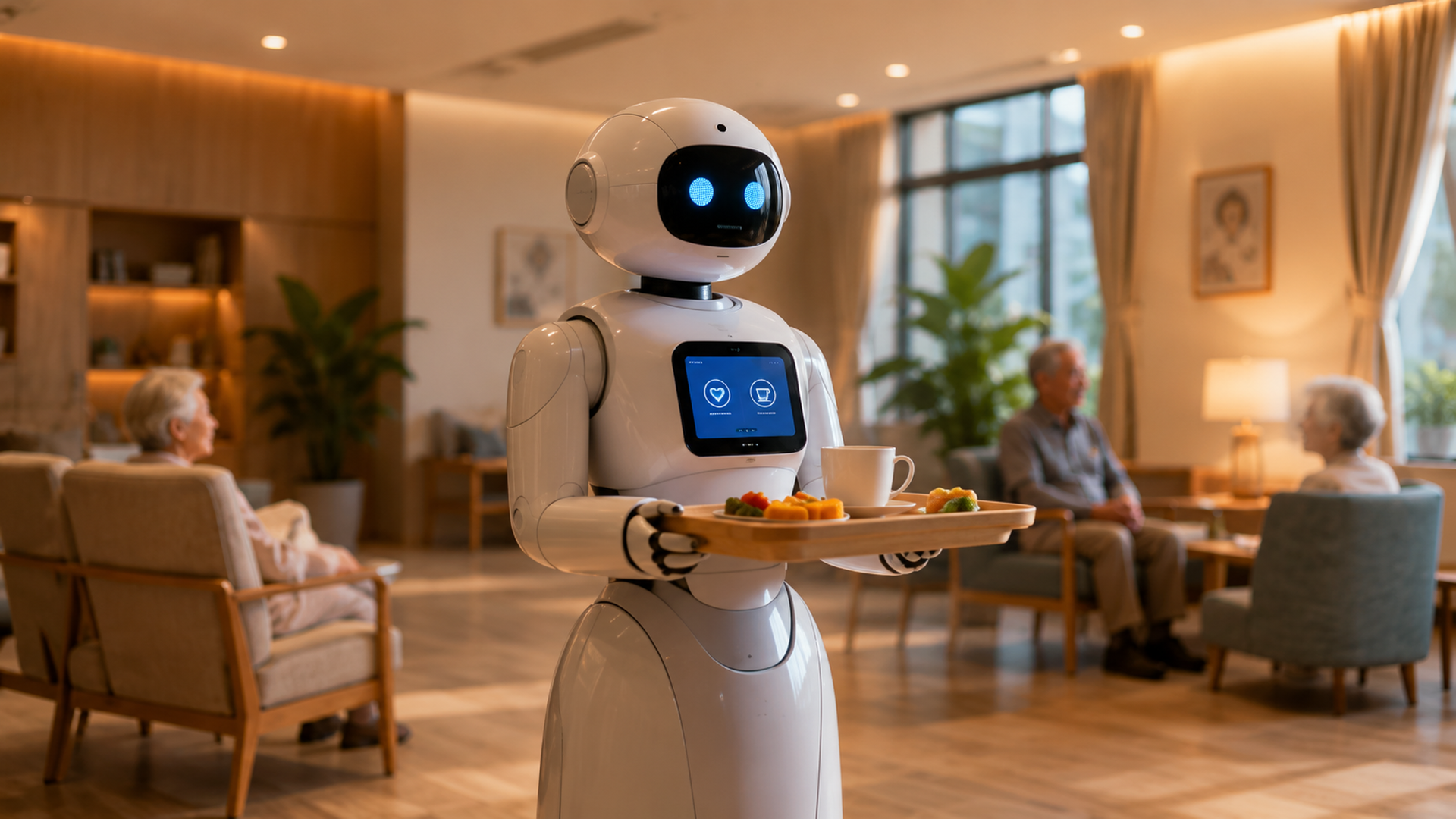
In recent years, care robots have been packaged very gently: they remind people to take medication, accompany them in conversation, patrol rooms, detect falls, deliver meals, and ideally even use a non-annoying voice to tell elders "Good luck today." In an era of aging populations, shrinking caregiving manpower, and families exhausted by relentless demands, such imagery is highly appealing. Who wouldn't want an assistant that never calls in sick, never complains about fatigue, and never misreads the shift schedule? The problem is that care is not a logistics process that can be automatically completed simply by breaking tasks into pieces. It involves bodies, emotions, dignity, family relationships, and public institutions—all of these combined constitute care, rather than merely placing someone temporarily in a state that "looks managed enough."
Care robots are worth paying attention to not because they symbolize the future, but because they force us to answer an uncomfortable question: do we want technology to strengthen caregiving, or to mask gaps in the care system? If the former is true, robots can become very useful assistive tools; if the latter, they will quickly turn into electronic placebos responsible for making society feel as though it is trying.
II. Outsourcing Companionship to Machines: The Greatest Fear Is Not Coldness, But Pretending Not to Be Cold
Many people are resistant to care robots because they believe "companionship" should not be handed over to machines. This intuition is far from absurd. After all, what elders truly need often goes beyond reminders to take medication; it includes someone willing to listen until a story is finished, someone who remembers their daily rhythms, and someone capable of detecting emotional shifts in the hesitation of a single sentence. Robot interaction design can be made very gentle, yet it cannot automatically replace social connections.
However, the problem should not be reduced to "machines are bad, humans are best." If certain robots can assist with night patrols, fall notifications, medication reminders, remote contact, or rehabilitation guidance, they may indeed provide help for isolated elders or families bearing heavy caregiving burdens. What truly needs vigilance is technology being used to substitute the human labor and services that should already exist. If public services are inadequate, family members are forced into overwork, community support is insufficient, and then society sends in a cute machine saying "Look, we have innovation," this is not care progress—it is packaging structural coldness as warm design.
III. Care Sites Are Not Laboratories; Errors Ultimately Fall on People
Care technology often looks very ideal in demonstration settings: flat floors, smooth pathways, gentle lighting, cooperative users, stable networks. Real-world homes and institutions are completely different. There may be slippers, wheelchairs, walkers, pets, wires, cardboard boxes, and children's toys scattered around; elders might have poor hearing, fluctuating cognitive states, unstable emotions, or defensiveness toward new technology. All of these factors create a very large gap between the "real-world use" of care robots and demo videos. If a robot gets stuck, misreports, collides, blocks paths, or makes erroneous judgments, the risk ultimately borne is never the product presentation—it is always the users themselves.
Beyond physical safety, data governance is also a core issue. Care robots equipped with microphones, cameras, sensors, and behavioral recording functions collect the most sensitive type of data: medication adherence, daily routines, emotions, mobility abilities, visitor information, conversation content, and details of family life. Who can see this data? How long should it be retained? Can families download it? Can insurance companies or institutions use it for risk assessment? If algorithms misjudge falls or miss anomalies, who is responsible? Unless these questions are clearly addressed before system deployment, so-called smart care may simply mean making surveillance cameras look cuter.
IV. Remote and Indigenous Townships Cannot Be Reduced to Performances of "Equipment Going Downhill"
Placing care robots within the context of remote and Indigenous townships makes the problems even more complex. These areas face not only aging populations but also transportation distances, shortages of caregiving manpower, network stability, maintenance capacity, language and cultural differences, and family caregiving structures. If external units merely send equipment in for photos, then after three months accounts expire, parts break down, networks become unstable, and no one knows how to reset them—such "innovations" quickly turn into plastic souvenirs stored in warehouses.
For Indigenous public services, the first question must be about processes, not models. Which types of elders need reminders? Who will receive alerts? How do cultural health stations, clinics, tribal leaders, churches, and families divide responsibilities? If users prefer their mother tongue or Indigenous language, can robots accommodate this? Will data remain in locally controlled systems? If all these questions lack answers, and the only response is "AI robots entering the tribe," then it is merely another old play where localities are treated as backdrops for technology exhibitions.
V. Good Care Technology Should Make Caregivers More Human-Like, Not More Machine-Like
The most reasonable positioning of care robots is not to replace caregivers but to assist with certain repetitive, time-consuming, and fatigue-inducing tasks—such as reminders, simple patrols, delivering items, activity guidance, night sensing, and emergency notifications. If they can reduce the mechanical time caregivers spend on such tasks, freeing up more genuine companionship, judgment, soothing, and trust-building time, then they may become good tools. Conversely, if introducing robots merely means a caregiver must manage more residents, write more records, and handle more machine issues, this is not innovation—it simply pushes already overworked people into another form of digital overwork.
Therefore, evaluating care technology should not focus solely on demonstration counts or satisfaction surveys. More important metrics include: whether fall risk decreases, whether caregivers' working hours improve, whether family anxiety reduces, whether elders' loneliness diminishes, whether alerts are effectively responded to, whether data governance is clear, and whether users can refuse or pause usage. If the entire service collapses once technology is withdrawn, this indicates we have built not public services but a subsidy-driven performance.
VI. The Real Question Is Not Whether Elders Like Robots, But Whether Society Willing to Care for People
An aging society certainly needs technology; the issue is not whether to use it, but how. Rejecting all technology is unrealistic, and blind faith is more dangerous. The most mature approach places robots in an auxiliary role within public services: designs that are explainable, data that is controllable, processes with human handovers, maintenance that is sustainable, cultures that can be adjusted, and failures for which someone is responsible. If these conditions hold, care robots can become useful tools; if not, they may simply be another beautiful device packaging social responsibility as a product.
Thus, the real question to ask is not "Will elders like robots?" but "Is society willing to invest sufficient manpower, time, and institutions in caregiving?" Robots can remind people to take medication, but they cannot remind policies not to be lazy; they can deliver meals, but they cannot convey genuine respect through public systems. The ultimate value of care technology is not making machines more human-like—it is preserving the humanity of human caregiving.
VII. Care Cannot Be Turned Into an Emotion-Outsourcing Business Model
Even more concerning is that future care technologies may grow into a full "loneliness industry." Platforms would not only sell robots but also sell quantified companionship, subscription-based concern, and monthly emotional responses. For businesses this makes sense; for society it signals danger. Once loneliness becomes a scalable market, the responsibility of public services can more easily be transferred to commercial products. Elders are not merely usage scenarios, and care is not simply a user retention problem. If institutions forget this point, even the friendliest robot shells may only serve to monetize solitude.
Care technology truly worth supporting should make it easier for families, caregivers, cultural health stations, and local public systems to collaborate—not force each person to anxiously face their own device alone. If technology can reconnect people, it is a tool; if it merely slices up caregiving responsibilities that society should share into monthly fee plans, it may become another kind of escape that looks gentle but is actually expensive.
Sources retained from the Chinese original
AI use and content-safety disclosure
This article was assisted by AI for data organization, structural drafting, and sentence polishing; human editors set the viewpoint and fact-checking direction