Battery Recycling Is Not the End of Environmentalism: When Materials Science Starts Calculating Cities, Mines, and Generational Energy Equity
Original Chinese title: 電池回收不是環保尾聲:當材料科學開始計算城市、礦山與下一代能源公平
The wave of retired EV batteries is pushing recycling from an environmental slogan to a spatial governance issue. The true circular economy isn't just taking apart batteries—it's calculating recycling technology, urban flows, processing capacity, and mining pressure together.
全明正
全明正 is a cultural and visual recorder from the Shuanglong Indigenous community of the Bunun people, long concerned with energy transition, materials technology, low-carbon supply chains, industrial policy, and local environmental governance.
I. Battery's Second Life Is Often Told Too Much Like an Inspirational Story
Energy transition loves to talk about second lives. After retiring, EV batteries can be used in cascading applications, recycled into metals, or turned into new battery materials—as if every battery will find a gentle home in the circular economy. This narrative sounds comfortable, even touching: a battery that once powered cars now returns to the energy system to continue serving the Earth. The problem is that materials do not cycle automatically because the story sounds good.
Retired batteries are very concrete things. They have weight, chemical composition, residual charge, safety risks, transportation costs, disassembly difficulty, and varying recycling technologies. They will not walk themselves to the most suitable recycling plant nor avoid fires, illegal processing, or inefficient flows on their own. As EV sales continue to rise, the wave of retired batteries is only a matter of time. The real challenge is not slogans like "Do we support recycling"—which no one dares oppose—but whether recycling capacity is ready in the right place at the right time with the right technology.
A recent study from Nature Sustainability using China as a case precisely breaks this issue apart. Analyzing 364 cities, over 300 recycling projects, and 24 battery chemistries, it estimates retired battery flows and recycling supply-demand configurations for 2020–2030. Results indicate total retired batteries may reach 16.67 to 19.99 million tons, with hotspots shifting across regions over time. This reminds us that battery recycling is not merely a factory technology issue but a spatial governance problem.
II. If Recycling Technology Is Placed in the Wrong Place, It Also Creates Waste
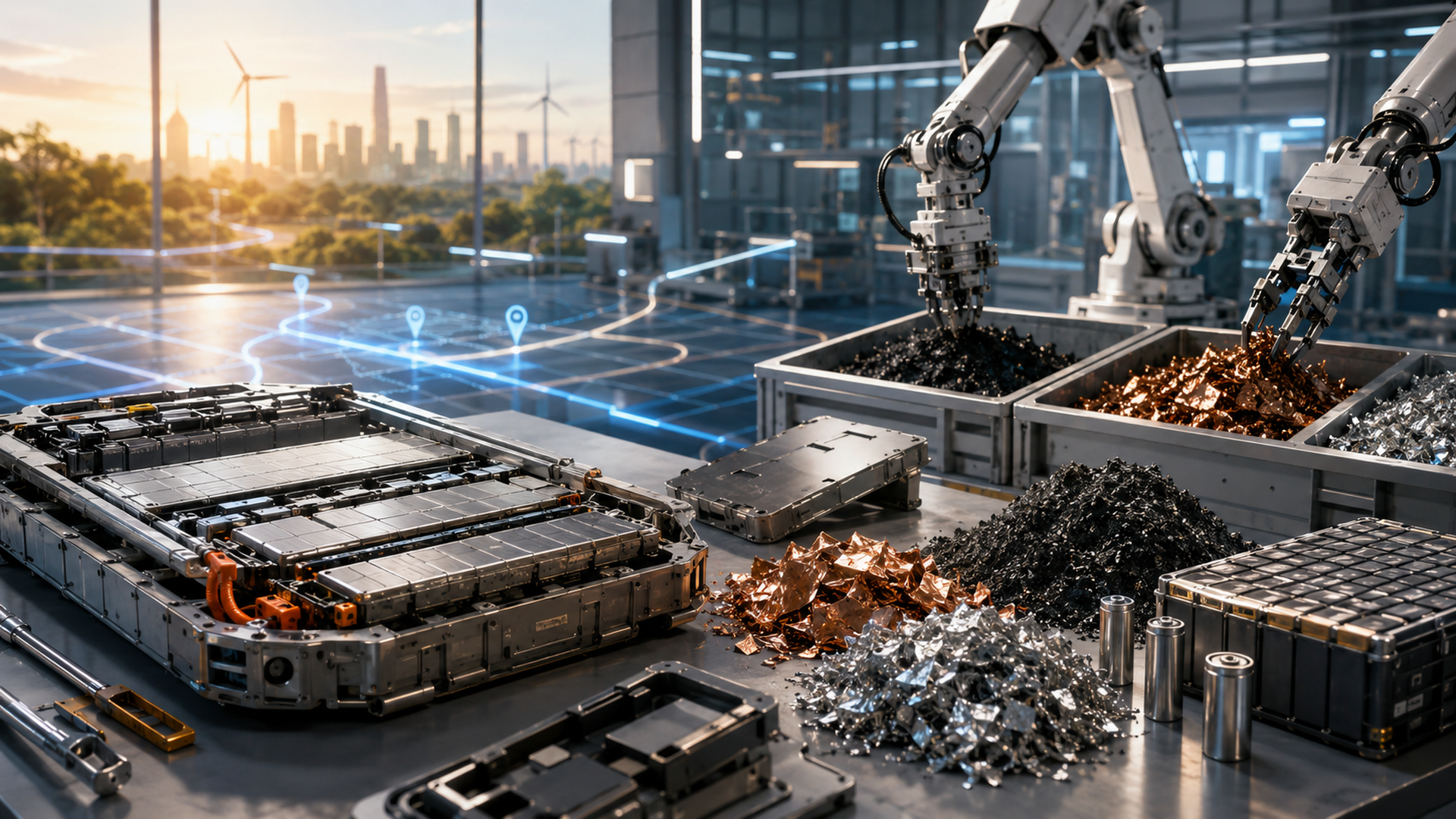
When discussing battery recycling, media loves to show robotic arms, black powder, smelting furnaces, chemical tanks, and shiny metals. These images are high-tech, but they answer only half the question: can technology recycle? The other half is more realistic: where retired batteries are generated, where recycling plants are located, how high transportation costs are, whether local processing capacity is oversupplied or insufficient, and whether different chemistries fit existing processes.
If large volumes of retired batteries appear in certain urban clusters while recycling capacity is deployed elsewhere, logistics distance, carbon emissions, and safety risks rise. If some regions overbuild recycling capacity, idle equipment becomes new industrial waste; if others lack sufficient processing capability, illegal disassembly, cross-regional transfers, and external environmental costs may emerge. The most ironic image of the circular economy is a supposedly low-carbon recycling system that, to send materials to inappropriate places, emits an extra circle of carbon.
The study notes that cross-provincial coordination can improve utilization rates but cannot fully eliminate spatial mismatches between retired battery supply and processing capacity. This matters greatly for policymakers: markets will not automatically place every recycling plant in the most rational location, nor does local investment promotion equal national efficiency. If each city tries to grab a "green high-tech recycling park," the outcome may not be circular economy but another round of redundant construction under the banner of low carbon.
III. Materials Science Is Starting to Step Out of Laboratories and Into City Maps
Traditionally, materials science focuses on chemical composition, reaction efficiency, purity, energy consumption, and recovery rates—these remain core. But battery recycling forces materials science out of labs and into city maps because material flows are not abstract curves; they are determined by roads, ports, warehouses, fire codes, local industrial chains, and policy subsidies.
Different battery chemistries have different recycling values and processing paths. Cobalt-, nickel-, manganese-, and lithium-containing batteries differ from lithium iron phosphate batteries in economic incentives and technical choices. If policy uses only one set of subsidies or a single capacity metric, it may encourage wrong investments. More nuanced governance should place chemistry, retirement timing, urban flows, recycling technology, energy structure, and carbon calculations on the same table. This sounds like an engineer's dream and an official's nightmare, but energy transition is never powered by slogans.
For Taiwan, this issue will soon become concrete. EVs, storage systems, electric scooters, electric buses, and electronic products will generate different types of retired batteries. With limited land, high population density, and concentrated industrial chains, establishing high-standard recycling, safe disassembly, material tracking, and cross-county coordination early could enable precise governance; waiting until retirement volumes surge may leave local authorities with only two options: protest or outsourcing.
IV. Mining Pressure Will Not Disappear Because EVs Are Clean
Another core meaning of battery recycling is reducing pressure on primary mineral extraction. Energy transition requires lithium, nickel, cobalt, manganese, graphite, and copper—materials often linked to mines, land, water resources, labor conditions, and Indigenous Peoples' rights. If a country drives zero-emission vehicles in cities while leaving mining pollution, land conflicts, and water stress to distant communities, that is not cleanliness; it merely relocates dirt to invisible places.
Recycling cannot fully replace mining—at least not in the short term—but efficient recycling can lower new extraction pressure, make material supply more resilient, and allow energy transition without betting entirely on fragile geopolitics and high-conflict mining zones. The Nature Sustainability study notes that supply-demand planning scenarios reduce emissions and improve lithium recovery. This is no small matter: lithium is not just a symbol on the periodic table; it is key to whether energy transition can avoid new wounds.
From Indigenous Peoples' and local environmental governance perspectives, battery recycling should be placed within broader "material justice" discussions. When cities enjoy new-energy convenience, where materials come from, where waste goes, and which places bear processing risks cannot be hidden behind supply chains. If circular economy only speaks beautifully at the consumption end while ignoring inequalities in mining and recycling ends, it easily becomes a high-end version of garbage classification propaganda.
V. Recycling Data Itself Is Infrastructure
To do battery recycling well, data is more important than imagined. If every large battery has clear passport information—including manufacturer, chemistry, capacity, usage history, health status, maintenance records, and recycling destination—back-end processing becomes safer and more efficient. Conversely, if retired batteries flow into the market as a pile of identity-unknown black boxes, recycling plants can only guess while disassembling, raising risks.
This is why battery passports, material tracking, and digital product ledgers are becoming new infrastructure for energy transition. They do not sound as sexy as battery breakthroughs but directly affect recycling efficiency and safety. Future competitive battery industries will compete not only on energy density but also on traceability, disassembly friendliness, repairability, and recyclable design. Designing a hard-to-recycle battery while claiming to support circular economy is like locking the trash can and praising people for rarely throwing away garbage.
VI. Energy Transition's Maturity Starts from Willingness to Handle the End
The most charming images of energy transition are solar panels, wind turbines, EVs, and smart grids; the least charming are retired equipment, waste materials, recycling plants, fire codes, and local environmental assessments. Yet whether a transition is mature depends on its willingness to handle the end. Policies that only showcase new equipment without planning exit routes will quickly turn low-carbon dreams into next-generation waste problems.
Battery recycling is not the end of environmentalism but the second front line of energy transition. It brings materials science, urban governance, mining ethics, industrial policy, and local environment to one table. True circular economy does not end when arrows are drawn in a circle; it must ensure materials truly return, risks truly decline, and those bearing costs are no longer always the same silent local communities.
If EVs are the stars of energy transition, retired battery recycling is the truth after makeup removal. Truth may not be pretty but deserves honest facing. After all, the next generation needs not only brighter batteries but an energy system that does not require forgetting to appear clean.
Sources retained from the Chinese original
AI use and content-safety disclosure
This article was assisted by AI for data organization, structural drafting, and sentence polishing; human editors set the viewpoint and fact-checking direction