When Phones Start Understanding Birdsong: Citizen Science's Ears Grow, and Errors Fly Further
Original Chinese title: 當手機開始聽懂鳥叫:公民科學的耳朵變大了,錯誤也跟著飛得更遠
Bird-identification apps are turning millions of smartphones into ecological sensor networks, but massive identification results lacking location, recordings, human verification, and bias control can amplify errors into seemingly precise natural maps.
鍾靜蓉
鍾靜蓉 is a doctoral researcher in digital education at National Taiwan University of Science and Technology, focusing on digital teaching strategies, technology-assisted learning, meta-data reasoning analysis, and human-computer interaction in education and public science.
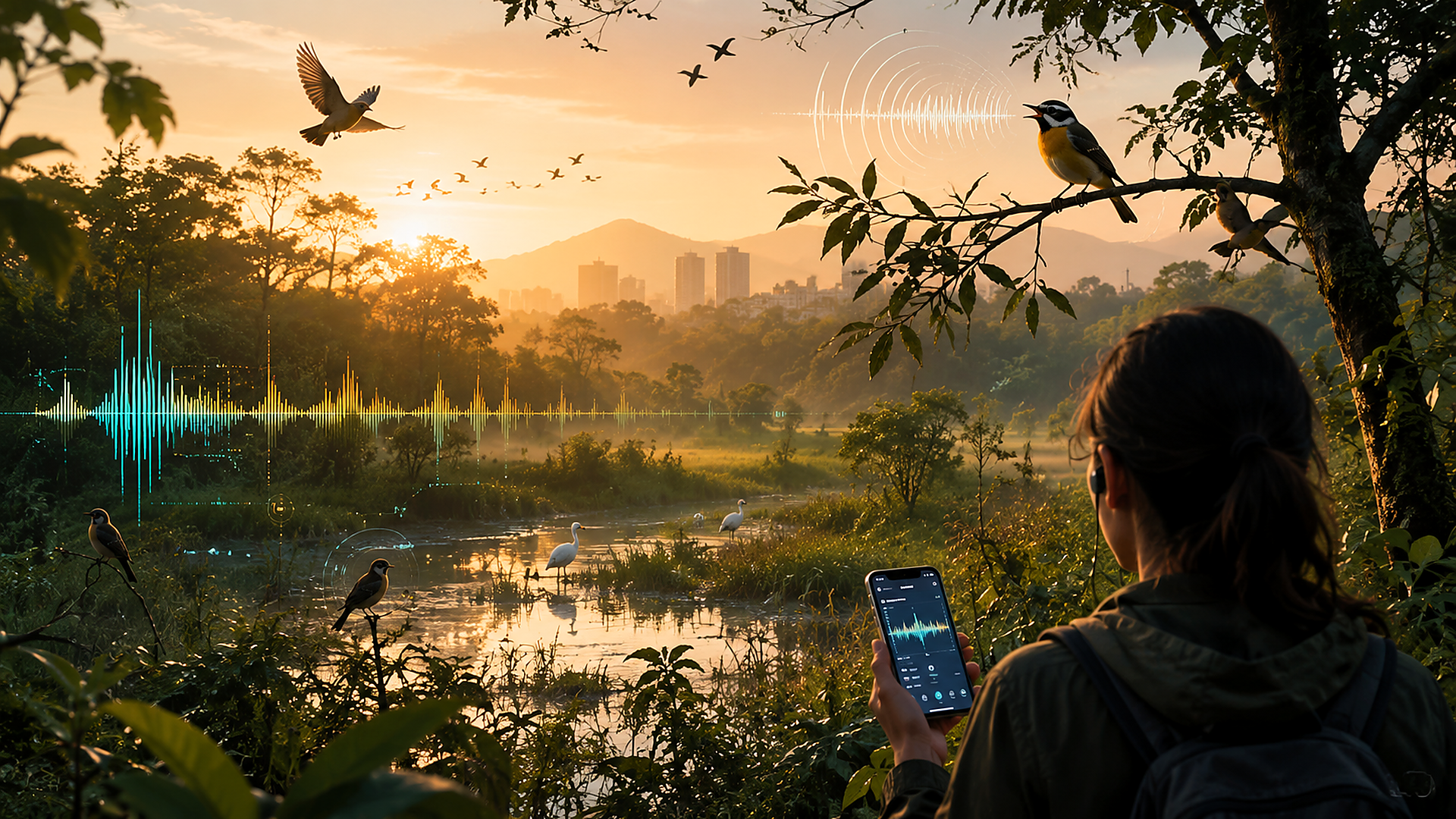
When Phones Start Understanding Birdsong: Citizen Science's Ears Grow, and Errors Fly Further
Walking into a forest and hearing bird calls without seeing the birds is one of the most common frustrations in natural observation. Now, opening your phone app instantly lists possible species; sound spectrograms scroll like a marquee, names and photos pop up quickly. This experience is fascinating: vague sounds suddenly get named, unfamiliar environments gain subtitles.
The popularity of bird-identification AI has indeed lowered barriers to nature observation. Beginners don't need to memorize field guides before paying attention to seasons, habitats, and species differences. When many users' observations enter citizen science platforms like eBird, they can supplement professional surveys in manpower, time, and space. In July 2026, Merlin Bird ID's sound recognition data will further link with the eBird biodiversity data system, sparking new imaginations about global citizen science scale.
But a phone identifying a name does not mean the forest has handed over its ID card. Models are affected by background noise, device microphones, overlapping calls, geographic range, season, and training data. Urban car sounds, streams, cicadas, wind, and human voices can distort spectrograms; different species may have similar calls, and the same species shows regional dialects, age, and context differences. Apps display probability judgments made by models based on existing data—not testimony signed by birds themselves.
The key of citizen science is therefore not 'everyone can identify' but 'everyone can leave observations that can be checked.' When convenient identification results start flooding databases, data quality governance must upgrade accordingly; otherwise we'll get a very precise, beautiful, and possibly confidently wrong natural map in some places.
Quantity Is Not Quality: Two Hundred Million Errors Won't Become Truth Because They're Big
Big data easily produces a political aesthetic: more points, brighter maps, real-time dashboards look more scientific. But ecological data is not social media likes. The value of observation records depends on time, location, method, effort, recordings, observer experience, and verifiability.
For example, one hundred bird-identification results at the same spot could mean one hundred birds or just one bird recorded repeatedly by one hundred tourists. A city park with huge data doesn't necessarily indicate rich species; it may simply be convenient to access, stable internet, many users. Remote mountains, private lands, military zones, night time, and bad weather have less data—not because there are no organisms, but because human smartphones rarely reach them.
If this 'observation effort bias' isn't corrected, models and policies reinforce each other. Data-rich places get identified more, studied more, listed for conservation; data-poor areas are judged low importance and lose survey resources further. In the end, we think we're mapping biodiversity but actually map human leisure routes, smartphone brand distribution, and cell tower signals.
Thus citizen science platforms need to retain original recordings, confidence scores, model versions, geographic ranges, and human verification status, allowing experts and communities to correct results. Errors aren't shameful; untraceable and uncorrected ones are terrifying. Scientific data maturity isn't about never making mistakes but knowing how errors get discovered, marked, and spread.
Bioacoustic AI's Breakthrough: Small-Sample Species Finally Get Heard
Traditional bioacoustic monitoring faces a cruel bottleneck: recordings accumulate easily, labeling is expensive. Sensors can record continuously in forests for months; researchers return to face thousands of hours of audio. Popular bird species have abundant data; rare frogs, insects, chicks, island species, or unnamed sounds often lack enough samples to train dedicated models.
The 2025 'Search for Squawk' project shows a more agile workflow: using pre-trained acoustic embeddings on large bird sound data, file indexing search, and active learning lets ecological researchers build new recognizers in shorter time. Cases include unknown coral reef sounds, Hawaiian chicks, and island birds occupying territories. The true value of this technology isn't just model speed but lowering barriers for small research teams and resource-poor regions to enter automated monitoring.
However, transfer learning brings new biases. Using bird models to understand frogs, insects, or coral reef soundscapes may work or not; it can force different ecosystems into existing feature frameworks. Models perform well in one region but may misfire after climate, dialect, or recording equipment changes. Researchers must publicly disclose test conditions, error types, and non-applicable ranges—not just average accuracy.
For Taiwan this is especially important. Island terrain, altitude gradients, monsoons, typhoons, cicadas, frogs, plus many endemic species and regional calls make local data unsuitable for relying solely on overseas models. Building open, graded-authorization, traceable local sound datasets will have longer-term value than simply buying a 'identify everything' API.
Recordings Capture Not Just Birds but People, Places, and Sensitive Species
Passive acoustic monitoring is often described as non-intrusive because it doesn't directly disturb animals like capture, banding, or close-range tracking. But 'not touching animals' doesn't mean no ethical issues. Sensors may also record human conversations, work sounds, ceremonies, private land activities, and identifiable locations. If devices are placed in Indigenous communities, farmland, trails, or community boundaries, data governance can't just ask for research permission; it must ask whether residents know about recordings, how long audio is kept, who can download it, and how human voices get identified.
Sensitive species locations need extra caution. Rare birds, nests, breeding sites—if instantly publicized—may attract photographers, poachers, or over-observers. Citizen science platforms usually blur coordinates for some species, but AI real-time recognition and community sharing are faster; users might upload precise locations, photos, and sounds to open platforms before official masking.
Soundscape in Indigenous traditional territories may also contain cultural meanings. Certain bird calls serve as seasonal indicators, hunting knowledge, taboo reminders, or parts of ancestral narratives—not just freely extractable training data. Research and platforms treating all sounds as 'natural resources' ignore knowledge rights and community consent. Two-Eyed Seeing doesn't reject technology; it demands scientific classification and local understanding coexist, with communities deciding what can be publicized and what only used in specific contexts.
AI Can Remind 'There Might Be Birds' but Cannot Alone Decide 'No Birds Here'
The most dangerous use of automatic recognition isn't occasionally misidentifying a bird; it's being used to prove absence of important species. If development units don't detect protected species during short-term monitoring, they may claim limited impact; but non-detection could stem from wrong season, equipment failure, model lacking regional calls, species not vocalizing then, or environmental noise masking.
Ecological surveys need to combine acoustic AI with visual observation, habitat assessment, seasonal timing, historical records, and expert interpretation. Models suit expanding screening, finding segments needing confirmation, analyzing long-term changes—but shouldn't become sole negative evidence. Especially in environmental impact assessments, conservation area adjustments, and engineering development, 'not detected' and 'does not exist' must stay clearly distinct.
Similarly, citizen science data can hint at trends but doesn't necessarily represent population numbers. Increased reports of a species could mean population expansion, better app recognition, more users, or observation fads. Good research incorporates platform changes into models rather than interpreting every curve as nature itself.
The Real Revolution Isn't Machines Understanding Birds—It's More People Willing to Listen
The most beautiful outcome of bird-identification apps may not be generating the world's largest database but stopping people who never cared about nature. When someone first realizes dawn window sounds aren't 'birds calling' but two or three species at different distances responding, their relationship with living space changes. Names aren't endpoints; they're entry points to attention.
But for attention to become public knowledge it must accept scientific discipline and ethical constraints. Users need to know identification results have uncertainty; platforms must provide corrections and data sources; researchers handle geographic, class, and equipment biases; policymakers can't treat app lists as complete ecological surveys; communities should decide how sounds, locations, and cultural knowledge get used.
AI enlarges human ears but doesn't automatically make judgments humble. The next stage of bioacoustics isn't pursuing a natural version of search engine that always answers instantly—it's building a public listening system that preserves evidence, admits errors, respects local knowledge, and says 'I'm not sure' when needed. Forests have never been silent; we just listened too little before. Now we listen more—and must be careful not to mistake our models for the whole forest.
Sources retained from the Chinese original
AI use and content-safety disclosure
This article was assisted by AI for data organization, structural drafting, and sentence polishing; human editors set the viewpoint and fact-checking direction