Unmanned Farm Machinery Does Not Remove Farmers from the Fields: Slope Smallholders Need Repairable, Shareable, and Refusable Automation
Original Chinese title: 無人農機不是把農民移出田裡:山坡小農需要的是可修、可共享、可拒絕的自動化
Smart agriculture often imagines large flat farms, but slope, small area, multiple crops and shared labor require different automation: smaller, safer, repairable, offline-capable, and allowing farmers to retain the right to refuse or take manual control.
Two-Eyed Seeing Lab
Co-authors: 王振庭
Two-Eyed Seeing Lab focuses on dialogue between science and technology, Indigenous Peoples, local communities and environmental knowledge; co-author 王振庭 is a Natural Science Education Teacher who has long been engaged in natural science, environmental observation and technology education.
I. In Smart Agriculture Promotional Videos, Fields Are Always Flat and Internet Coverage Is Always Full
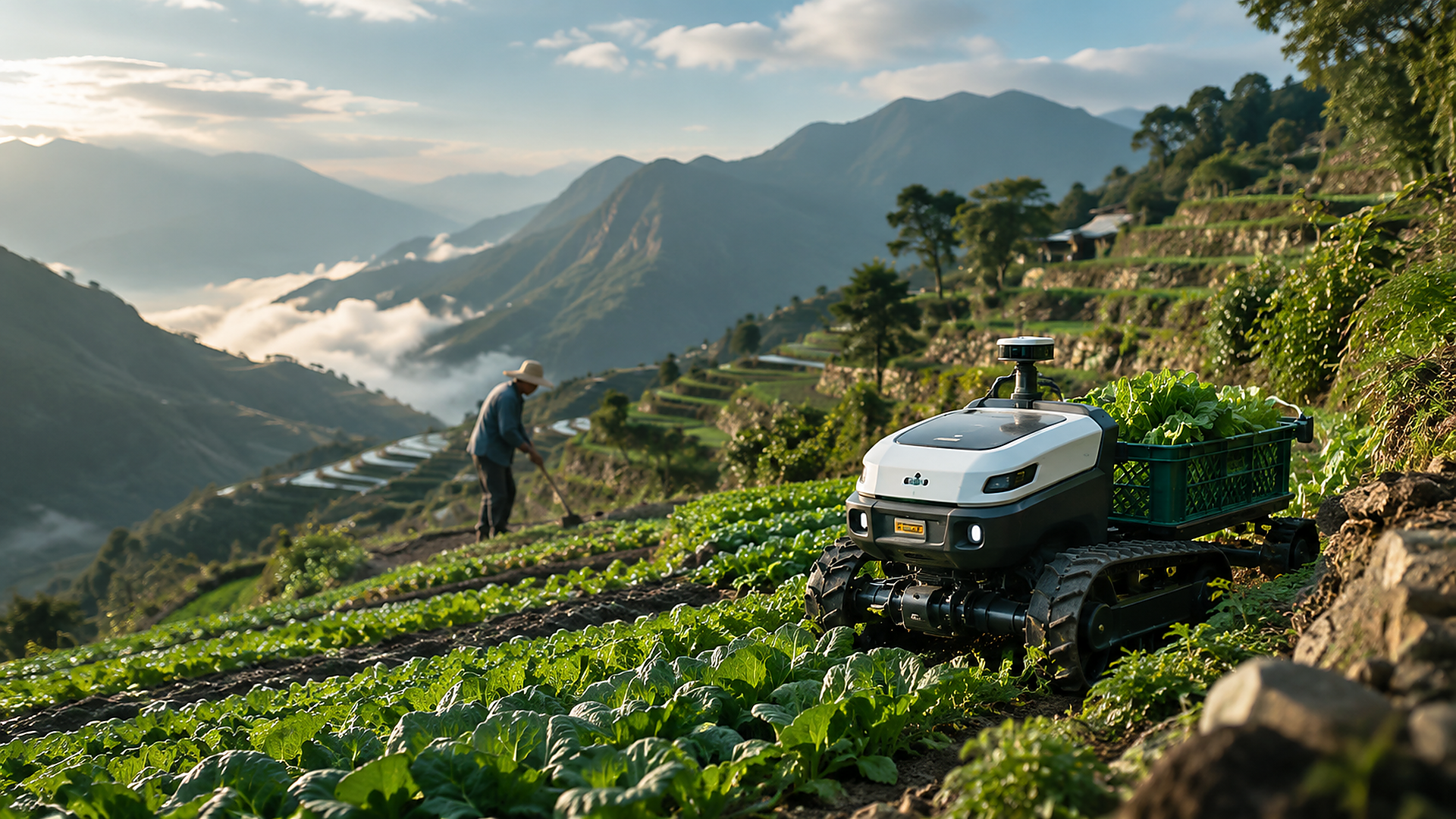
The typical image of agricultural robots is very futuristic: unmanned tractors move along straight furrows, drones spray evenly, robotic arms pick fruits of uniform size, and dashboard instruments draw beautiful curves of soil moisture, water content and yield. These systems are mostly designed for large-scale, standardized, high-investment farms. The problem is that many farmers work on small plots with mixed crops, uneven slopes, narrow roads, and unstable internet and repair resources.
Taiwan's mountainous areas and Indigenous township agriculture are especially so. Millet, red amaranth, coffee, tea, vegetables, spices and understorey crops may be scattered across terraces, slope lands, forest edges and irregular plots. Farming is not only about maximizing yield; it also involves rituals, family labor division, seed preservation, land care and seasonal knowledge. If systems designed for large monoculture farms are simply transplanted here, the usual outcome is not efficiency gains but machines that are too heavy, difficult to turn, sensors disturbed by fog and rain, ending up as the most expensive photo props in warehouses.
Therefore, slope smallholders do not need a "smaller version of the future"; they need a different technological philosophy. Automation should reduce danger and repetitive labor, not require farmland to be reshaped to suit machines. Machines must adapt to the landscape, not force the landscape to surrender to catalog specifications.
II. Agricultural Automation Should Reduce Hard Labor, Not Farmers' Judgment
The UN Food and Agriculture Organization defines agricultural automation as including not only fully autonomous robots but also mechanical and digital tools that improve diagnosis, decision-making or execution. This broader understanding matters because what smallholders most need may not be full unmanned operation; it could be electric transport, precise weeding, slope safety assistance, irrigation control, early pest and disease alerts, and simple image recording.
"Unmanned" is often treated as the highest form of progress, but agriculture is not a warehouse conveyor belt. Fruit ripeness, soil conditions, weather changes and local microclimates require experiential judgment. Mountain farmers know which slope sections cannot be entered by machinery after consecutive rains, recognize certain clouds and wind directions that signal afternoon thunderstorms, and understand why some fields must not receive the same treatment due to rituals or seed preservation. If systems treat such knowledge as non-standard human interference, they will delete the most important resilience.
Good automation should make farmers' decisions easier, not hide them inside supplier models. Interfaces must show reasons and uncertainties, allow manual override; equipment needs clear stop buttons and low-speed safety modes; operation must continue when data connections fail; model updates cannot suddenly change execution logic. True maturity of agricultural robots is not that they dare to walk alone in fields but that they know when to stop and wait for people.
III. Barriers to Smallholder Adoption Are Not "Lack of Tech Literacy" but Unreasonable Costs, Scales and Repair Systems
Tech policies often attribute low adoption rates to farmers' age, education or digital skills, as if more courses would make them willingly purchase systems. In reality, a farmer's refusal may be highly rational: equipment price exceeds annual income, subscription fees keep rising, parts can only be replaced by the manufacturer, sensor lifespans are short, data formats cannot be exported, or machines require cloud authorization to start.
For small plots, single-household purchase is often uneconomical. More viable models may involve cooperatives, agricultural associations, Indigenous community organizations or local service teams sharing equipment, billed by operating hours, area or seasonal tasks. Such "machinery-as-a-service" can lower thresholds but must avoid platform monopolies. If service providers control scheduling, pricing, farm data and repair rights, smallholders could shift from owning tractors to queuing for algorithms.
Right to repair is therefore central to agricultural resilience. Equipment should provide parts diagrams, maintenance manuals, diagnostic codes and reasonable supply years; common consumables must be obtainable locally; software cannot brick hardware if the company collapses. Local vocational schools, farm machinery shops and youth teams can be cultivated into a repair network rather than all faults waiting for urban engineers to remotely log in. A busy farming day is not an ordinary customer service ticket.
IV. Slope Environments Demand More from Machines Than Showgrounds Ever Could
Slope machines first face safety. Center of gravity, wheelbase, brakes, soil bearing capacity and side-slope stability differ from flat terrain. Mud after rain, fallen leaves, gravel and temporary water flows can mislead positioning and path planning. Tree crowns and mountain walls may block satellite signals; mobile networks are unstable in valleys; remote control is not a reliable backup.
Therefore, slope agricultural robots need multi-source positioning, low-speed torque, rollover detection, terrain constraints, near-range emergency stops and disconnection safety strategies. Equipment weight must be controlled to avoid soil compaction or damaging terrace slopes. Rather than pursuing a giant machine that does everything, modular small platforms should develop: transport, mowing, spot-spraying, image patrol or seeding modules swapped as needed; failures do not have to shut down the whole season.
Agricultural machinery must also face crop diversity. Large visual models are usually trained on uniform crops and ample light; when encountering mixed planting, weed coexistence, shading, different maturity colors and traditional varieties, recognition may drop. If systems only recognize commercial varieties, local seed sources become outliers in data. This is not just a technical issue but an agricultural biodiversity problem.
V. Data Cannot Automatically Grow Ownership from Fields
Smart farm robots collect location, plot, crop, growth, yield, pest and disease, fertilization and farming timing. These data can improve services but may also be used to assess loans, insurance, contract prices and land value. If farmers do not know where their data flows, they might unknowingly hand over production advantages, planting strategies and local knowledge to platforms.
Indigenous township agricultural data also involves collective rights. Traditional crops, seed sources, collection sites, seasonal indicators and ritual relationships cannot necessarily be uploaded after a single user's consent. System design must distinguish personal farm data, community-shared data and culturally sensitive data, providing local storage, tiered authorization and deletion mechanisms. If data are used to train models, feedback, benefit-sharing and model usage must be explained.
Two-Eyed Seeing is not converting elders' experience into a few dropdown menus. It requires engineering teams to enter local contexts before design, understanding which judgments can be quantified, which need oral and relational preservation, and which should never be public. Agricultural technology that only extracts knowledge without returning to the community is old-style resource extraction wearing sensor coats.
VI. The Future Is Not Farms Without Farmers but Farmers No Longer Forced to Fill System Gaps with Their Bodies
Labor shortages and aging are real issues. Transporting, spraying, mowing, night patrols and slope work can indeed harm bodies. If automation reduces exposure and risk, investment is worthwhile. But policy should not package all problems into machine procurement. Labor shortages may also stem from low agricultural income, difficulty acquiring land, lack of youth housing and care support, and production systems that leave risks with producers.
Recent international agricultural AI and robot training programs emphasize talent development; this is a necessary step. Yet true capacity building cannot only train people who operate expensive equipment; it must also cultivate those who can assess suitability, repair, modify, manage data and negotiate service contracts. Local communities need technological subjectivity, not forever waiting for the next subsidy to replace machines.
Smart agriculture suitable for slope smallholders can be advanced yet may not look most sci-fi. It might be a cart that two people can carry, works offline, has open parts, moves slowly but rarely tips; it could be a sensor network jointly managed by an Indigenous community; or simply letting farmers carry twenty kilograms less, inhale pesticide once less, and complete transport before torrential rain. The value of technology lies not in removing people from images but in ensuring they no longer need to fill agricultural system gaps with pain, risk and unpaid labor.
The endpoint of unmanned farm machinery should not be unmanned rural areas. A truly resilient future is where farmers still decide how land is cared for, and machines know themselves as tools, not landlords.
Sources retained from the Chinese original
AI use and content-safety disclosure
This article was assisted by AI for data organization, structure drafting and sentence polishing; human editors set the viewpoint and fact-checking direction