Cities Cannot Rely on Air Conditioning Alone: How Radiative-Cooling Materials Turn Roofs into Surfaces That Radiate Heat to the Sky
Original Chinese title: 城市不是只能靠冷氣續命:輻射冷卻材料如何把屋頂變成向天空散熱的表面
Air conditioning moves indoor heat outdoors and drives up peak electricity demand. Passive daytime radiative cooling, cool roofs, and highly reflective materials can turn building envelopes into heat-management interfaces, but no bucket of white paint is a complete solution. This article examines the science, limits, and urban-governance implications.
Yuan Media AI Editorial Desk
An interdisciplinary editorial team covering artificial intelligence, science, public policy, and questions of civilization, with an emphasis on evidence-based scrutiny of technology narratives and policy slogans.
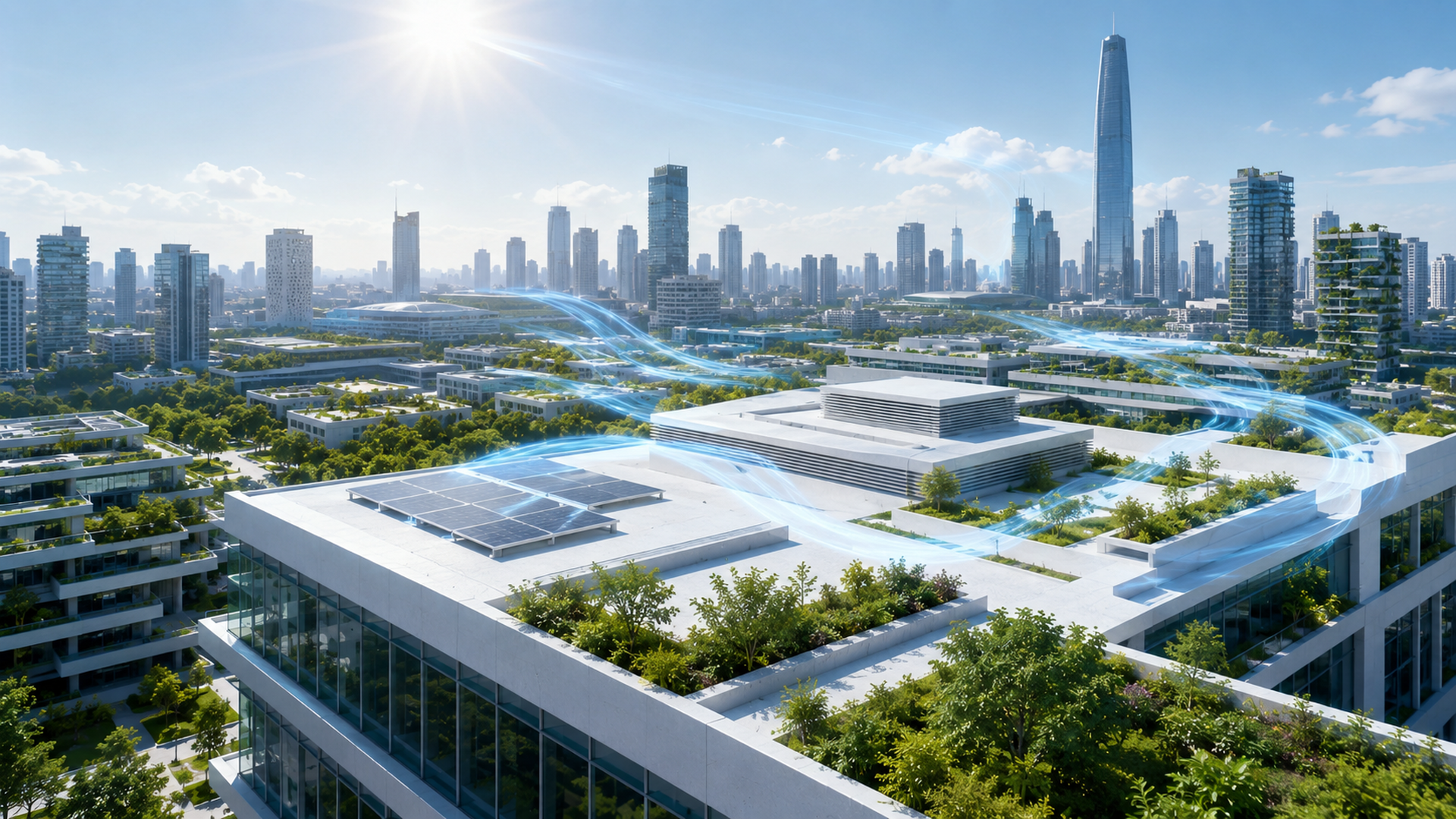
# Cities Cannot Rely on Air Conditioning Alone: How Radiative-Cooling Materials Turn Roofs into Surfaces That Radiate Heat to the Sky
When heat waves strike, a city's instinctive response is to turn up the air conditioning. Indoor temperatures fall, but outdoor units discharge heat into the streets; peak electricity demand rises and places greater strain on the grid; and people without air conditioning—including residents of top-floor units and older homes, as well as those who work in high-heat environments—remain at greater risk. It is as if a building were running a fever while everyone simply pushed the heat into the next room.
Air conditioning is essential and can save lives during extreme heat. The problem begins when it becomes a city's only cooling strategy: buildings are allowed to absorb large amounts of solar energy, and electricity is then used to move that heat elsewhere. Materials science points to another approach. What if roofs, exterior walls, windows, and public facilities were designed from the outset to absorb less sunlight and release their own heat more effectively?
Passive daytime radiative cooling, cool roofs, highly reflective coatings, and smart-window materials all address that question. They need not look futuristic; they may be no more conspicuous than an ordinary surface. Yet some of the most consequential urban technologies emerge not from adding another illuminated device, but from enabling a material to store less heat during a heat wave.
Releasing Heat to the Sky Sounds Like Science Fiction, but It Is Thermal Radiation
Every object above absolute zero emits thermal energy as electromagnetic radiation. At temperatures typical of the Earth's surface, most of that radiation is infrared. The atmosphere is comparatively transparent within a particular range of infrared wavelengths known as the atmospheric window. A material with high solar reflectance and strong thermal emittance at suitable infrared wavelengths can therefore shed heat toward the colder sky, even in direct sunlight.
This is the principle behind passive daytime radiative cooling. It does not mean that a material simply “throws heat into space” and solves the entire problem. Its optical properties instead reduce the solar energy it absorbs while increasing the thermal energy it emits. Foundational studies have demonstrated below-ambient cooling in direct sunlight, and later research has explored porous polymers, ceramic particles, barium sulfate coatings, fiber membranes, and tunable structures.
This can sound like a contest to produce the “whitest white.” Cities, however, are not pristine laboratory samples. The relevant question is not merely which material achieves the best reflectance measured to another decimal place. It is whether that material can be installed at scale, withstand weathering, remain clean, be repaired, stay affordable, and continue to function in humid, rainy, dusty, and polluted environments.
Cool Roofs Are Not New, but “White” Comes with Social and Physical Conditions
Cool roofs generally combine high solar reflectance with high thermal emittance to lower roof temperatures and reduce the heat entering a building. The benefits can be especially direct for top-floor homes, warehouses, schools, and buildings with large flat roofs. The U.S. Environmental Protection Agency has long identified cool roofs as one way to mitigate urban heat islands while noting that results vary with climate, building form, material aging, and winter heating needs.
Maintenance is frequently overlooked. A new coating may look brilliantly white in a test, then accumulate dust, oil, algae, and industrial particles within months. As reflectance declines, so does performance. A policy that pays only for the initial application, without funding inspections, cleaning, and recoating, risks turning urban cooling into a one-time photo opportunity.
Glare and urban appearance also matter. A highly reflective surface in the wrong location may direct intense light toward neighboring buildings, roads, or pedestrians' sightlines. A material suitable for a roof may not suit a wall, and a solution designed for a hot climate may carry winter heating trade-offs in a cold one. Effective heat adaptation does not mean painting an entire city the same shade of white; it requires attention to orientation, season, humidity, building use, and neighborhood conditions.
Radiative Cooling Is Neither an Air-Conditioning Replacement nor Climate Magic
Technology coverage often presents new materials as “air-conditioning free” or “zero-energy cooling,” as though a bucket of paint could make a heat wave surrender. In practice, clouds and atmospheric humidity affect radiative cooling; high humidity can reduce infrared transparency. Buildings also contain heat from occupants, equipment, lighting, and ventilation. If windows admit excessive solar heat or the roof is poorly insulated, one surface material cannot repair the entire building.
More importantly, these materials can reduce surface temperatures and part of a building's cooling load, but they cannot guarantee safe indoor temperatures in every setting. Hospitals, long-term care facilities, data centers, tightly sealed homes, and people at elevated risk still need active cooling. Presenting passive cooling as a substitute for air conditioning can distort policy priorities and create danger during heat waves.
The sound approach is to reduce avoidable heat first, then use less energy to manage what remains. Shading, insulation, natural ventilation, nighttime heat purging, tree cover, permeable surfaces, green roofs, cool roofs, smart windows, and efficient air conditioning should operate as a layered package, not compete for the role of a single technological hero.
Cities Do Not Lack Miracle Materials; They Lack Heat Governance
If high-performance cooling materials appear only on new luxury housing, technology parks, and signature buildings, they may reduce energy bills in a few places without addressing a city's most severe heat risks. Heat exposure often concentrates in neighborhoods with little shade, aging housing, many renters, substantial outdoor work, and limited public resources. Without deliberate distribution, cooling technology can produce a distinctly contemporary inequity: those who most need relief remain hot, while those best positioned to secure subsidies are first to turn their roofs white.
Cool-roof programs should therefore connect with heat-vulnerability maps, improvements to social housing, priority treatment for schools and care facilities, demonstrations on public buildings, landlords' repair obligations, and electricity assistance. Governments also need performance data, weathering tests, installation standards, and field monitoring, rather than relying solely on a material's best laboratory result.
Satellite observations and land-surface-temperature data can help identify hot spots, but remote-sensing images are not a complete account of risk. A high surface temperature does not necessarily mean that people there experience the greatest heat stress; shade, wind, humidity, indoor ventilation, and patterns of human activity all shape exposure. Heat governance must bring materials science, building design, public health, and social policy to the same table.
Releasing Heat to the Sky Still Requires a Full Environmental Ledger
A cooling material is not sustainable merely because it consumes no energy while operating. Assessment must also cover raw-material extraction, manufacturing energy, adhesives and solvents, worker safety during installation, service life, cleaning needs, particles shed through peeling or wear, and end-of-life disposal. Some highly reflective components may be costly or carry substantial environmental burdens, while novel films that perform impressively in the laboratory may not be suitable for construction at scale.
A technology with genuine public value should be able to answer five questions: Can it be mass-produced? Will it withstand the local climate? Can ordinary construction crews install it correctly? Can it be inspected and maintained? What remains when it reaches the end of its useful life?
A material that stays pristine only in a research photograph may represent good science without yet making good policy. If it can reliably reduce heat loads on schools, corrugated-metal-roofed factories, remote clinics, and older apartment buildings—and if costs and maintenance arrangements are transparent—it begins to function as urban infrastructure.
Conclusion: Air Conditioning Saves Lives in Emergencies; Materials and Design Reduce the Emergencies We Create
Cities should not demonize air conditioning. Extreme heat poses real health risks, and access to safe cooling is a public-health necessity. But cities should also reject a complacent model in which dark roofs, glass curtain walls, and unshaded streets absorb immense amounts of heat before each household is expected to buy its own air conditioner.
Radiative-cooling materials remind us that building surfaces are not passive skins; they are interfaces for heat exchange. Cool roofs show that inexpensive, mature measures can produce substantial benefits. Smart windows and adaptive materials suggest that future buildings need not maintain identical thermal behavior throughout the year.
Governance ultimately determines whether these measures succeed: who benefits first, who pays for maintenance, who monitors performance, and who remains in an unsafe room during a heat wave. Technology can help roofs radiate heat to the sky; policy must ensure that cities do not cool only for those with the most resources.
Sources retained from the Chinese original
- U.S. Environmental Protection Agency | Using Cool Roofs to Reduce Heat Islands
- Raman et al., Nature | Passive Radiative Cooling below Ambient Air Temperature under Direct Sunlight
- Li et al., ACS Applied Materials & Interfaces | Ultrawhite BaSO4 Paints and Films for Remarkable Daytime Subambient Radiative Cooling
- UN Environment Programme | Global Cooling Watch 2023
AI use and content-safety disclosure
AI assisted with data organization, structural drafting, and sentence-level editing. Human editors determined the perspective and direction of fact-checking.