The Moon Needs Standard Time: When a Second Becomes Space Infrastructure and Geopolitics
Original Chinese title: 月球也要有標準時間:當一秒鐘開始變成太空基礎建設與地緣政治
As lunar bases, communication networks, and autonomous systems take shape, 'lunar standard time' moves beyond romantic speculation to become a foundational infrastructure issue that navigation, communications, law, and geopolitics must address.
Lawrence Lee | Technology Journalist, Science Fiction Critic, and Space Science Educator
Long-term focus on space policy, science fiction narratives, and science education; skilled at translating complex technology issues into public cultural and civilizational questions.
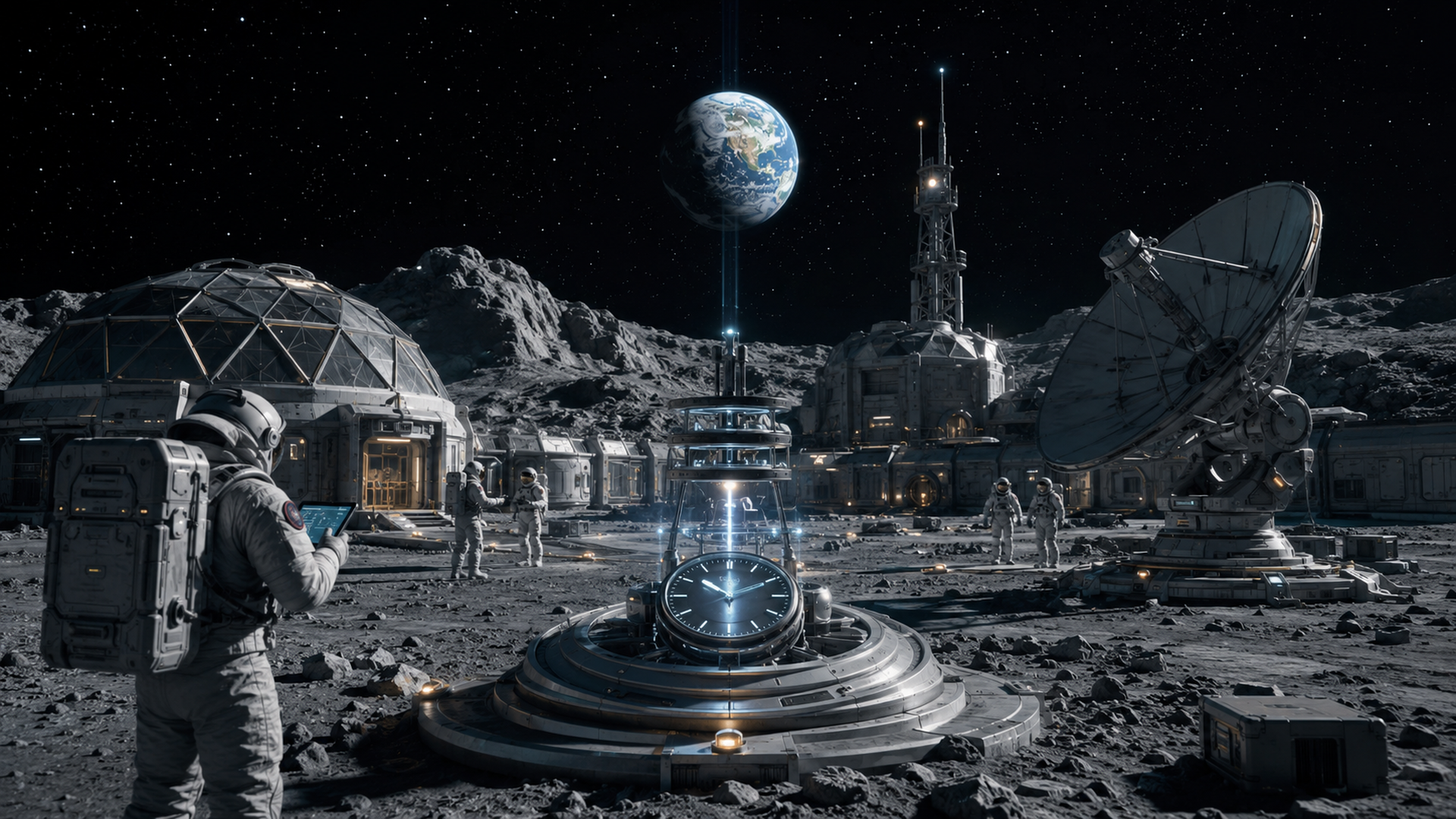
We rarely treat 'time' as infrastructure. On Earth, when you open your phone, computer, navigation system, or trading platform, time seems to be there by default, like air. But when humanity pushes its sights from low Earth orbit toward the Moon, this taken-for-granted assumption begins to fail.
The Moon is not a suburban extension of Earth; it is not a new development zone that can be managed simply by zooming in on the map. As lunar missions shift from flag-planting and sampling to symbolic landings toward long-term habitation, communication networks, energy systems, autonomous robots, and international cooperation, a seemingly literary but actually hard-core question surfaces: what time should the Moon use?
You can think of it as the space version of 'what time is it now,' but do not be fooled by the problem's cute surface. Behind it lie navigation synchronization, communication alignment, equipment coordination, mission logging, legal liability, and international order. Without a shared operational time standard, machines, bases, landers, and orbiters on the Moon would be like project management meetings where everyone has their own spreadsheets but no common clock. In space this is not an administrative nuisance; it is real risk.
Why Can't the Moon Just Use Earth Time?
The first intuitive answer: just adopt UTC universally? The problem is not that simple. Coordinated Universal Time on Earth is indeed a crucial foundation for cross-regional collaboration, but the Moon's physical environment, gravity conditions, and motion reference frame cause subtle yet non-negligible differences in how precise clocks operate and synchronize. For everyday life, tens of microseconds may seem trivial; but for navigation, positioning, landing, and high-precision communications, such discrepancies accumulating over time can lead to misalignment, latency, or interpretation errors. As mission density increases, this becomes not just an academic question but a systems engineering problem.
More critically, the Moon's future will involve missions from multiple nations, not just short-term operations by a single country. The United States' Artemis program, Europe's lunar communication and navigation concepts, Japan, India, and other countries' lunar plans are all moving lunar activities from national showcases toward industrial and institutional competition. As participants increase, coordination costs rise; once coordination costs become significant, common standards turn into sources of power. This is a recurring theme in the history of technology: standards appear neutral but often determine who becomes the hub.
How Does One Second Become Geopolitics?
When people discuss space geopolitics, they often focus on rockets, rare resources, orbital militarization, or helium-3 in lunar regolith. These are certainly important, but more foundational battlegrounds are quieter and even more critical: who defines the standards? Whose systems become interoperable references? Whose protocols are tacitly accepted as reasonable? From the Internet to satellite navigation to telecommunications specifications, history repeatedly shows that those who control standards may not be the loudest, yet they often wield the most long-term influence.
Lunar time is precisely such an issue. On the surface it is technical coordination; in reality it is a design of order. If future lunar bases need to share data, allocate energy, schedule robots, cross-check emergency alerts, or even conduct commercial transactions, all records must carry timestamps. When disputes arise, whose time standard is recognized places that party closer to the judge's seat. This is not conspiracy theory; it is institutional engineering. You can put it poetically: future lunar competition is not just about who arrives first, but who gets to define 'simultaneity.'
Lunar Time Is Not a Clock Problem, It Is the Skeleton of the Entire System
From an engineering perspective, lunar standard time relates to at least three layers. The first layer is navigation. Whether it's landers, rovers, orbiters, or surface-moving equipment, all require highly consistent time references for position estimation and signal correction. The second layer is communication. Between Moon and Earth, between the lunar surface and orbit, and among different devices, synchronization mechanisms are needed to reduce latency and error. The third layer is governance. Mission logs, device permissions, accident liability, and international cooperation agreements all depend on a time system that can be jointly recognized.
If we imagine the future Moon as a city under construction, then time is the 'invisible road' beyond water and electricity. You do not normally sing its praises, but without it everything that appears advanced will stall. This explains why governments like the United States and related space agencies have recently begun publicly discussing the necessity of lunar time, and why Europe's aerospace community continues to debate lunar communication and navigation services. The question is no longer 'whether to discuss' but 'who leads, how to integrate, and when to implement.'
Science and Civilization Are Tied Together Again on the Moon
I find this topic particularly compelling because it reveals that space exploration has never been just about rockets. When we talk about lunar time, we are actually discussing a larger matter: how civilization translates abstract concepts into coexisting orders. Time has always done this in human history. Agricultural civilizations used calendars to schedule farming; the age of navigation used precise timing to improve longitude determination; industrialization standardized time for railways and factories; the digital era relies on network time protocols and atomic clocks to support global transactions and data flows. The space age simply extends this historical line outward.
But extension does not mean romance. It also means we must address institutional issues earlier, rather than waiting until commerce, military interests, and international competition have already crowded the Moon before taking remedial courses. One of humanity's biggest flaws on Earth is that we tend to rush ahead—first occupy, first deploy—and only later discover that standards, rules, and governance frameworks are far more difficult than imagined. If the future Moon truly becomes a multi-actor space, then time standards should be treated as pre-governance rather than post-hoc patchwork.
A Good Standard Is Not a Unilateral Command from One Country
Here we must also beware of another trap: mistaking 'need for standards' for 'can be decided unilaterally by the strongest.' Of course, in reality those with capacity to push standards are often the resource-rich players; but if lunar governance lacks transparent negotiation and international interoperability from the start, future trust costs will be extremely high. If a time system is built as an appendage of one country's technical ecosystem, it may land quickly but will not necessarily become a truly stable common framework.
The more ideal direction is to let time standards simultaneously satisfy scientific precision, engineering feasibility, and international interoperability. In other words, they must be verifiable, usable, and acceptable. This mirrors our expectations for public infrastructure on Earth: just because someone erects a tower in their yard does not automatically make it everyone's road. If space governance wishes to avoid repeating old colonial logic, it must preserve more open discussion and institutional design space during standard formation.
Asking Time on the Moon Is Really Asking How We Will Cooperate in the Future
The most fascinating aspect of lunar standard time is that what appears to be a scientific question about one second actually reflects the entire cooperative order. How you define, calibrate, synchronize, and recognize time ultimately returns to a very Earthly, very human question: how do we build trustworthy collaborative relationships in shared space? This makes lunar time a kind of civilization test. It does not ask who can recite physics formulas; it asks who understands that infrastructure, policy, industry, and public order are inseparable.
So next time you hear 'the Moon also needs standard time,' do not treat it as sci-fi trivia. That is not just space enthusiasts' self-amusement; it is the underlying condition for whether future lunar society can function. Someday in the future, when bases on the Moon turn on lights, vehicle convoys depart, machines coordinate, emergency alerts are issued, and international mission handovers occur, they may silently rely on today's seemingly abstract discussion. At that point we will understand more clearly: some historical turning points are not struck out with war drums but quietly begin with a clock precise to microseconds.
Sources retained from the Chinese original
AI use and content-safety disclosure
This article was assisted by AI for data organization, structural drafting, and sentence polishing; human editors set the viewpoint and fact-checking direction