No Cow in the Factory, Yet Milk Protein Is on the Menu: How Precision Fermentation Is Rewriting Food Identity
Original Chinese title: 牛沒有出場,乳蛋白卻上桌了:精準發酵正在重寫食品的身分證
Precision fermentation enables microbes to produce milk proteins, fats, and functional ingredients, but the real competition lies not only in laboratories but also in naming, labeling, allergens, regulatory frameworks, and public scientific literacy.
鍾靜蓉
鍾靜蓉 holds a doctorate in digital education from National Taiwan University of Science and Technology. Her work focuses on digital teaching strategies, technology literacy, meta-data reasoning, and public understanding of emerging technologies.
How Can Milk Protein Appear Without a Cow?
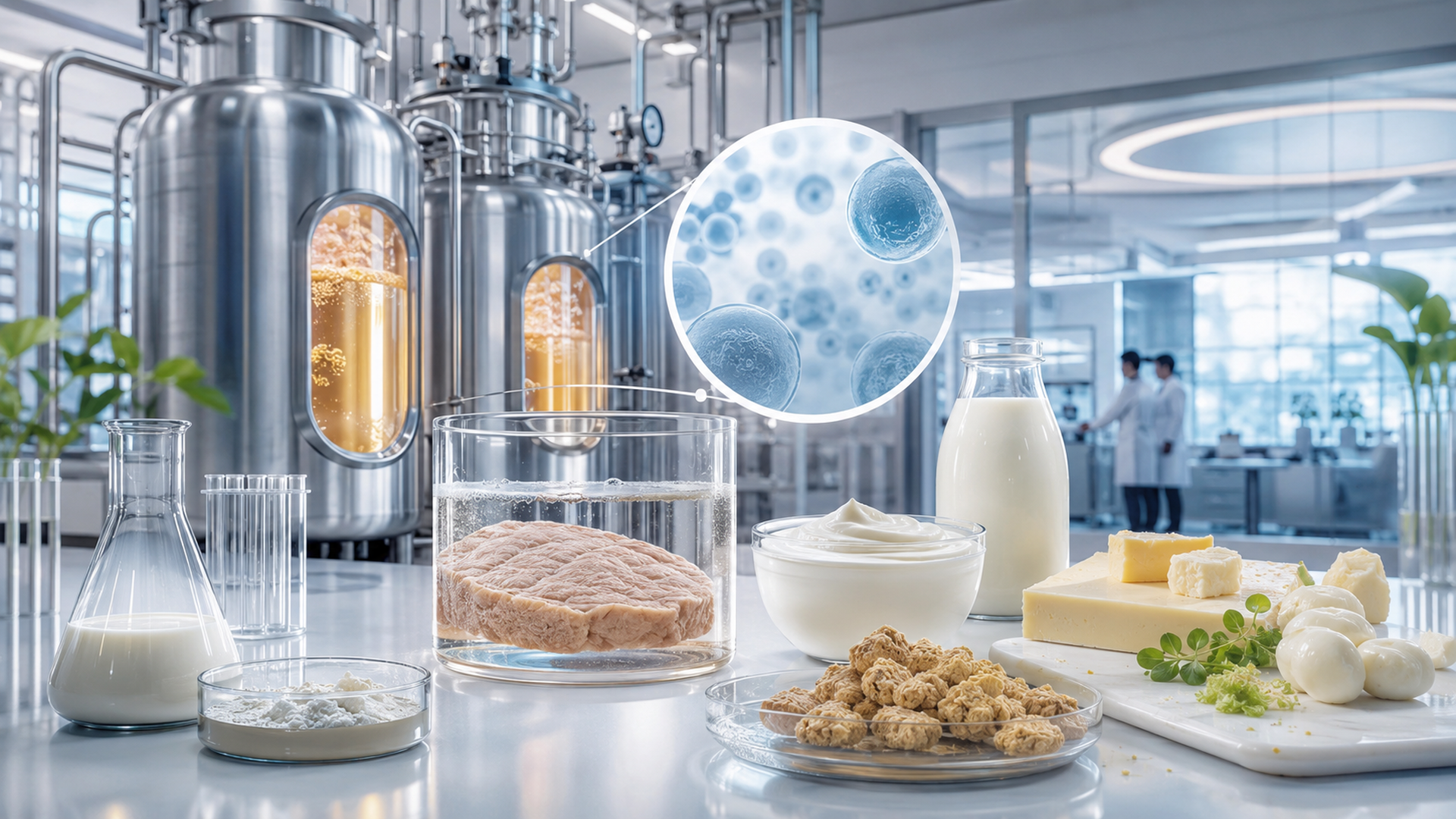
Humans have relied on fermentation for millennia. Soy sauce, bread, wine, yogurt, and pickles all depend on microorganisms to transform ingredients. Precision fermentation is more directed. Producers first select a target molecule, then use engineered or screened microorganisms to make it in a bioreactor. The target might be whey protein, casein, a particular fat, an enzyme, an aroma compound, or a nutrient. After fermentation, the desired component is separated and purified for use in a food formulation. It may perform a function similar to an animal-derived ingredient even though no animal takes part directly in production.
The result can sound like a culinary magic trick: no cow enters the factory, yet milk protein reaches the table. Behind the illusion are molecular biology, fermentation engineering, purification, quality control, and regulatory documentation. The difficult part is not merely producing a protein. It is showing that the ingredient remains stable and safe at commercial scale and that the market understands what it is. From the standpoint of digital education, the subject is also a test of scientific literacy: can society distinguish the unfamiliar from the unsafe, and a technology narrative from evidence?
“Artificial Food” Does Not Explain Precision Fermentation
Public debate often divides novel foods into “natural” and “artificial.” The categories are convenient and analytically weak. Modern food already depends on breeding, processing, enzymes, purification, and formulation. The useful questions concern transparency about ingredients, production, risk, nutrition, environmental effects, and labeling—not whether a product looks natural enough. Precision fermentation also differs from cultivated meat. Cultivated meat grows animal cells with the aim of producing muscle, fat, or tissue; precision fermentation generally uses microorganisms to manufacture particular components. Both are forms of emerging biomanufacturing, but their safety assessment and process controls differ. Collapsing them into one category of “lab-grown food” gives consumers an emotional cue rather than an explanation.
Industry should likewise resist selling precision fermentation with slogans such as “exactly the same” or “greener.” Even where a molecule has the same or a closely similar structure, the finished formulation, processing conditions, and nutritional performance may differ. Environmental outcomes depend on energy sources, feedstocks, factory efficiency, purification, and transport. Precision fermentation may reduce some land use and reliance on animals; it does not receive an automatic certificate of permanent sustainability. Binary stories are poor science education and poor food communication. When expectations fail, myths ultimately leave the public less willing to trust technology.
Food Safety Covers the Entire Production Process
Safety assessment cannot stop at the final protein. Regulators need to consider the production organism, genetic construct, growth medium, fermentation conditions, purification, residues, contamination control, consistency between batches, and intended use. An ingredient used in infant food, sports nutrition, or an ordinary beverage will involve different exposures and contexts. Consumers reasonably ask, “What exactly am I eating?” Regulators must also ask, “How can we show that every batch follows the same risk controls?”
Allergens are an especially important example. If a microorganism produces a protein identical or highly similar to a cow’s-milk protein, someone with a milk-protein allergy may still react. The absence of a cow from the process does not mean the absence of dairy-related allergen risk. Labeling therefore cannot be governed by marketing language alone. Regulators must also distinguish the production strain from the finished ingredient. Consumers usually eat the separated component, not the microorganism itself, but the manufacturer still has to demonstrate effective purification, impurity control, and the absence of unwanted process residues. Safety is not the phrase “the same as nature.” It is a verifiable chain of evidence.
Naming Is a Costly Battle Disguised as Semantics
Once a novel food enters the market, some of the fiercest disputes move to the front of the package. May it be called milk or cheese? Should it say “animal-free milk protein,” “fermentation-derived milk protein,” or use an entirely new name? Naming affects market classification, shelf placement, consumer expectations, and the interests of established industries.
Traditional dairy producers worry that new products may borrow familiar names without meeting the same production standards. Startups argue that banning familiar terms makes functionally similar products harder to understand. If governments regulate only through prohibited words, essential information can be relegated to tiny print on the back. If they impose no constraints, marketing departments may turn the word “precision” into an unsupported guarantee of scientific authority.
A more useful approach lets the product name, production source, allergen warning, and nutrition information work together. Within seconds, consumers should be able to tell what the component is, how it was made, whether it contains proteins associated with dairy allergy, and how it differs from conventional products. Transparent labeling need not reproduce a technical dossier on the package, but it cannot substitute a reassuring green-leaf graphic for material information. Good public communication does not patronize consumers; it makes important facts visible and intelligible.
Costs Will Not Fall as Neatly as a Presentation Slide Suggests
Precision fermentation is often described by a cost curve that falls rapidly as production scales. That may occur, but biomanufacturing is not software copied to more servers. Bioreactors require sterile operation, feedstocks, energy, agitation, oxygen, cooling, and downstream purification. At scale, mixing, mass transfer, and contamination can become more difficult. Food ingredients also sell at lower prices than most pharmaceuticals. A drug manufacturer may be able to absorb expensive purification; a food producer faces per-kilogram costs and a mass market. Products requiring exceptional purity, costly media, or large amounts of energy can lose their apparent advantage.
Startups understandably showcase success in small bioreactors. Investors should also ask about yield per batch, cleaning time, energy demand, and wastewater at commercial scale. This is not an argument against the technology; it is a reminder that biology is not frictionless software. Microorganisms grow and mutate. Factories suffer contamination and shutdowns. The least precise part of precision fermentation may be its commercial forecast. Education about the field should therefore show how technology, cost, regulation, and consumer psychology constrain one another.
Environmental Claims Need a Full Lifecycle
Precision fermentation may reduce demand for pasture, some greenhouse-gas emissions, and the use of animals, but the actual result depends heavily on production conditions. Benefits may shrink if a plant runs on carbon-intensive electricity, obtains feedstocks from input-intensive agriculture, or relies on energy-heavy purification. They may grow when the producer uses low-carbon energy, improves conversion efficiency, and finds productive uses for by-products. Companies publishing environmental figures should therefore state their system boundaries. Do they count only fermentation inside the plant, or also feedstock cultivation, equipment, purification, packaging, and transport? Is the comparator an efficient dairy farm, a global average, or a worst case? A favorable baseline can make any technology look like a winner.
Public policy can require consistent lifecycle-assessment methods and encourage independent review. Environmental claims without transparent methods become another form of packaging rhetoric. This is where meta-data reasoning matters: readers must look beyond the headline number and ask where the data came from, who selected the baseline, which variables were excluded, and whether uncertainty was reported honestly.
Taiwan’s Opportunity Is Larger Than a Vat of Protein
Taiwan has capabilities in fermentation, food processing, biotechnology manufacturing, equipment, and supply chains that could support a precision-fermentation industry. A policy focused only on subsidizing startup prototypes, however, would neglect the longer-term foundations: pilot-scale facilities, management of food-grade strains, testing methods, regulatory expertise, consumer communication, and access to international markets. Small and medium-sized enterprises may be unable to build complete fermentation and purification lines on their own, making shared pilot facilities important. Academic research should incorporate regulation and scale-up early rather than discovering after publication that a material is unsuitable for food use or uneconomic to manufacture.
Regulators also need to make application pathways clear so that companies do not test public patience by launching in a gray area and explaining later. Taiwan need not pursue milk protein alone. Local fermentation strains, specialized enzymes, flavor compounds, uses for plant by-products, and nutrition for older adults may fit local industry better. What is fashionable internationally should not be mistaken for the only viable answer at home.
Precision fermentation is changing not only food ingredients but the basis on which food identity is judged. People have traditionally understood food through farms, animals, and crops; more ingredients may soon be produced through cells, microorganisms, and bioreactors. That is neither inherently better nor inherently worse, but it demands stronger institutional explanation. Consumers are not necessarily opposed to technology. They often resent being treated as though they have no need for detail. If companies invoke science only when it serves them and cite trade secrets whenever risk is raised, trust will deteriorate quickly. A cow need not enter the factory for milk protein to reach the table, but safety evidence, allergens, naming, environmental claims, and industry responsibility all have to arrive before the ingredient reaches a shopping basket.
Science Education Must Teach Judgment, Not Just Answers
Public communication about precision fermentation need not turn everyone into a biochemical engineer. It should equip consumers to ask useful questions. Does the product contain milk-protein allergens? Has its production process undergone safety review? What baseline supports its environmental claims? Does the label distinguish source from function? Those questions are more productive than asking whether someone “supports future food.”
The subject is also well suited to teaching meta-data reasoning. Students can move beyond reading a nutrition label to evaluating data sources, comparison conditions, and competing interests. As technology becomes increasingly adept at packaging itself, science education must extend from transmitting knowledge to interpreting evidence. Precision fermentation is not a referendum in which everyone must choose support or opposition. It is a demonstration of a broader civic skill: identifying what needs verification amid commercial language, scientific findings, regulatory documents, and public emotion.
The future of precision fermentation will be decided not only in laboratories, but in classrooms, markets, and regulatory text. Those who can explain the evidence clearly have the best chance of making a novel food into a trusted part of daily life.
Sources retained from the Chinese original
AI use and content-safety disclosure
This article was assisted by AI for data organization, structural drafting, and sentence polishing; human editors set the viewpoint and fact-checking direction