Not All Robots Need Bones: How Soft Robots Can Enter Places Humans Cannot
Original Chinese title: 不是所有機器人都該有骨頭:軟體機器人如何鑽進人類進不去的地方
Soft robots use flexible materials, pneumatic actuation, and biomimetic structures to gain adaptability. They may have roles in search and rescue, medicine, and care, but durability, energy, control, and validation remain practical barriers.
王振庭
王振庭 is a natural science teacher whose work focuses on science education, inquiry-based teaching, technological literacy, and bringing emerging science into the classroom.
A Robot’s Bones May Be Its Limitation
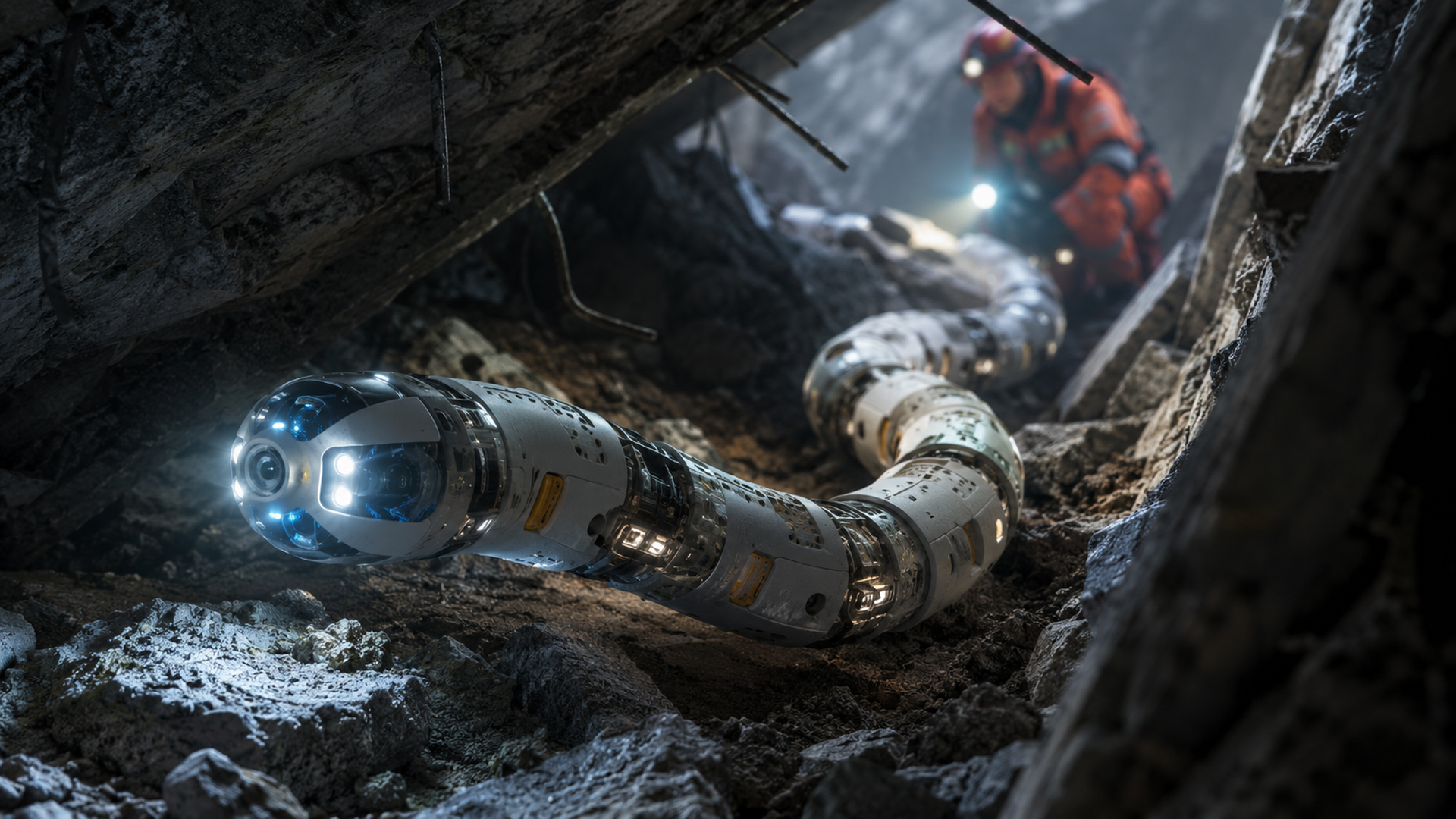
Industrial robots are built around rigidity, repetition, and precision. Metal arms move rapidly along fixed production lines, with errors too small for the unaided eye to detect. But when the setting shifts from a factory to a collapsed building, a narrow pipe, the inside of the human body, or the side of an older adult, rigidity can turn from an advantage into a risk. A rigid machine can fit through a narrow gap only by being made smaller. A soft robot can change its shape. It may bend like a snake, wrap around an object like an octopus arm, crawl like a caterpillar, or extend from its tip like a growing vine. Rather than imitating living organisms by adding more joints, it makes the material itself part of the motion.
The quality that makes this field so compelling is also what makes it difficult. Softness allows a machine to adapt to its surroundings, but it makes position, force, and control harder to predict. A conventional robot resembles a ruler; a soft robot is more like a living hose. The first is easier to calculate, while the second is better able to move through the physical world. For natural science education, soft robots offer a useful lesson: engineering is not always about making something harder, faster, or stronger. Sometimes the real innovation is enabling an object to change with its environment.
A Soft Robot Is Not a Metal Gripper Padded with Foam
The term “soft robot” refers to a machine whose body makes extensive use of materials that can bend, stretch, or deform. It does not mean simply adding a layer of rubber to the end of a metal gripper. Common materials include silicone, elastomers, textiles, flexible composites, and structures with variable stiffness. The available actuation methods are equally varied. Pneumatic systems use air pressure to expand chambers; hydraulic systems use liquids to produce motion; shape-memory alloys change shape with temperature; dielectric elastomers deform under an electric field; and cables and motors can pull flexible structures. Each approach involves trade-offs among force, speed, weight, controllability, and energy.
One of the central ideas in soft robotics is morphological computation. Not every adaptive response needs to be calculated in real time by a central processor; some of the work can be performed naturally by the material and shape of the body. When a soft gripper picks up a tomato, its fingers conform to the fruit without first constructing a perfect three-dimensional model. The body itself performs part of the control task. This may sound like intelligence, but it is better understood as engineering humility: instead of requiring the world to accommodate the machine, the machine first accommodates the world.
Why Search and Rescue Has a Particular Need for Softness
After an earthquake, explosion, mine collapse, or building collapse, the environment is filled with irregular gaps, sharp objects, dust, water, and unstable structures. Conventional wheeled or tracked robots can carry powerful sensors, but they may become trapped in narrow passages. Drones can search an area quickly, but they have difficulty penetrating deep into rubble. A soft robot can use a long, slender body to enter gaps while carrying cameras or sensors for temperature, sound, gases, or signs of life. Vine-like robots can even extend from the tip, reducing sliding between the body and the ground and potentially disturbing fragile structures less. For a trapped person, a soft device may also be safer approaching the body than a rapidly moving metal arm.
Yet “may be used for search and rescue” is one of the most common promises in robotics research, and one of the claims that most needs qualification. A laboratory maze is clean and repeatable. A real disaster site contains mud, water, reinforcing steel, broken glass, and communications dead zones. Passing through a hole in a demonstration video does not establish that a robot can operate reliably for ten hours amid aftershocks. The value of rescue technology therefore depends not only on mobility, but also on deployment time, operator training, maintenance, batteries, communications, and integration with incident command. Rescue teams do not need a scientific exhibit that can be started only when its research team is present.
Soft Does Not Mean Fragile, but Durability Remains a Problem
Soft materials can absorb impacts and reduce harm to people and the surrounding environment. Repeated bending, however, causes fatigue, while sharp objects can puncture an air chamber or outer surface. Heat, cold, chemical contamination, and ultraviolet radiation can all change material performance. Medical devices must also meet requirements for sterilization and biocompatibility. Researchers are exploring self-healing materials, fiber-reinforced structures, modular skins, and variable-stiffness designs. A machine could remain soft while passing through a gap, then stiffen when it needs to bear a load or grasp an object. This idea of “having bones when needed” may prove more practical than complete softness.
Variable stiffness also makes a system more complex. Materials, actuators, sensors, and controls must work together, and a tiny breach can cause a loss of pressure. The awkward engineering reality is that a robot may resemble a living organism but behave like a leaking pool float when it needs repair. Classroom teaching on soft robots should therefore go beyond impressive videos to address material fatigue, energy sources, feedback control, and safety testing. Scientific literacy means understanding not only why a technology could succeed, but also why it may not yet be ready for use.
Controlling a Soft Body Is Harder Than Controlling Metal Joints
The angle of each joint in a rigid robot is relatively easy to measure. A soft robot may bend at countless points along its body. Its model must account for nonlinear material behavior, friction, pressure, loads, and contact with the environment, causing computational demands to rise quickly. Sensing is also difficult. A conventional rotary encoder cannot directly measure an entire flexible structure, so researchers use flexible strain sensors, optical fibers, pressure sensors, machine vision, or external tracking. Those sensors must themselves be able to bend without compromising the robot’s softness.
Machine learning can help build control models by learning the relationship between inputs and deformation from large amounts of movement data. It also introduces questions of interpretability and safety. If a soft robot is used in medicine or rescue, saying that “the model usually succeeds” is not enough. The system needs safety limits, defined failure modes, and a mechanism for human intervention. Progress means more than producing movement that resembles a living organism; it also means enabling an operator to know when the machine can be trusted and when it should be stopped.
From Surgery to Care, the Value of Softness Lies in Reducing Harm
Medicine and care are another important direction for soft robotics. Flexible catheters, deformable endoscopes, soft exoskeletons, and rehabilitation gloves can make contact with the body more safely. A wearable soft robot can provide assistance through textiles, cables, and pneumatic structures rather than enclosing joints in a heavy metal frame. In care for older adults, a robot’s strength should not be measured only by how much weight it can lift. It may be more important for a device to help a person dress, support an arm, turn in bed, or grasp a fragile object without applying harmful pressure. Gentle contact may also reduce fear for the user.
Soft material alone does not guarantee safety. Uncontrolled pneumatic pressure, cable tension, or control errors can still cause injury. Medical-grade devices require long-term testing, cleaning protocols, and clinical evidence. It is much faster to film a research prototype as a “revolution in care” than to put it through meaningful validation. Technology communication requires restraint here: it can encourage imagination without presenting an unvalidated prototype as a replacement for care workers.
Biological Inspiration Is More Than Copying Nature’s Shapes
Soft robots often draw inspiration from octopuses, snakes, fish, insects, and plants. What matters is not merely their appearance, but how living organisms use materials, structures, and their surroundings. An octopus has no skeleton yet can control its arms precisely through muscles and pressure. A plant grows slowly but finds space along obstacles. Animal skin protects, senses, and deforms at the same time. A machine shaped like an octopus but designed without regard for energy efficiency or integrated sensing is only biomimetic styling. Deeper biological inspiration asks how nature distributes control through a body, continues functioning after damage, and completes tasks with limited energy.
The most likely future is not one in which soft machines replace rigid machines altogether, but one in which the two are combined. Metal structures provide force and precision, while flexible components provide adaptability and safety. A large rescue platform might carry a flexible probe; a surgical robot might use a soft end effector; and an industrial arm might handle irregular objects with a soft gripper. Engineering does not need to choose sides or declare that rigid machines are obsolete. The real questions are how much rigidity and softness each task requires, and what happens when the system fails. Not every robot should have bones, but neither should every robot resemble a jellyfish. The right body depends on the world it must enter.
A Good Science Class Does More Than Demonstrate What Robots Can Do
Bringing soft robots into a natural science classroom should involve more than showing a video and inviting students to say how impressive it looks. More valuable teaching breaks down the underlying concepts: how air pressure causes deformation, why materials fatigue, how friction changes movement, how a sensor converts bending into a signal, and how a control system makes decisions in an uncertain environment. These questions connect physics, life science, materials science, and engineering design.
Soft robots also provide a useful way to discuss the ethics of technology. When a robot can go where a person cannot, students should ask who decides where it goes, what images and sounds it collects, how data from a disaster site is protected, and who bears the risk if it fails. A rescue robot may appear neutral, but its use involves safety, privacy, resource allocation, and authority at an incident scene. Science education that teaches principles without judgment risks producing people who can operate a technology but do not question its consequences.
The deeper lesson of soft robotics is not that machines can finally be made to resemble living organisms. It is that the field requires us to think again about adaptation. Success in nature does not always come from meeting force with force; often it comes from finding a path through the surrounding environment. The same is true in engineering and education. Technological literacy does not mean admiring machines. It means recognizing their limits and designing responsibly within them.
For teachers, soft robots also offer a strong subject for inquiry: why do some tasks benefit from hard materials while others are safer with soft ones? Students can build simple models from straws, balloons, silicone, cardboard, or string and observe how different materials behave under pressure, bending, and friction. This is more than a craft activity. It turns abstract mechanics and biological adaptation into observable phenomena. Once students understand that a material can “solve” part of a problem, engineering design becomes a negotiation among body, environment, and task rather than a matter of software control alone.
More importantly, this form of teaching shows that science and society are not separate. Material choices affect safety, sensor data raises privacy concerns, and the deployment of rescue equipment affects priorities for scarce resources. When the curve of a soft robot helps students see connections among mechanics, life, ethics, and public decision-making, science class becomes more than memorization. It becomes a way to understand how the world is designed, used, and open to revision.
Sources retained from the Chinese original
AI use and content-safety disclosure
AI assisted with research organization, structural drafting, and language editing. Human editors set the article’s perspective and established its fact-checking priorities.