If a Video Looks Real, Does That Make It Evidence? Courts, Media Forensics, and Chain of Custody in the Deepfake Era
Original Chinese title: 影片看起來是真的,證據就是真的嗎:深偽時代的法院、媒體鑑識與保管鏈
As deepfake videos become increasingly indistinguishable from reality, the challenge shifts beyond identifying fakes to establishing an evidence chain of custody that courts, media, and the public can trust.
Liyu Chiu
Liyu Chiu has long been engaged in civic literacy, media literacy, and AI education, focusing on information verification, social trust, and digital citizenship in the platform era.
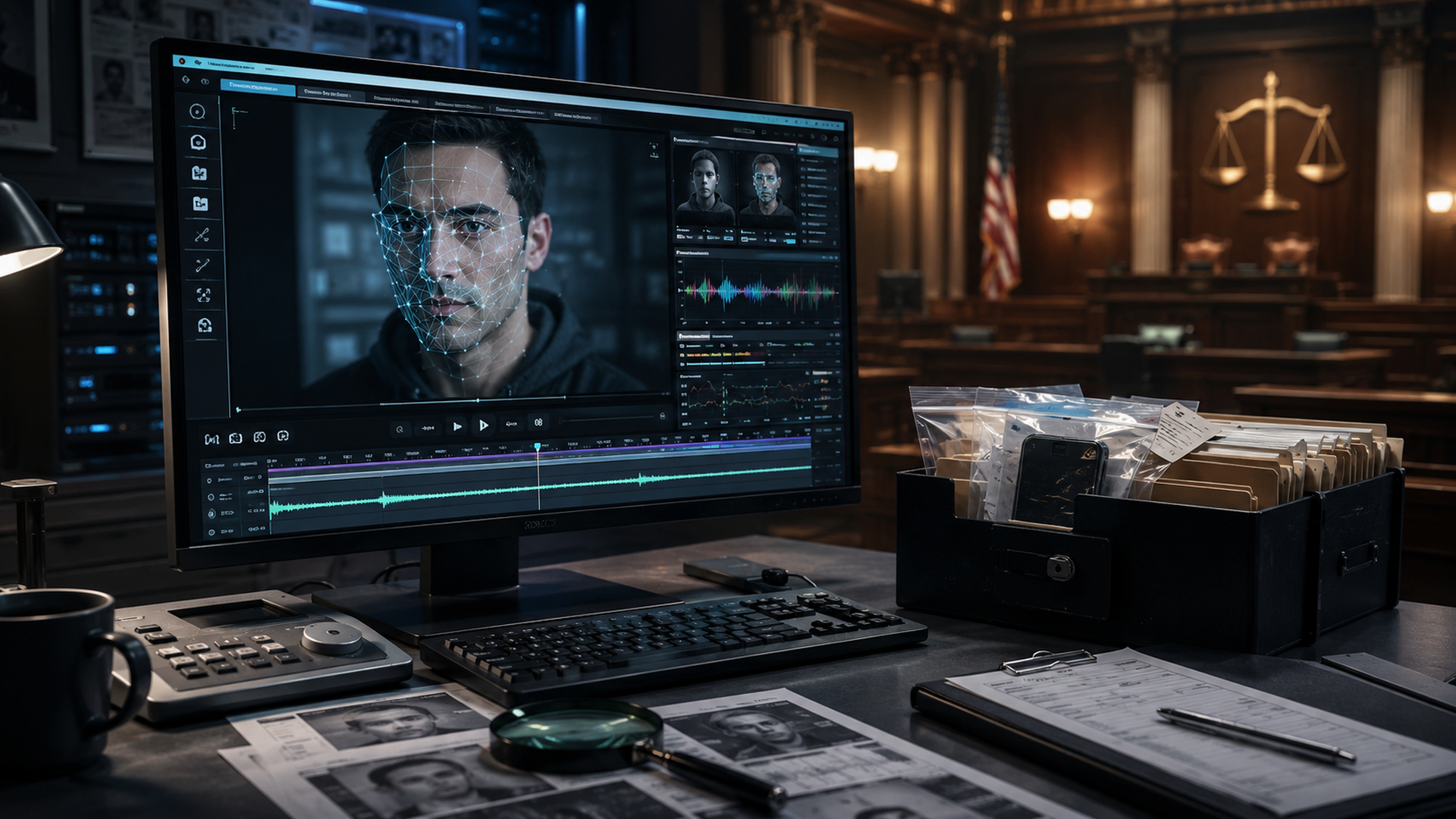
Looking Real Is No Longer a Starting Point for Judgment
Visual media once drew much of its persuasive power from a sense of presence. A camera captured a moment, a recording preserved a voice, and video seemed to return viewers to the scene. In news reporting, criminal investigations, public controversies, and political smears alike, images were treated as some of the material closest to truth.
Deepfake technology has dismantled that intuition. The problem is no longer limited to pasting one face onto another body. Voices, lip movements, expressions, lighting, gestures, and entire settings can now be synthesized at steadily falling cost. The public is left in an uneasy position: the more convincing an image appears, the less its appearance guarantees authenticity. At the same time, genuine footage can be dismissed with the claim that AI produced it.
This is the “liar’s dividend.” When fabrication becomes easy, the damage extends beyond any one video to the wider infrastructure of trust. Fabricated footage can be used to harm someone, while authentic footage can be denied as fake. The central question can no longer be only whether a particular video is real. We must also ask how it was obtained, preserved, transmitted, and verified.
Evidence Is Threatened by Weak Procedure as Well as Fabrication
It is tempting to think that a more powerful deepfake detector will solve the problem. That is like buying a larger umbrella in a downpour while leaving the roof unrepaired. Detection tools matter, but the deeper challenge deepfakes pose to courts and journalism is procedural fragility.
Imagine a video going viral on a social platform. News outlets download, forward, edit, and compress it; other accounts repost it again. By the time an examiner sees it, the original file may be gone, the recording device unknown, upload records incomplete, and metadata stripped away. Even an excellent forensic analyst can then offer only a probabilistic assessment of degraded material. The failure is not a lack of technical skill. The chain of custody was broken at the outset.
A chain of custody is the documented history of evidence from collection and preservation through transfer, analysis, and presentation. It establishes where an item came from, who handled it, and whether it was changed. Criminal-justice systems have long treated that record as essential. In digital public life, however, forwarded screenshots, recordings of screens, and files copied from platforms are often treated as equivalent to original material. That assumption is especially hazardous in the deepfake era because every conversion and re-encoding can erase traces that would otherwise support authentication.
Courts Must Apply Standards of Proof, Not a Single Real-or-Fake Test
Courts do not admit evidence simply because it looks credible. Evidence must satisfy requirements concerning admissibility, relevance, authenticity, and procedural fairness. In the deepfake era, establishing the authenticity of visual evidence demands additional forms of proof. Judges and jurors cannot determine synthesis by sight alone, but neither should every technical decision be delegated to an opaque model.
A robust approach therefore needs several layers. First come the original file and device provenance: can investigators obtain the recording device, upload history, server logs, or raw data? Second are metadata and file structure, including timestamps, compression methods, and anomalous traces. Third is forensic analysis of the content itself, such as facial boundaries, blinking patterns, consistency of light and shadow, voice characteristics, or synchronization between speech and lip movement. Fourth is external corroboration: witnesses, data from the scene, other camera angles, and the surrounding chronology and location.
Reliable evidence gathering, in other words, requires more than possession of a video. The file must be placed within a verifiable account of the event. If a society allows one striking image to stand in for a full investigation, deepfakes will merely expose—and accelerate—an evidentiary laziness that was already present.
Newsrooms Must Preserve Evidence, Not Merely Detect Fakes
Journalists often approach deepfakes as a problem of detection. Yet a newsroom’s role includes preservation as well as verification. When reporters receive footage from an event, failing to retain the original file, document its source, record a cryptographic hash, and preserve contextual information can make later authentication far more difficult.
This is particularly important in breaking news, conflict settings, and public controversies, where much firsthand material comes from members of the public. A newsroom that republishes viral material in haste, without a basic verification process, can harm both the people depicted and its own credibility. Once an outlet has repeatedly used fabricated images, later corrections may do little to prevent trust in journalism as a whole from eroding.
Media-literacy education must therefore teach more than how to spot visual “tells.” It must also teach how an evidence chain works. The crucial questions are not whether something looks odd at first glance, but where it came from, whether the original file survives, who uploaded it, whether it was edited, and what independent evidence corroborates it. These questions may be less dramatic than a viral post, but they bring public reasoning closer to evidence and further from impulsive sharing.
Technology Companies Share Responsibility for the Content Supply Chain
Users cannot carry the entire burden of deepfake risk. Platforms, model providers, and developers of content tools also have responsibilities. Content credentials, watermarks, provenance labels, and standards such as C2PA are receiving growing attention because they can preserve traceable information at important stages from generation and editing to publication.
None is a cure-all. Watermarks can be removed, credentials work only when an ecosystem adopts them, and techniques of attack and defense will keep evolving. They nevertheless point toward an important principle: authenticity should be supported by technology and procedure, not entrusted solely to eyesight and intuition. Provenance systems must also be designed with privacy in mind so that verification does not unnecessarily expose personal information or create risks for sources.
Generative tools that keep reducing the cost of abuse without transparent safeguards are outsourcing their social costs. The technology sector often declares that tools are neutral. But when misuse is made frictionless and protection is relegated to an optional extra, “neutrality” becomes little more than a legal escape hatch.
Education Must Confront Trust Fatigue
The most dangerous outcome of the deepfake era may not be universal belief in fabricated video. It may be a public that no longer believes anything. When students respond to every disputed clip with “Who knows whether it’s AI?”, public discussion slides toward cynicism. That posture can look like rational skepticism while abandoning the responsibility to verify.
Media literacy should cultivate disciplined skepticism, not suspicion for its own sake. Suspicion without procedure is merely a feeling; doubt without evidentiary standards can be exploited by those with power. Civic education should teach that not every claim can be decided immediately, but that the quality of judgment can be improved step by step by examining provenance, chain of custody, independent corroboration, and transparent methods.
In the Deepfake Era, Truth Is a Team Effort
Truth is often imagined as something discovered by a single actor: a courageous reporter, an ingenious detective, or one decisive recording. It now looks more like a team effort. Camera operators must preserve original files; platforms must retain records; newsrooms must establish procedures; forensic specialists must conduct and explain analyses; courts must scrutinize evidentiary standards; and citizens must resist careless sharing.
If society waits for a supercharged AI detector to classify everything as true or false, the next generation of synthesis tools will leave us exposed once again. What needs repair is the culture of evidence. A video that looks real is not necessarily reliable evidence. With sound procedure, clear provenance, and an intact chain of custody, however, facts still have a chance of surviving the noise.
The question has never been only, “Is this video fake?” It is whether, in an era when fabrications can be produced at scale, we remain willing to build institutions that serve the truth.
The deeper danger appears when politicians, corporations, or influencers learn to use “possibly AI-generated” as a universal shield. Society can then be pulled into a chronic inability to speak with confidence about what happened. Doubt unsupported by procedure ultimately favors whoever can command the most attention.
Sources retained from the Chinese original
- Original source: NIST AI 100-4|Reducing Risks Posed by Synthetic Content
- Original source: C2PA|Coalition for Content Provenance and Authenticity
- Original source: Reuters Institute|Journalism, media, and technology
- Original source: U.S. DOJ|Computer Crime and Intellectual Property Section(CCIPS)
- Original source: NIST|Computer Forensics Tool Testing Program
AI use and content-safety disclosure
This article was assisted by AI for data organization, structural drafting, and sentence polishing; human editors set viewpoints and fact-checking directions