Turning Roofs into Windows to the Night Sky: Can Passive Daytime Radiative Cooling Cool Cities?
Original Chinese title: 把屋頂變成夜空的窗口:被動日間輻射冷卻能不能替城市降溫
Passive daytime radiative cooling materials can shed heat outward into space during daylight, offering a non‑electric cooling possibility. Yet moving from experimental roofs to city scale still faces cost, durability, and overall building design challenges.
王振庭
王振庭 is a natural science teacher who has long focused on climate, materials, energy literacy, and accessible science education.
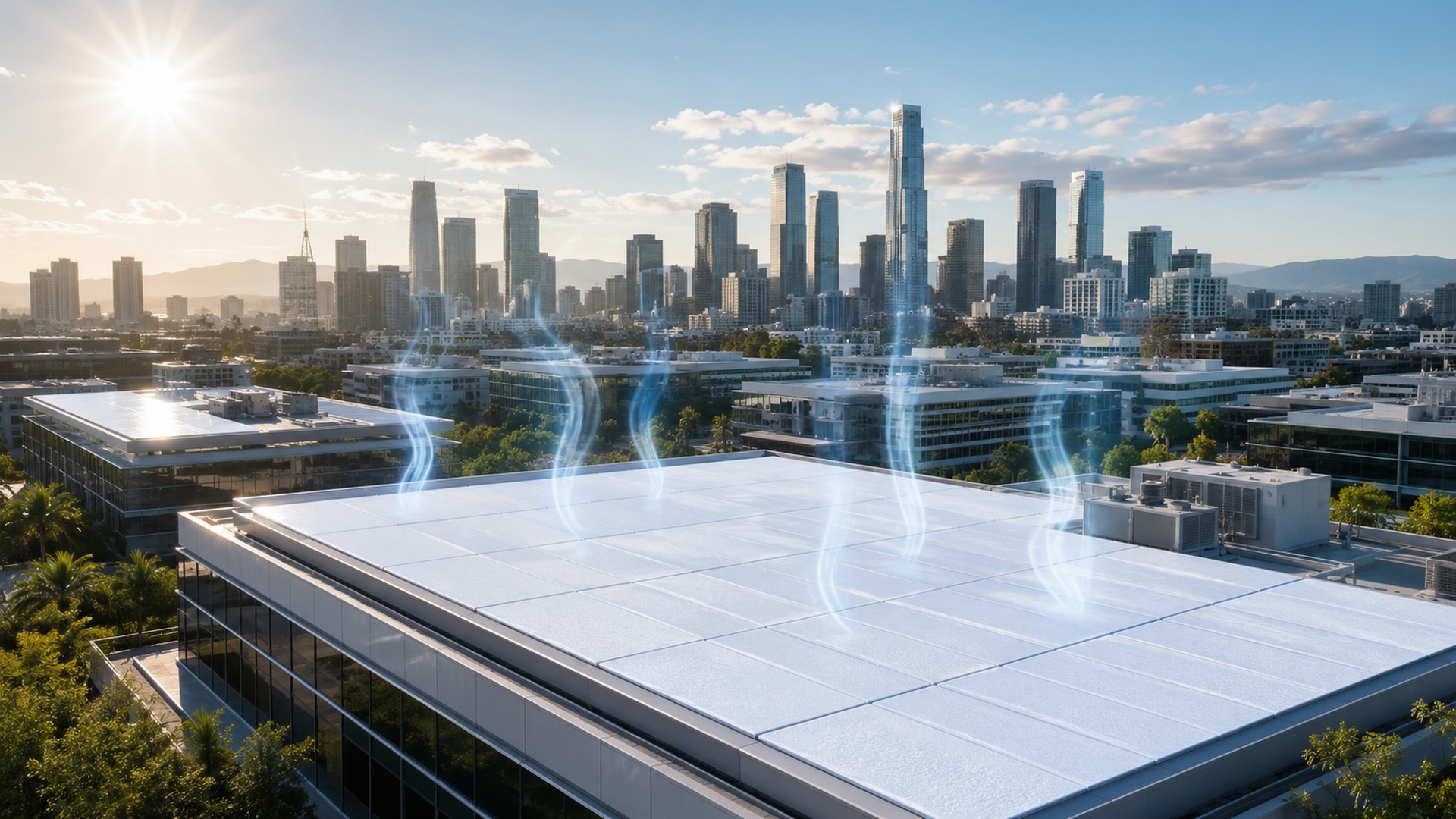
Turning Roofs into Windows to the Night Sky: Can Passive Daytime Radiative Cooling Cool Cities?
Every summer, cities feel like a large pot slowly heating up. Asphalt roads absorb heat, concrete stores it, glass curtain walls reflect and trap warmth; during the day it feels as if you’re standing in front of a hair dryer, and at night the massive heat stored from daytime lingers, making evenings feel like extended workdays. People turn on air conditioners, buildings increase cooling capacity, grid load rises, then more waste heat is dumped back onto streets. This cycle isn’t useless—it’s like painkillers: it temporarily suppresses symptoms but doesn’t address the root cause.
Passive daytime radiative cooling appeals because it offers another vision: without compressors or heavy electricity use, surface temperatures can still drop. What makes it even more intriguing is its simplicity—not creating cold, but more efficiently sending heat away.
Why Heat Can Be Thrown Upward
All objects above absolute zero radiate thermal energy. The challenge on Earth’s surface is that it simultaneously absorbs solar radiation and ambient heat, so achieving a net daytime output isn’t easy. Passive daytime radiative cooling materials excel at two things: first, reflecting as much sunlight as possible to avoid absorbing visible light and near‑infrared; second, efficiently emitting in a specific atmospheric window of the mid‑infrared spectrum, allowing heat to pass through the atmosphere toward the colder outer space.
That’s why some describe it as turning roofs into windows to the night sky. Even while the sun shines, the material’s spectral selectivity reflects what should be reflected and emits what should be emitted, so under certain conditions surface temperature can fall below ambient air temperature.
It sounds almost counterintuitive, which is why recent media coverage often frames it as “magic paint” or “electricity‑free air conditioning.” Scientifically the concept holds up; engineeringly there are still many practical thresholds. What’s truly interesting isn’t whether it succeeds in papers, but whether it can deliver stable benefits under dust, humidity, typhoons, urban pollution, and long‑term exposure.
Material Breakthroughs: Starting from “White Isn’t White Enough”
Initially many thought painting roofs white would suffice. White does reflect more sunlight, so traditional cool roofs are already a practical strategy. Passive daytime radiative cooling materials pursue not just high reflectivity but precise spectral design. Researchers use polymers, porous structures, nanoparticles, or multilayer films to achieve extreme solar reflection and strong emission in the atmospheric window.
This means they’re more demanding than ordinary white paint and harder to understand simply as “good white.” The least romantic part of materials science is that beautiful lab data don’t guarantee large‑scale construction deployment. Mechanical strength, adhesion, price, ease of installation, dirt resistance, and maintainability all matter—urban roofs aren’t paper charts; they gather dust, hold water, get stepped on by birds, and face typhoon winds.
Urban Heat Islands Won’t Be Solved by a Single Coating
Whenever new cooling tech is discussed, society often asks: “Will this be enough?” The answer is almost always an embarrassed no. Urban heat islands are multifactorial—building density, green cover, traffic, surface materials, wind fields, air‑conditioner exhaust, and social inequality all play roles. Radiative cooling can help building envelopes, but it’s not a lone hero.
If a building has excessive window‑to‑wall ratios, insufficient shading, or large internal heat sources, roof material alone cannot reverse the load. Similarly, if an entire neighborhood lacks shade and ventilation, cooling benefits get offset by the environment. The viable path is integrating such materials into holistic design: together with shading, ventilation, insulation, greening, façade color, equipment efficiency, and energy management.
In short, good cooling materials aren’t saviors; they’re important pieces of a complete building climate strategy.
No Electricity Is Attractive—But Don’t Forget Real‑World Contexts
The most appealing phrase about passive cooling is that it uses no electricity. For cities under high energy pressure and heavy peak loads, this is a huge advantage. If roofs and façades can reject part of the heat at the door, indoor air‑conditioning load may drop, reducing peak demand and carbon emissions.
Yet “no electricity” doesn’t mean “no conditions.” Radiative cooling performance depends on weather, humidity, cloud cover, sky view factor, and installation method. Cloudy, humid, or shaded environments may underperform compared to dry sunny regions. Some applications also need heat exchangers, fluid circulation, or cold‑storage design to transfer surface cooling effectively indoors or to equipment.
Thus the most honest statement is that it offers low‑energy cooling potential rather than a miracle of free refrigeration everywhere and always. A key task in science education is preventing good technologies from being mythologized; once myths fail on the ground, society often discards valuable solutions along with them.
From Buildings to Food, Then to the Grid
Daytime radiative cooling isn’t limited to buildings. Research also explores its use in refrigeration, cold chains, solar‑panel heat dissipation, outdoor equipment cooling, and even preserving medicines or food in power‑deficient areas—showing potential beyond comfort into basic livelihoods.
The more applications, the finer the assessment must be. Applying material on a roof versus using it for medical coolers demands very different considerations: roofs prioritize construction lifespan and large‑area cost; coolers need temperature stability and hygiene reliability. Policies that see only “hot technology” and blanket subsidies risk flattening these important scenario differences.
Taiwan Needs Testing, Not Slogans
For Taiwan, daytime radiative cooling is directly attractive: high temperatures, high humidity, pronounced urban heat islands, and heavy summer electricity pressure. Yet precisely because of this, Taiwan needs local field tests rather than simply transplanting foreign paper conclusions. Materials that perform well in dry inland cities may not excel under sea breezes, salt damage, typhoons, or long‑term humid conditions.
Therefore the most valuable next step isn’t to proclaim a “nationwide roof revolution” but to establish demonstration sites: schools, public buildings, factories, low‑income housing, and high‑heat exposure venues can serve as long‑term monitoring points. Measurements shouldn’t be limited to surface temperature; indoor thermal comfort, air‑conditioning electricity use, cleaning frequency, material aging, and cost‑recovery periods should all be tracked.
Without such testing, policy easily follows familiar patterns: beautiful graphics, abundant news coverage, budgets approved first, then after three years only faded roofs and outdated results websites remain.
Making Buildings Generate Less Heat Is Truly Dignified Cooling
Extreme heat isn’t just a meteorological issue; it’s also a public‑health and urban‑justice problem. The most vulnerable often live in the hottest places with least shade and hardest to sustain air conditioning. If passive cooling materials can combine with public housing, schools, community spaces, and medical facilities, their significance goes beyond energy savings—they enable more people to secure basic comfort without exorbitant electricity bills.
Turning roofs into windows to the night sky sounds poetic, but what truly matters is institutional and design maturity: buildings that absorb less heat, shed more of it, are friendlier to the grid, and kinder to people. If cooling can only rely on air conditioners working desperately hard, cities forever fight their own waste heat; passive daytime radiative cooling at least offers a new path worth serious investment and honest verification.
Another often‑overlooked aspect is the construction and maintenance labor market. Without local technicians who understand material properties, roof safety, and measurement validation, even good solutions can become one‑off projects. A truly mature cooling transition should cultivate on‑the‑ground maintenance capacity rather than treating high tech as a display showcase.
Sources retained from the Chinese original
- Original source: DOE Energy Saver|Cool Roofs
- Original source: Berkeley Lab|Energy Technologies Area
- Original source: Raman et al.|Passive radiative cooling below ambient air temperature
- Original source: Zhai et al.|Scalable-manufactured randomized glass-polymer hybrid metamaterial for daytime radiative cooling
- Original source: IPCC AR6 WGII
- Original source: IEA|The Future of Cooling
AI use and content-safety disclosure
This article was assisted by AI for data organization, structural drafting, and sentence polishing; human editors set the viewpoint and fact‑checking direction