Sodium-Ion Batteries Are Not Lithium's Poor Cousin: The Energy Transition Needs a Second Battery Language
Original Chinese title: 鈉離子電池不是鋰的窮親戚:能源轉型需要第二種電池語言
Lithium-ion batteries dominate how we imagine mobile devices and electric vehicles, but the energy transition cannot rely on a single chemistry. The value of sodium-ion batteries in stationary storage, short-range transport, and supply-chain diversification depends not on replacing lithium, but on establishing a second practical battery language.
Lawrence Lee | Technology Journalist, Science Fiction Critic, and Space Science Educator
Technology journalist, science fiction critic, and space science educator focusing on energy, materials, civilizational infrastructure, and technological narratives.
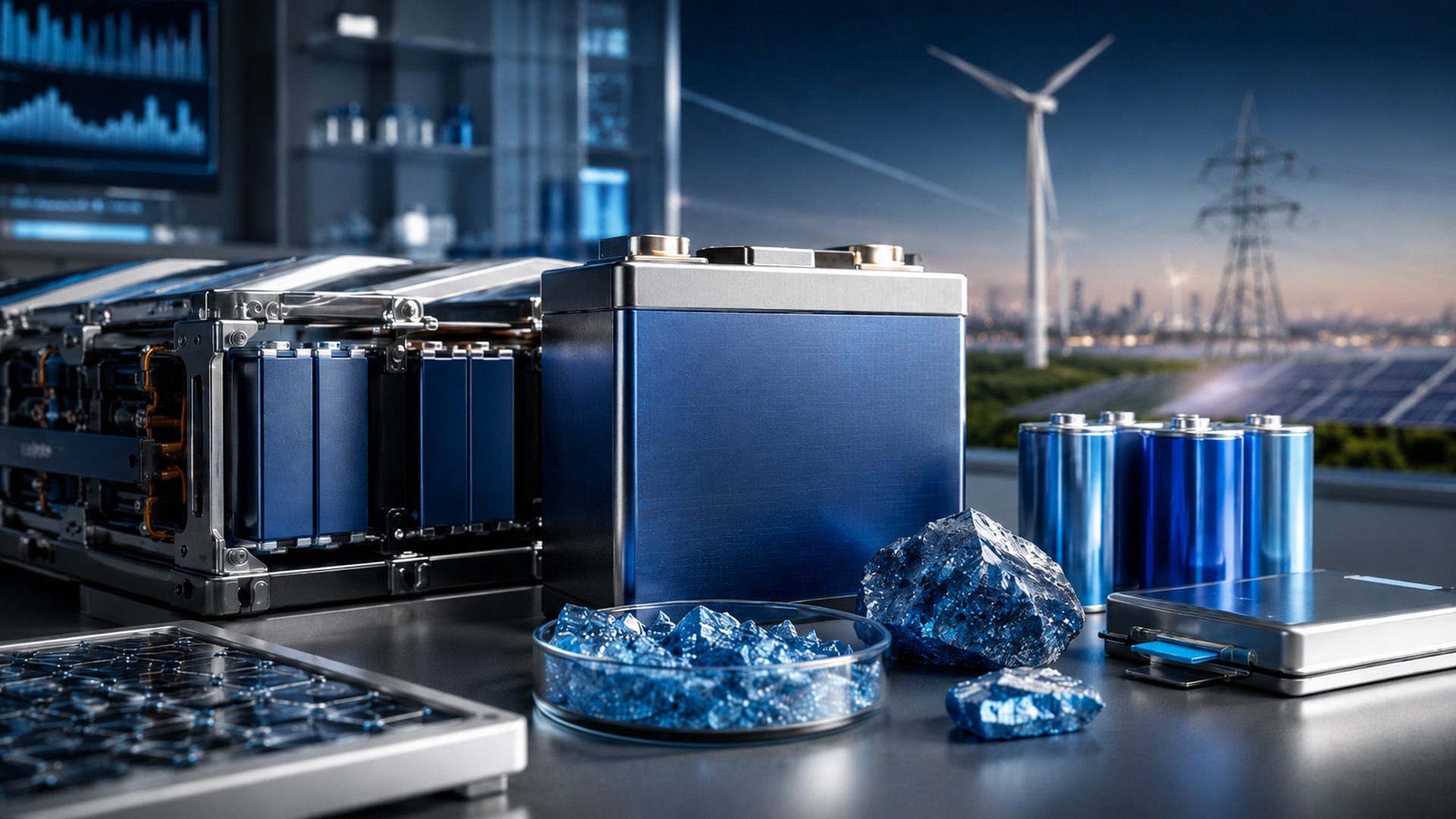
Discussions of new battery chemistries often turn into a familiar technology-industry talent show: What will beat lithium? What is the next-generation champion? What will charge an electric vehicle in five minutes, send it around the island three times, and save both the grid and the planet along the way? A materials-science study barely emerges from the laboratory before headlines rush to crown it.
Sodium-ion batteries are often cast in this script as "a cheaper but heavier version of lithium-ion." That is only half right, and it leaves out the more important half: the energy transition needs not a single hero but a portfolio of technologies that work in different settings. The value of sodium-ion may not lie in dethroning lithium. It may lie in ensuring that civilization's entire need for energy storage is not locked into one materials platform and one supply chain.
A Battery Is Not One Product; It Serves Many Uses
Phones place a premium on size and weight. Electric vehicles prioritize range, charging speed, and safety. Data centers need instantaneous power and reliability, while power grids require long service life, low cost, cycling efficiency, maintainability, and deployment at scale. These needs overlap, but they are not identical.
Lithium-ion batteries succeeded in part because they achieved a highly competitive balance among energy density, efficiency, cycle life, and manufacturing scale. But a chemistry that is best suited to a phone is not necessarily the only choice for every form of storage. A storage installation beside an industrial park, absorbing solar power during the day and discharging at night, does not need to fit in a pocket. A fixed-route shuttle does not need intercontinental range. When the application changes, the evaluation criteria should change with it.
Sodium-ion batteries generally have lower energy density than high-performance lithium-ion systems, putting them at a disadvantage where weight and volume are critical. Yet sodium is widely available, some designs can reduce reliance on lithium, nickel, and cobalt, and manufacturers may be able to adapt existing lithium-ion production expertise and equipment. Sodium-ion is not a cost-free solution, but it offers another combination of materials and another supply-chain option.
Abundant Sodium Does Not Automatically Make a Cheap Battery
Seawater contains abundant sodium, so public discussion often leaps straight to the claim that sodium-ion batteries must be cheap. Resource abundance matters, but battery cost has never depended only on how common an element is in Earth's crust. Cathode-material purity, electrolytes, separators, current collectors, manufacturing yield, plant depreciation, quality control, module design, battery-management systems, and certification all contribute to the final cost.
More importantly, the lithium-ion industry already operates at enormous scale. When a technology has mature suppliers, equipment, engineering talent, testing standards, and global orders, its advantage extends beyond materials: the entire ecosystem works to lower costs. Sodium-ion is not trying to catch up with a single cell, but with an industrial city that has been operating for years.
Whether sodium-ion becomes inexpensive therefore depends not only on chemistry, but also on growing production volumes, product standardization, stable plant operations, and customers willing to sign long-term contracts. New technologies often encounter a familiar absurdity: customers say they will adopt once prices fall, while manufacturers say they need orders before prices can fall. This is not a scientific problem. It is a problem of industrial coordination.
Low-Temperature Performance, Safety, and Service Life Cannot Be Reduced to Slogans
Marketing likes to attach simple labels to a technology: sodium-ion performs well in the cold, is safe, charges quickly, and lasts a long time. These claims may hold for particular materials and designs, but they do not automatically apply to every sodium-ion battery. Performance depends on cathode and anode materials, electrolytes, particle architecture, manufacturing processes, and control strategies. Calling every vehicle a car does not mean that every one of them can go off-road.
Safety requires particular care. Some sodium-ion chemistries may offer better thermal stability or more favorable transport conditions, but battery modules remain high-energy systems. Internal short circuits, overcharging, thermal management, mechanical damage, and system failures still have to be addressed. Translating "relatively safer" into "nothing can go wrong" is the language marketing departments most enjoy and fire services least want to hear.
Service life cannot be reduced to a cycle count. Charging and discharging once a day produces different aging from frequent high-power cycling; hot and cold environments impose different stresses; and a single laboratory cell is not a container-scale system. Useful comparisons hold test conditions constant and examine usable capacity, efficiency, degradation, maintenance, and total life-cycle cost rather than comparing each company's most flattering chart.
Stationary Storage May Be the More Sensible Starting Point
For a battery with lower energy density but a more geographically diverse materials supply and room for costs to fall, stationary storage is an obvious application. Wind and solar output varies, so grids need more tools for balancing supply and demand. Factories and communities may also need peak shaving, backup power, or microgrid storage.
In these applications, physical footprint is rarely the only constraint. Safety, service life, maintainability, price, and security of supply may matter more. Sodium-ion can therefore compete alongside lithium iron phosphate, flow batteries, pumped hydropower, thermal storage, and other options. The point is competition within a portfolio, not a sword fight in which one technology eliminates all others.
Energy systems have widely varying needs. Second-scale frequency regulation, multi-hour load shifting, multi-day backup, and seasonal storage require very different technologies. If policy uses a single subsidy specification to select a "battery champion," it may reward the technology best able to fit the form rather than the portfolio best suited to the system.
Electric Vehicles Will Not Disappear, but They Do Not All Need the Same Answer
Sodium-ion batteries may also serve some transport applications, including short-distance commuting, compact cars, two-wheelers, commercial shuttles, or markets with particular requirements for low-temperature performance. Their lower energy density may constrain long-range vehicles, but not every commuter needs to carry a battery of more than 100 kWh to work.
The automotive industry has turned range into a display of muscle, producing ever-heavier vehicles and ever-greater demand for materials. Matching different battery chemistries to actual patterns of use may be more sensible than maximizing battery capacity in every car. Sustainable transport is not merely a matter of replacing a fuel tank with a battery pack; it also requires rethinking vehicle size, public transport, sharing, and urban distances.
A Second Battery Language Means Supply-Chain Resilience
The energy transition is not simply a matter of replacing equipment at the point of generation. It also reallocates materials and manufacturing capacity. The mining, refining, and processing of lithium, nickel, cobalt, and graphite are highly concentrated, and deployment is vulnerable to both prices and geopolitics. Developing sodium-ion batteries, recycling, alternative materials, and multiple storage technologies can reduce single-point risks.
Avoiding a particular critical mineral does not eliminate environmental costs. Sodium-ion still requires minerals, chemicals, energy, factories, and land. Every large-scale industry must confront questions of mining, emissions, labor, and recycling. If technological diversification merely moves extraction pressure from one map to another, civilization has changed color without changing its habits.
Policy should therefore require full life-cycle data, design for repair, responsibility for recycling, supply-chain transparency, and local environmental assessment. The battery industry cannot talk about sustainability only at product launches and then lose the signal at mines and end-of-life facilities.
Stop Asking What Will Replace What; Ask Which Technology Fits Where
The most promising feature of sodium-ion batteries is that they force us beyond the idea of a single winner. They do not need to outperform lithium-ion on every metric. They need only be more appropriate, affordable, and accessible in particular applications, and to demonstrate safety and service life. Technological progress does not always take the form of a new monarch ascending the throne; sometimes the toolbox finally gains a wrench of the right size.
The energy transition is an infrastructure project, not a product unboxing. It requires decades of operation, maintenance, regulation, and public trust. A mature strategy does not pronounce an old technology dead after one breakthrough paper, nor does it exclude a new option because its initial costs are higher. It creates test sites, publishes data, compares full life-cycle costs, and lets different chemistries prove themselves where they fit.
Lithium-ion does not need to be disparaged, and sodium-ion need not accept the role of poor cousin. The real poverty lies in imagining the future in only one language. When energy systems learn a second and a third battery language, they gain not another talking point, but a greater ability to face supply disruptions, price volatility, and climate risks without panic.
Further Reading and Sources
- International Energy Agency: Batteries and Secure Energy Transitions, April 2024. Covers global battery-storage deployment, cost trends, and data on supply-chain diversification.
- International Energy Agency: Global Critical Minerals Outlook 2024, May 2024. Covers supply and demand for lithium, nickel, cobalt, graphite, and other materials, as well as geographic concentration.
- Nature Reviews Materials: Sodium-ion batteries: present and future, 2022. Covers material systems, energy density, cycling, and barriers to commercialization.
- U.S. Department of Energy: Energy Storage Grand Challenge, updated on an ongoing basis. Covers storage-technology portfolios, testing, and supply-chain policy.
AI use and content-safety disclosure
AI assisted with data organization, structural drafting, and prose refinement. Human editors set the article's perspective and fact-checking priorities.