If Green Energy Ignores Recycling, It Merely Moves Waste Elsewhere: The True Cost of a Battery Circular Economy
Original Chinese title: 綠能若不處理回收,最後只是換地方堆垃圾:電池循環經濟的真成本
The energy transition is not only a race to install equipment; it also tests who can afford to recycle it. As lithium-ion batteries, energy-storage systems, and electric vehicles move to the center of the low-carbon narrative, end-of-life recycling, remanufacturing, and the allocation of responsibility become decisive. Without sound institutions, green energy will merely shift pollution from smokestacks to landfills and export ports.
鄭淑禎
鄭淑禎, Assistant Professor at Shih Chien University; focuses on business governance, public policy, and institutional design in the technology sector, with particular attention to gaps between corporate narratives and policy realities.
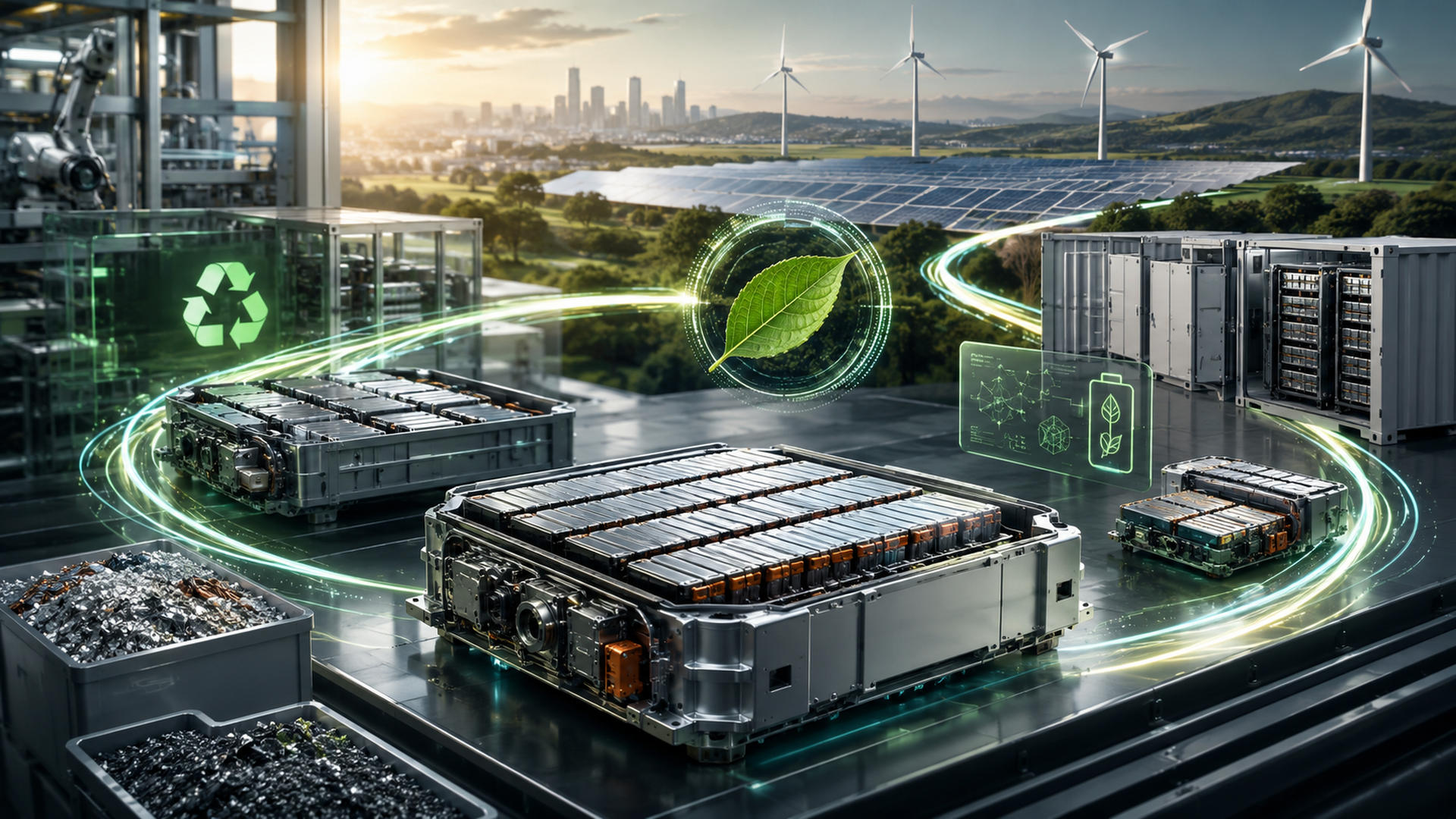
The energy transition tells its best stories at product launches. Solar panels gleam in neat rows, streamlined electric vehicles move quietly, and battery-storage cabinets stand like night watchmen in a future city. Everything looks more sophisticated than it did in the coal-fired era. Pull the camera back, however, and retired batteries, recycling lines, dismantling costs, hazardous-material transport, and materials remanufacturing strip half the filter from the green narrative. A mature energy transition is not merely a race to install equipment; it is a test of who can bear the full cost of its life cycle. If a society eagerly subsidizes purchases but shows little interest in end-of-life collection, remanufacturing, or the allocation of responsibility, its green-energy revolution may only move pollution and risk somewhere else.
Batteries Are Not Products; They Are a Global Chain of Responsibility
Batteries sit at the center of this problem. From consumer electronics and electric scooters to electric vehicles and utility-scale energy storage, lithium-ion batteries have become core components of the low-carbon economy. They enable renewable-energy integration and transport electrification, but they also create new pressures in mining, manufacturing, safe operation, and end-of-life management. As countries rush to expand storage and electric mobility, the market emphasizes capacity, driving range, charging speed, and falling costs, while giving less attention to harder questions: Where will these batteries go when they retire? How mature are recycling technologies? How should different chemistries be sorted? Who pays the recycling costs? If the recoverable value is lower than the cost of processing, how will the system prevent batteries from circulating through poorly regulated channels? These are not side issues; they are the foundation on which the transition stands.
Recycling Is Not Throwing All Batteries into One Machine
Battery recycling is difficult first because batteries are not a uniform product category. Products, brands, and battery chemistries differ substantially in how they must be dismantled and how their residual value is assessed. Lithium iron phosphate and ternary lithium-ion batteries have different metal-value profiles, while their module designs, adhesives, packaging, and safety mechanisms also vary. A recycling facility therefore cannot simply feed every battery into the same magical machine. It needs comprehensive front-end sorting, safe transport, dismantling processes, assessments for reuse, and material-extraction technologies. Recycling is not a minor back-office chore; it is an entire industrial system. Without scale, standards, and transparent information, even the best policy slogan delivers decarbonization only on paper.
Second Life Cannot Be an Excuse to Delay Handling
The second key point is that "second life" must not be conflated with actual recycling. Industry increasingly promotes secondary uses, such as repurposing retired electric-vehicle batteries for low-load storage. This can extend service life and reduce resource waste, but it is not a panacea. It postpones final processing; it does not make the problem disappear. Without performance assessments and clearly assigned responsibility, second-life applications may also create new safety risks and information gaps. Many companies present second life as the perfect circular-economy solution, as if moving an old battery to a new location grants it rebirth. A policy that stops there is like repainting old building materials and declaring sustainability complete: reassuring, perhaps, but more than a little self-satisfied.
After Sale, Responsibility Cannot Evaporate
The third issue is the allocation of responsibility. If battery recycling depends entirely on market prices, no one may be willing to process batteries when their metal value is low, while high risks encourage every party to pass responsibility elsewhere. Extended producer responsibility, deposit-refund systems, mandatory information disclosure, design for disassembly, and product passports therefore become essential. Their common principle is simple: companies cannot capture the profit when a product is sold while leaving society to pay when it retires. As energy storage and electric vehicles expand rapidly, failure to establish a responsibility chain early will allow growing end-of-life volumes to overwhelm local governments and recycling systems while sending environmental risks soaring. Repairing the system later will inevitably cost more than acting now.
Recycling Is Also About Material Security and Industrial Competitiveness
Battery policy also intersects with international politics. Supply chains for lithium, nickel, cobalt, graphite, and rare metals are already part of geopolitical strategy, making recycling a matter not only of environmental protection but also of material security. Recovering critical materials from retired batteries can reduce pressure for primary mining and lower supply risks. In recent years, the European Union has advanced its Battery Regulation, requiring greater transparency on carbon footprints, recycled content, and product information; the United States and Asian countries are also developing critical-mineral and circular-material systems. Recycling is therefore not an accessory to green energy, but part of industrial competitiveness. Many governments have yet to acknowledge this because recycling plants do not appear on achievement slides as readily as science parks do.
Taiwan Lacks Not Slogans, But a Complete Responsibility Chain
Taiwan needs to plan early for a battery circular economy. The island simultaneously faces growth in electric transport, expansion of energy-storage infrastructure, and pressure to upgrade industrial supply chains. Without forward-looking institutions, the most likely failure will not be a single technical breakdown but a systemic lack of information: uncertainty about where end-of-life batteries will come from and in what volumes, how specifications move through the system, who bears responsibility, and whether local processing capacity is sufficient. The public also has questions about storage safety, fire risk, and recycling destinations. If policy can proclaim net zero but cannot explain the end-of-life plan, social trust will not keep pace with deployment.
Circular Economy Needs Boring Infrastructure
At a deeper level, this is a classic gap between sustainability narratives and institutional reality. Everyone likes to say that green technology represents the future, but few acknowledge how much mundane infrastructure that future requires: classification standards, tracking codes, data platforms, recycling obligations, occupational-safety rules, quality assurance for remanufactured materials, transport for dangerous goods, and coordination across local government. These systems do not come with product launches or make share prices soar, but they are what keep green energy from becoming another waste economy. Without them, even the most attractive transition may merely move problems from the power-generation end to the waste-management end.
Recycling Is a Protagonist, Not a Supporting Role, in Energy Transition
If we ask whether battery recycling is merely a supporting player in the energy transition, the answer is the opposite: it is one of the leading roles. A genuinely green energy system must prove not only how much clean electricity it can produce, but also whether it can manage retirement responsibly and in the public interest. When recycling, remanufacturing, and the allocation of responsibility are built into the design, the energy transition moves from posters into reality. Otherwise, we have merely restaged the old script of "high pollution, high consumption, and low responsibility" against greener scenery.
Viewed through the lens of local industrial development, a battery circular system can also become a source of new manufacturing and service capabilities. Recycling extends beyond end-of-life dismantling to testing, sorting, module reassembly, material purification, tracking platforms, insurance, and risk management. A region that connects these capabilities may capture more value in the green supply chain. Recycling, in other words, is not merely a cost center; it can be an entry point for new industries. The institutions must still come first: without clear rules and a stable volume of material to recycle, even strong technologies will struggle to develop into a mature market.
Further Reading and Sources
- International Energy Agency: Global EV Outlook 2025—Electric vehicle batteries|Date: 2025|Verification considerations: Confirm global battery demand, electric vehicle growth and 2030 outlook.
- European Union: Regulation (EU) 2023/1542 on batteries and waste batteries|Date: 2023-07-28|Verification considerations: Check recycling efficiency, recycled materials, battery passports and supply chain transparency requirements.
- UNEP International Resource Panel: Global Resources Outlook 2024|Date: 2024-03-01|Verification considerations: Confirm global resource use, circular economy and material governance context.
- Ministry of Environment: Waste Lithium Battery Recycling Information|Date: As updated by the agency|Verification considerations: Confirm Taiwan's guidance on lithium-battery classification, terminal insulation, recycling, and public safety.
- Separation and Purification Technology: Lithium-ion battery recycling—critical review of techno-economical and socio-environmental impacts|Date: 2026-02-26|Verification considerations: Confirm pyrometallurgical, hydrometallurgical, direct recycling methods and lifecycle cost and environmental impact comparisons.
AI use and content-safety disclosure
This article was assisted by AI in data organization, structural drafting, and sentence polishing; human editors set its perspective and fact-checking direction, with verification considerations retained for item-by-item human review.