Before Museums Put Ancestors in the Cloud: Digital Archives Must Ask More Than Resolution
Original Chinese title: 博物館把祖先放上雲端之前:數位典藏不能只問解析度
Digital archiving does not become progress merely because artifacts are scanned at higher resolution. When museums and cultural institutions put ancestral belongings, ritual images, oral histories, and community records in the cloud, the key questions are who decides what may be made public, how it should be interpreted, who may download and reuse it, and whether communities retain the rights to withdraw material, correct it, and set tiered access.
陳錦瑜
Teaches courses on chatbots and cultural exploration; focuses on interpreting Taiwanese culture in relation to international trends, fostering appreciation of cultural diversity, developing global citizenship grounded in the UN Sustainable Development Goals, and building sustainable global partnerships.
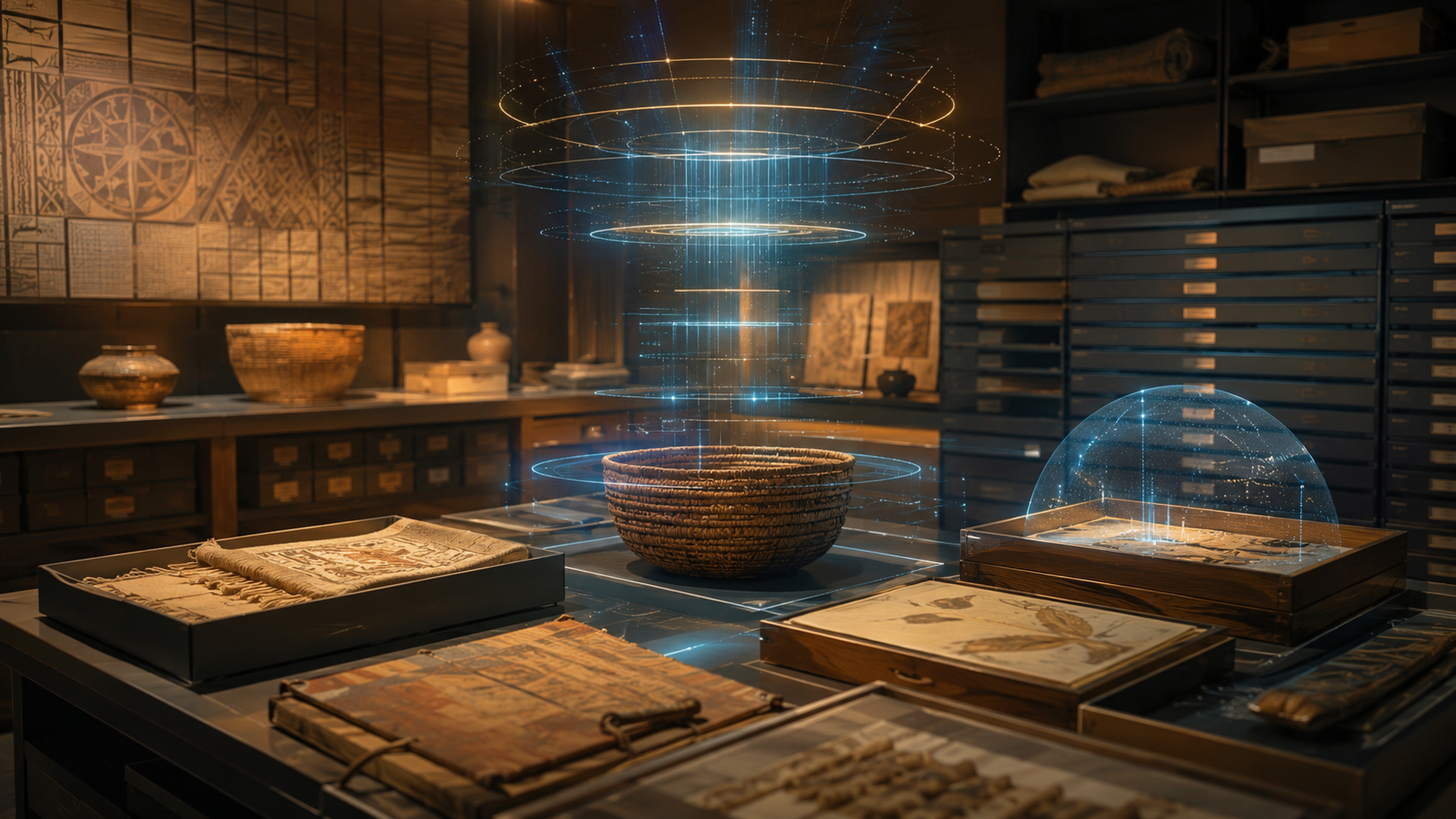
One modern ailment of museums is the tendency to misdiagnose every complex problem as "insufficient resolution." Capture sharper photographs, make more three-dimensional scans, upload them faster, and the responsible authority seems to earn a certificate of technological absolution—as if sharper images automatically made history fairer and prompted ancestors in the cloud to click "Like." But it is never that simple. When cultural institutions move images of ancestral-spirit ceremonies, old family photographs, Indigenous-language recordings, weaving patterns, oral histories, excavated objects, and community records onto digital platforms, the real question is not how many K of resolution an image has. It is who decides which content may be seen, which must be restricted, and which may be accessed only by particular community members, researchers, or community representatives. Unless those questions are settled first, a so-called "digital-archive upgrade" may simply move old inequalities onto a new server.
Who Has the Right to Interpret Cultural Data
The first blind spot in digital archiving is how easily engineering language takes control. Project presentations readily discuss equipment, formats, backup systems, and platform traffic, but rarely confront the harder question of interpretive authority. Who writes the object description? Who decides whether a ritual video depicts a "cultural performance" or contains "taboo knowledge"? Who determines whether an ancestral belonging may be displayed publicly, limited to educational use, or kept within the community's governance context? If every judgment ultimately returns to curators, contractors, or platform administrators, even a beautiful digital platform can become a new system for speaking on other people's behalf: it claims to preserve a culture while silencing the people to whom that culture belongs.
Open Access Does Not Mean Unconditional Disclosure
The second blind spot is treating "openness" as the only virtue. Museums and academic databases around the world increasingly emphasize open access, open data, and educational sharing. These principles have value, but the same standard cannot simply be applied to Indigenous knowledge, family narratives, or ritual information. Discussions of Indigenous Data Sovereignty have long emphasized that cultural data are not ordinary administrative records. They are often bound to kinship, land, language, ritual, wounds, and collective memory. Some content can be preserved but should not be made indiscriminately public; some may be studied only with community consent. Even when materials have already entered a public collection, the community should retain the right to reclassify them, restrict discovery and access, or request their removal. Put plainly, openness must not override consent, and technical convenience cannot trump cultural boundaries.
Tiered Access Matters More Than Putting Everything Online
This is why tiered access matters more than putting everything online. A sound digital archive does not simply dump files onto the internet; it assigns different access levels to different materials: public educational use, access for registered researchers, use after application and approval, community-only viewing, preservation backups with no public access, and even periodic review. This governance structure may look cumbersome, but it is more honest than the efficiency myth of making everything available with one click. Culture is not a universal format, and data governance cannot rely on two lazy choices: "put everything up" or "lock everything down." A mature institution treats administrative costs as part of its ethical responsibility. It does not push the burden back onto the community by saying, "Decide everything yourselves, then come back to us."
Generative AI Amplifies Reuse Risks
The third blind spot is ignoring the risks of reuse after digitization. Many institutions assume that scanning and uploading material, then adding a copyright notice, fulfills their duty of protection. Today's risks, however, extend beyond conventional copying to data scraping, model training, derivative design, and decontextualized circulation. Upload an image containing a ritual motif today, and tomorrow it may be harvested as a commercial asset. Release an Indigenous-language oral recording, and before long it may be used to train a model with no community-governance mechanism. This is not science fiction; it is routine in the contemporary platform economy. A museum that still comforts itself by saying, "We identified the source," is holding a paper umbrella in a downpour: the gesture is visible, but it offers no real protection.
Taiwan Needs Long-Term Governance
For Taiwan, the central challenge in digital archiving is the institutional gap. Many projects prioritize initial buildout over long-term governance, visible results over community negotiation, and item counts and traffic over correction and withdrawal mechanisms. When a project ends, the platform remains but the relationships dissolve; files are online, but rights and responsibilities are unclear. This is especially harmful to Indigenous cultural materials, which are often not individual copyrighted works but complex bodies of material involving collective rights, the knowledge of Elders, and intergenerational co-governance. Applying routine administrative-procurement logic produces preservation projects that look digital but remain ethically crude.
Embedding Co-creation, Decision-Making Power, and Compensation into Systems
What truly deserves investment, then, is not a flashier archive interface but a more mature system of governance. First, establish community consultation and consent before a project begins, rather than asking only after recording and scanning are complete. Second, create adaptable metadata and sensitivity labels that embed cultural context in the data architecture, not merely in exhibition copy. Third, define licensing scope and rules for reuse, explicitly addressing AI training, commercial adaptation, and third-party downloads. Fourth, retain mechanisms for withdrawal, correction, and reclassification so that one authorization granted a decade ago does not permanently deprive a community of a voice in the material's future. Fifth, institutionalize co-management rather than limiting participation to the cheapest roles of "interviewee" or "material provider."
Another often-overlooked issue is how the labor of archiving is distributed. Community participation may be attractively packaged while Elders, cultural workers, and local young people are asked to fill the institution's knowledge gaps for free: identifying people and place names, enriching narratives, explaining taboos, and correcting mistakes, only to have that labor reduced to a line saying "Thank you for your assistance." If digital archives genuinely value co-creation, knowledge annotation, contextualization, and review of sensitive material must be recognized as professional work, with formal budgets and decision-making authority. Otherwise, the community once again becomes a data provider rather than a governance partner. This inequality may not look like a data problem, but it lies at the heart of data politics.
The Cloud Is Not a New Drawer for Ancestors
Ultimately, if museums truly want to bring ancestors into the cloud, they cannot treat the process as a high-resolution relocation. Ancestors are not stock asset packs, and community memory is not a platform content pool. Digitization can create opportunities for preservation, education, and connection, but only if institutions acknowledge that cultural data have boundaries, knowledge circulates under conditions, and technological progress carries ethical costs. Otherwise, the result is painfully familiar: the images are sharper, but power relations remain blurred; the platform is more modern, but cultural governance remains in the past. Such an "upgrade" merely places ancestors in a prettier drawer.
Further Reading and Sources
- UNESCO Charter on the Preservation of Digital Heritage|Date: 2003-10-15|Verification considerations: Confirms principles for digital heritage preservation, accessibility, and protection of sensitive information.
- Local Contexts: Traditional Knowledge Labels|Date: Continuously updated|Verification considerations: Confirms TK Labels design regarding cultural authority, usage conditions, and community agreements.
- Global Indigenous Data Alliance: CARE Principles for Indigenous Data Governance|Date: Promoted since 2018|Verification considerations: Confirm the four principles of Collective Benefit, Authority to Control, Responsibility, and Ethics.
- International Council of Museums: ICOM Code of Ethics for Museums|Date: According to official latest version|Verification considerations: Cross-checks ethical standards on museum-community cooperation, provenance verification, sensitive collections, and repatriation issues.
- Bureau of Cultural Heritage, Ministry of Culture: 國家文化資產網|Date: Continuously updated|Verification considerations: Confirm the official classification and public-access methods for Taiwan's cultural assets, traditional knowledge and practices, oral traditions, and antiquities.
AI use and content-safety disclosure
This article was assisted by AI in data organization, structural drafting, and sentence polishing; human editors set its perspective and fact-checking direction, with verification considerations retained for item-by-item human review.