Downsizing Farm Machinery Does Not Make It Suitable for Smallholders: Slopes, Field Ridges, and the Last Mile for Agricultural Robots
Original Chinese title: 農機不是縮小就叫適合小農:坡地、田埂與農業機器人的最後一公里
An agricultural robot that excels only in flat fields but cannot operate on slopes, navigate field ridges, or climb gravel farm roads does not yet serve the small-scale farms common in Taiwan and its Indigenous communities.
Yuan Media AI Editorial Desk
Editorial team focused on technology and public culture, local industry, agricultural resilience and Indigenous township public services; advocates that any technical solution must return to real landscapes and user conditions.
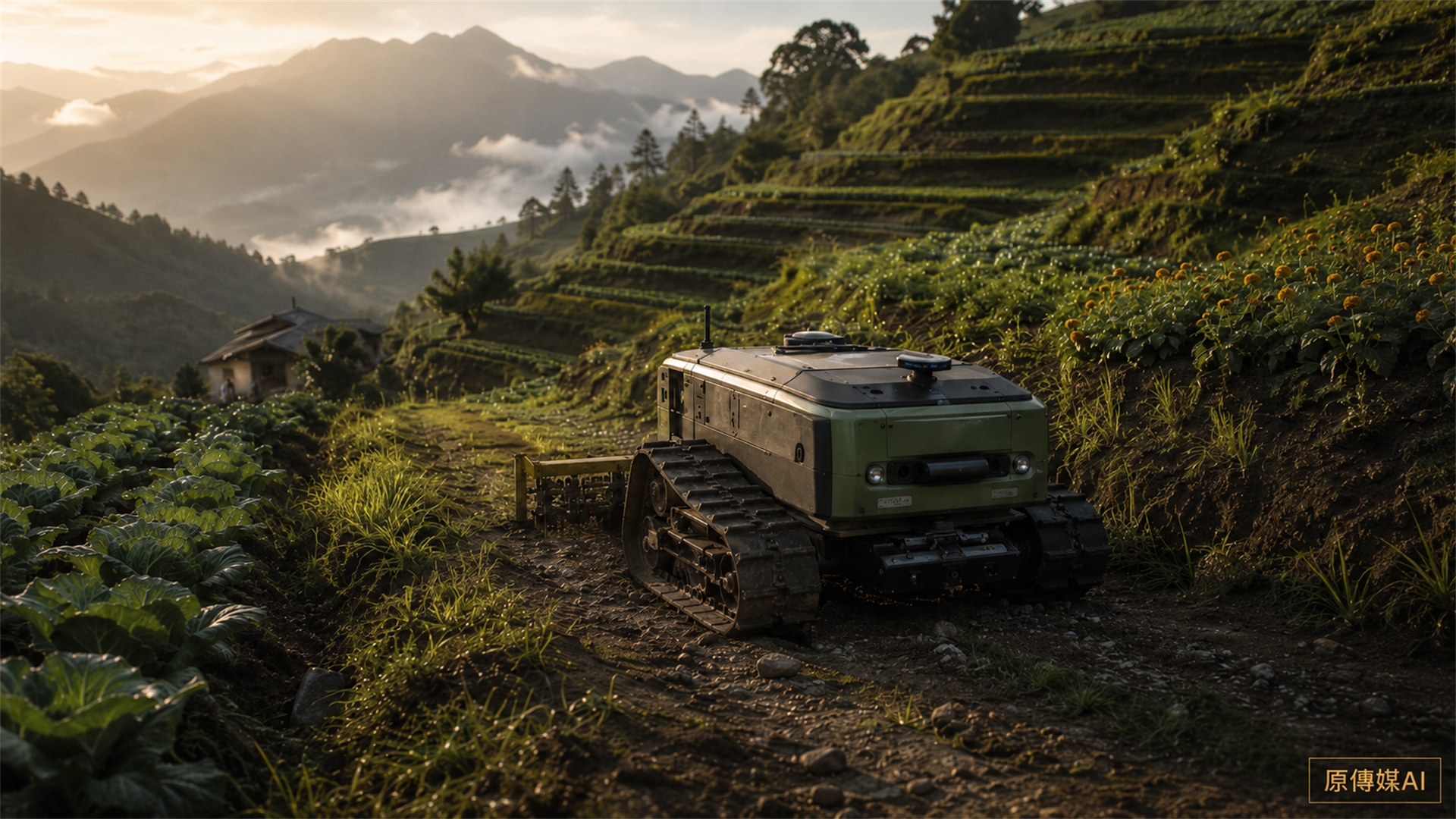
Presentations about agricultural technology often feature the same scene: a broad, straight field, orderly rows, clean roads, and an autonomous machine that seems to have arrived from the future, moving slowly through the sunset. It is an attractive image—exactly the kind that makes investors nod. But much of Taiwan’s farmland looks nothing like it, least of all farms in Indigenous communities and mountain regions. Real fields may include slopes, narrow farm roads, irregular plots, field ridges with tight turns, gravel, makeshift repairs to irrigation channels, and a working rhythm of “harvest what we can today and see what the weather brings tomorrow.” Many machines promoted as solutions to farm-labor shortages therefore meet their first obstacle in the field: not an AI model, but a corner they cannot turn.
The Last Mile Is Often Not a Network but a Field Ridge
The technology sector often uses “the last mile” to describe a gap in service. With farm machinery, the phrase becomes strikingly literal: the last mile may run from an industrial park to a farm road in an Indigenous community, from a demonstration farm to a hillside, or from a flat test plot to a real crop environment. Many machines perform smoothly on level ground because the site is controlled, the path is clear, and obstacles are few. In the conditions smallholders actually face, however, a machine may be too wide, lack sufficient ground clearance, have the wrong track width, lack gradeability or battery capacity, require too large a turning radius, or break down where nobody nearby can repair it promptly.
These details may appear minor, but they expose a central blind spot in farm-machinery innovation. A machine does not become suitable for smallholders simply because a large model is made smaller and fitted with sensors and automation modules. Smallholders face more than reduced scale: their working conditions are more fragmented, capital is more limited, repair resources are more dispersed, and crop types are more varied. If designers continue to treat large, standardized fields as the default, even highly sophisticated technology may fail in real farmland.
Site Suitability Applies to Machines as Well as Crops
Agriculture has long emphasized matching crops to place: which crops suit which land. The same principle should apply to machinery. Which machine suits a particular landscape? Which chassis can a farm road support? What kind of power and safety design is appropriate for a given slope? If the design of an agricultural robot does not begin with the landscape, its intelligence may exist only in the demonstration materials.
For hillside and small-scale farming, the crucial design criteria are practical: Can the machine travel safely on narrow farm roads and climb the required grades? Does it maintain traction on mud and gravel? Do its sensors remain reliable in humidity, fog, and when foliage blocks their view? Can working modules be changed quickly? Is the machine light enough to avoid damaging the field? And, most concretely, can farmers afford it, learn to operate it, and repair it when it breaks? If these questions remain unanswered, even the most refined autonomous-navigation system merely sends an unsuitable machine into an unsuitable place.
Labor shortage is real, but "replacement" should not be thought too simply
Farm-labor shortages are often cited as the strongest reason to introduce machinery, and rightly so. But a shortage of labor does not mean that a machine can simply replace a person. Many agricultural decisions depend on experience: reading soil moisture and plant condition, watching the weather and the first signs of pests or disease, and deciding whether to harvest now or stop work. Some tasks are well suited to mechanization; others call for machines that assist people rather than replace them. A viable approach treats machinery as a partner that reduces physical strain and improves safety and consistency, instead of assuming that all field knowledge can be packaged into an algorithm at once.
This is especially important for Indigenous communities and local industries. Farming in many places is not simply the production of standardized bulk commodities; it is closely connected to terrain, the division of labor within a community, family cooperation, and seasonal rhythms. Technology that merely copies the model of large-scale agriculture can easily miss the specific burden local farmers need reduced. They may need safe transport rather than fully automated harvesting, semi-autonomous weeding rather than a completely unmanned farm, or a chassis and power system that can reliably negotiate a mountain road after rain rather than the most dazzling computer-vision system.
The real thresholds are often in repair and business models
Many farm-machinery startups fail not because they cannot build a prototype, but because they cannot sustain after-sales service. A farmer buying a machine is not merely purchasing equipment; the purchase includes an entire maintenance relationship. Who will install it, teach people to use it, service it, and respond first if it breaks just before harvest? A machine that runs beautifully at a trade show but loses access to spare parts, repair centers, and qualified troubleshooting as soon as it leaves the city has not truly entered the agricultural industry.
Future development of farm machinery therefore has to address service models as well as the performance of individual machines. Leasing, shared fleets, partnerships with local repair providers, modular parts, and service networks built with farmers’ associations or local teams may be more viable than simply selling expensive equipment. Many farmers do not need to own a machine. They need an affordable and repairable service that is available during a particular stage of the farming cycle. Without this understanding, even advanced agricultural robots may serve only the small group with the most capital, the flattest fields, and the greatest market visibility.
If machine design does not return to place, it will hardly return to land
Agricultural technology often presents itself as the future, but farmland has little patience for rhetoric. The field asks one question: Does it work? Can it reduce part of the hardest physical labor? Can it make work safer for older farmers? Can it help operations recover quickly after a typhoon? Can it remain stable on difficult terrain such as slopes and field ridges? No flashy demonstration can substitute for answers to these questions.
The most worthwhile innovations in farm machinery should therefore begin with local farmers and landscape conditions together. Prototypes should be taken into Indigenous communities, onto hillsides, and along narrow farm roads, with users involved early in the design process. Engineers should not define the requirements alone; farmers, transport workers, local repair providers, and cooperative organizations should participate as well. That is how technology moves beyond praise in an urban exhibition hall and survives on the ground where it must actually work.
Agricultural resilience does not grow automatically from presentations
Amid climate change, an aging agricultural workforce, and the transformation of local industries, machinery is unquestionably important. But resilience does not emerge from piling up fashionable terms. It requires appropriate technology, institutions, and services to work together. For smallholders and Indigenous communities, the most valuable machine is not necessarily the largest, most expensive, or most heavily marketed as AI. It is the one best adapted to the terrain, most durable, easiest to maintain, and most dependable at a critical moment.
Farm machinery does not become suitable for smallholders merely by being made smaller, and a camera alone does not make a machine intelligent. The challenge always lies in the last mile: from concept to field, from prototype to repair, and from a technological vision to something a community can actually use. Only those who cross that distance can credibly claim to be advancing agricultural innovation.
Technology Should Bridge the Needs of Returning Young Farmers and Older Farmers
For many communities, farm machinery concerns not only efficiency but also generational continuity. Older farmers need relief from physical strain, while young people returning to rural communities need to see a viable livelihood. Technology that is expensive, difficult to repair, and dependent on service conditions found only in cities will not build a bridge; it may once again exclude local communities from innovation. Good farm-machinery design should make work safer for experienced older farmers, make it easier for younger people to take over, and help local cooperative organizations build new capacity in maintenance, operation, and service.
Sources retained from the Chinese original
AI use and content-safety disclosure
AI assisted with research organization, structural drafting, and language refinement. Human editors determined the perspective and fact-checking priorities, with verification considerations retained for item-by-item human review.