Cities Are Not Ovens, Yet We Build Them Like Ovens: Why Cooling Must Be Treated as Public Infrastructure
Original Chinese title: 城市不是烤箱,卻被我們蓋成烤箱:冷卻為何應被視為公共基礎設施
Facing increasingly frequent high temperatures, cities need more than energy-saving slogans: shade, ventilation, green corridors, water bodies, cooling centres and building codes must be treated as infrastructure.
鄭淑禎
Focuses on public policy, local industries, urban governance, and sustainable business models, with a long-term interest in how infrastructure shapes social resilience, health risks, and the distribution of public services.
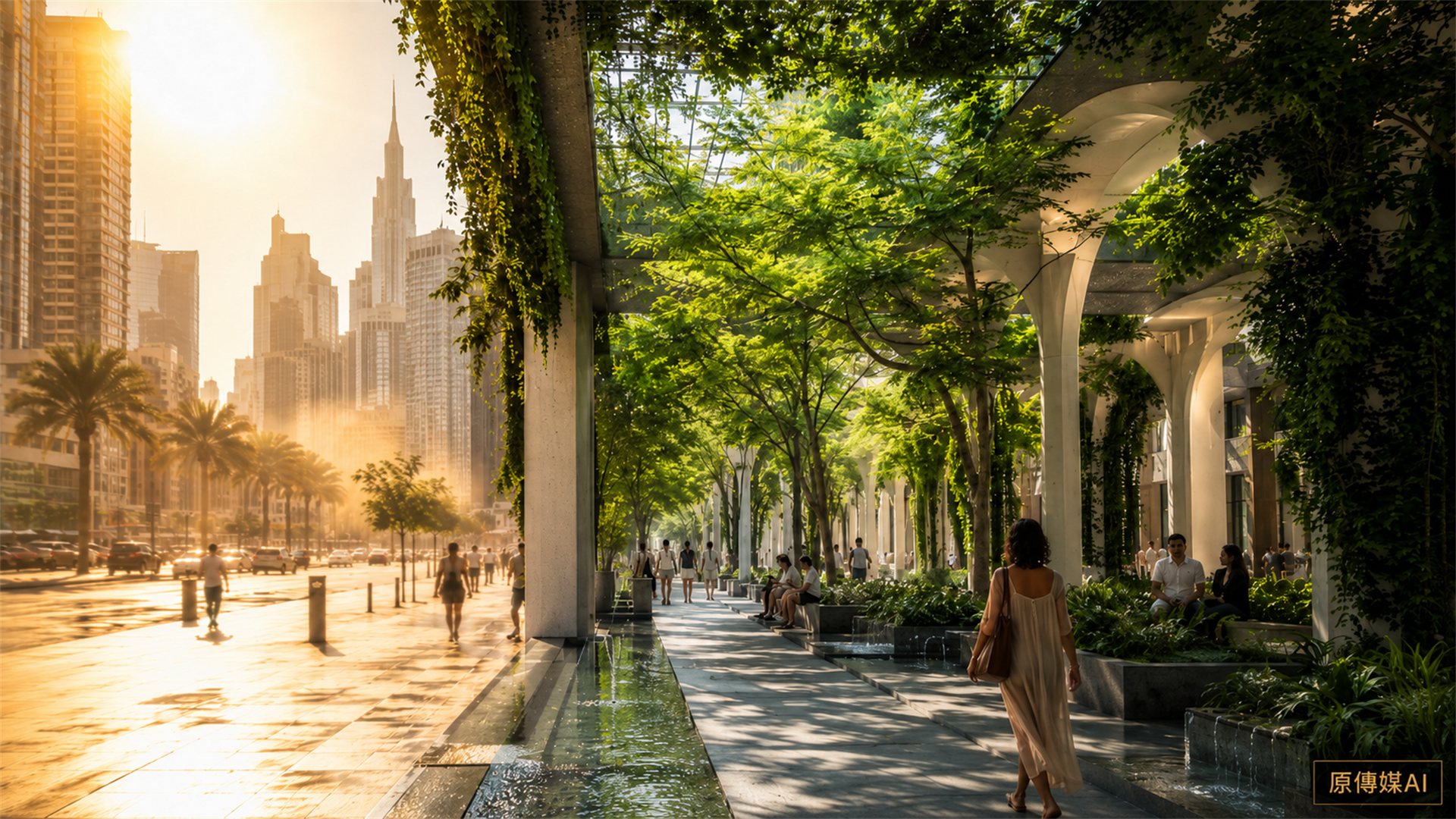
When walking through a city at noon in midsummer forces pedestrians to hurry like food on a baking tray, search for every patch of shade, and hope the next corner offers air conditioning, the problem is usually more than the weather. It is also governance. Extreme heat is unquestionably connected to global warming, but whether a heatwave becomes a daily ordeal depends on paving and building materials, street dimensions, tree-canopy density, public places to rest, transit waiting-area design, and even who can afford to live in a cooler neighborhood and who must work and live where shade is scarce. To put it bluntly, many cities are not defeated by the sun; they first build themselves into ovens.
Misidentifying Cooling as a Private Good Undermines Urban Justice
When people talk about cooling, their first thought is often air conditioning. That response is understandable, but dangerous. An air conditioner is an individual appliance, not a public solution. It protects people who have electricity, indoor space, and the ability to pay, but it does not automatically protect street workers, older adults in aging apartment buildings, public-transport users who must walk between connections, or anyone who has to wait outdoors during the day. When a city leaves all responsibility for escaping the heat to households and shopping centers, it quietly declares that those with more resources deserve to be cooler.
This is why cooling must be treated as public infrastructure rather than a private consumer good. Like water supply, drainage, roads, and public transport, access to cooling shapes collective safety, health, and equity. A street with no capacity to reduce heat is not merely uncomfortable; it raises the risks of heat illness, cardiovascular stress, workplace injury, and greater demand for medical care. A community without shade or water is not simply less attractive; it is less resilient. If extreme heat is the new normal, cooling belongs on the standard list of infrastructure.
The Urban Heat Island Effect Is Not Nature's Will; It Is a Political Outcome of Cumulative Design Choices
Urban heat islands are usually not caused by one engineering mistake, but by the accumulation of design priorities over time. Cities overuse heat-absorbing paving, treat trees as obstacles to development, build plazas without shade, prioritize roads over walking, and regard covered arcades and green corridors as optional. Each decision may appear minor on its own, but together they transform the city’s thermal environment. Heat is not an abstraction here; it is locked in layer by layer through materials, building density, transport systems, and land use.
Heat governance therefore cannot stop at public-awareness campaigns or the temporary spraying of water when temperatures make the news. Effective policy has to operate at both the street-block and building scales: increase tree-canopy coverage, design ventilation corridors, use high-albedo materials, preserve permeable surfaces, add pocket parks and shaded pedestrian routes, create accessible public cooling centers, and make heat reduction a requirement in building codes and urban-design reviews rather than an optional form of beautification.
Urban Cooling Must Prioritise the Vulnerable, Not Luxury Homes
Heat never strikes everyone equally. The first people harmed are often those already at a disadvantage: older adults, infants, people with chronic illnesses, residents of top floors or aging homes, outdoor workers, sanitation crews, delivery workers, construction workers, people experiencing homelessness, and those who rely on walking and public transport. They may rarely appear in urban-design presentations, but they bear the most direct costs of poor heat planning.
If public policy genuinely treats cooling as infrastructure, it should start with this unequal distribution of risk. High-exposure areas need shaded transit stops and drinking-water points. Communities need clearly identified and easily reached places where people can escape the heat. Neighborhoods with many older residents need heat-alert and outreach systems. Occupational-safety rules and limits on work during extreme heat must become part of governance, rather than being reduced to the instruction “Please drink more water.” Shifting responsibility back onto individuals is the easiest—and least responsible—approach.
Cooling Infrastructure Is Not Just Trees; It Also Includes Institutions
Discussions of cooling naturally turn to planting trees. Trees matter greatly, but reducing heat governance to a few new plantings ignores the institutional work involved. Trees require maintenance, water, room for soil, and long-term management. Sidewalks must be designed together with building setbacks, covered walkways, and storefronts. Cooling centers need operating budgets, publicly available information, and transport access. Building energy efficiency and indoor thermal comfort must be incorporated into regulations, subsidies, and renovation programs. Cooling is therefore not only a matter of spatial design; it is a governance program spanning finance, law, operations, and equitable distribution.
This reveals another common blind spot. Many cities readily invest in novel-looking smart applications but hesitate to fund the basic, unglamorous, and highly effective work of providing shade, maintaining assets, and caring for vegetation. Monitoring systems, sensors, and heat maps are useful, but if they merely map the heat more precisely without making the streets cooler, they do little more than confirm residents’ suffering in high resolution.
Buildings and Streets Must Cool Together Rather Than Heat Each Other
Urban cooling cannot rely only on parks or only on mechanical systems inside buildings. Effective strategies usually come from coordinating buildings and streets. A ground-floor interface that retains shade and places where people can linger makes walking safer. Better insulation and natural ventilation in a building envelope can reduce demand for indoor air conditioning. Green corridors, water, and permeable surfaces along streets can moderate the surrounding microclimate. Heat governance is not about one heroic facility; it depends on thoughtful coordination across many scales.
Cities should go further and include “access to cooling” in their planning indicators. Just as planners ask whether a public-transport stop is within reach, they should ask how long it takes a resident to walk from home to reliable shade, drinking water, or a public cooling center. Does a ten-minute walk during the day mean continuous exposure to the sun? Is access to thermal comfort distributed unevenly between older neighborhoods and new developments? Unless these questions are measured and tracked, heat governance can easily remain a slogan.
If Cities Do Not Cool Down, Economy and Health Will Pay Together
The cost of a heatwave extends far beyond electricity bills. Extreme heat reduces labor productivity, raises medical spending, strains the power grid, discourages the use of public space, and deepens social inequality. Over time, those costs also weaken a city’s competitiveness. Who wants to live, invest, or raise children in a city where walking feels like punishment, waiting for transport becomes a test of heat tolerance, and outdoor work carries a constant risk of heat illness? If public officials still treat cooling as an accessory, they are not treating climate risk as a basic responsibility of government.
Public infrastructure matters not because it looks impressive, but because it protects people reliably and universally. As the climate changes, cities must understand anew what protection requires. Cooling is not a luxury but a matter of safety; not scenery but a basic condition of life; not an optional extra but a standard requirement. Turning a city from an oven back into a livable place will take more than a net-zero slogan. It requires every shaded street, every well-cared-for tree, every genuinely accessible public place of refuge from heat, and every policy decision that finally treats extreme heat seriously.
From Budgets to Metrics: Cooling Must Be Formally Written into Urban Governance
If local governments genuinely treat cooling as infrastructure, the next step is not another public-awareness press conference. Cooling must be written into budgets, procurement, maintenance plans, and performance indicators. Do road-renewal projects also improve shade and permeability? Do schools, hospitals, markets, and parks have explicit standards for relief from heat? Must urban-renewal projects and major developments submit heat-risk assessments and cooling plans? These are the factors that determine whether a city can move from anxiety about heat to the governance of heat. Once cooling is institutionalized, it will not be remembered only during a heatwave; it will be maintained as an everyday public capacity.
Sources retained from the Chinese original
AI use and content-safety disclosure
AI assisted with research organization, structural drafting, and language refinement. Human editors determined the perspective and fact-checking priorities, with verification considerations retained for item-by-item human review.