Who Is Accountable for Legal Standards in the Age of AI Adjudication? Efficiency, Bias, and the Last Line of Human Judgment
Original Chinese title: AI 審判時代,法律判準誰來負責:效率、偏誤與人類裁決的最後防線
AI is rapidly entering courts, law firms, and administrative penalty processes, but justice cannot focus solely on efficiency. This article examines high-risk judicial AI through the lenses of bias, accountability, transparency, and procedural fairness, asking how such systems should be constrained.
Yuan Media AI Editorial Desk
Lead editorial writer. Focuses on Indigenous norms and taboos, law and public policy, education, technology governance, and public knowledge.
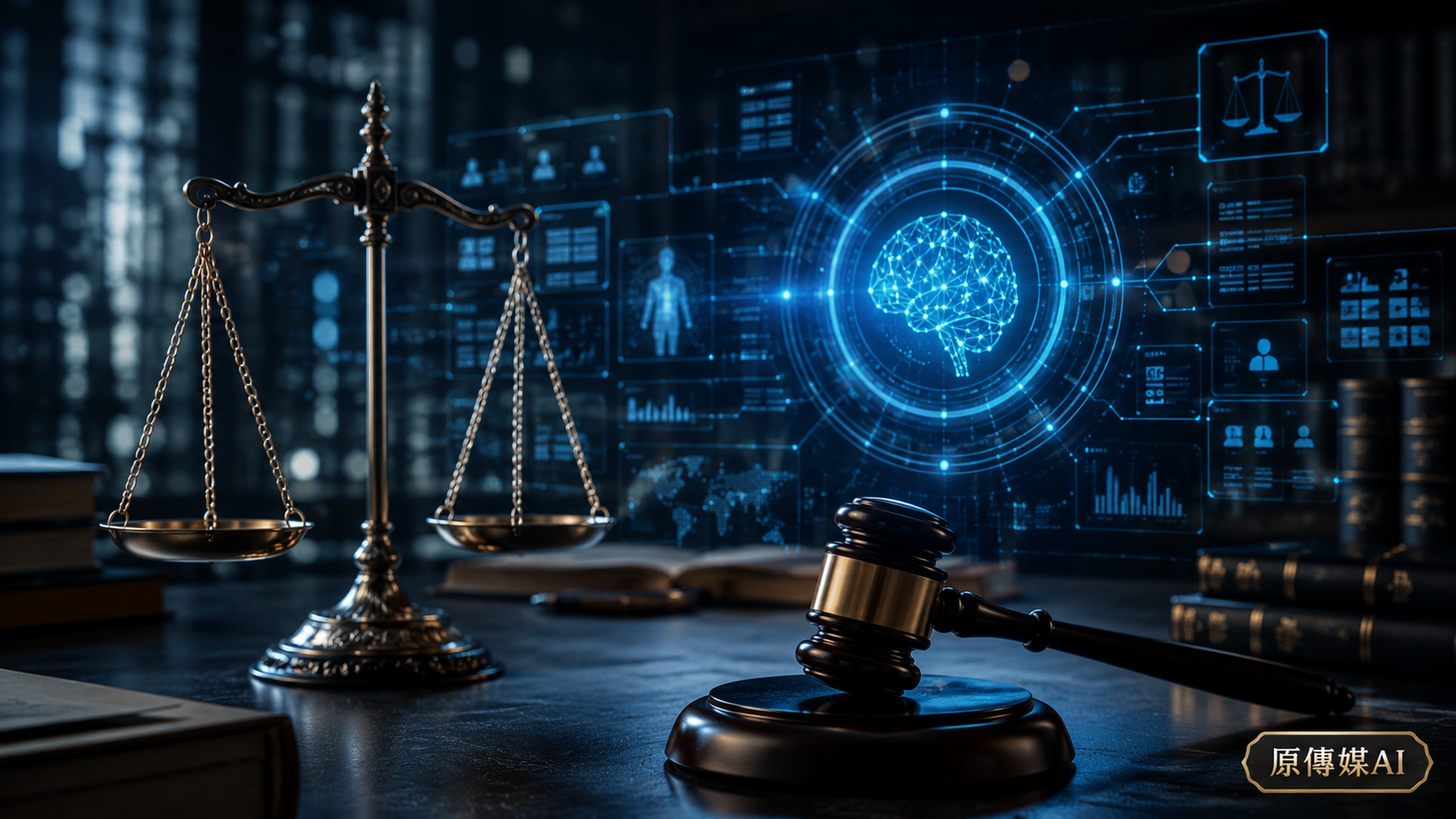
The most captivating aspect of AI entering the judiciary is never justice itself, but efficiency. The legal world has always been burdened by mountains of paperwork, protracted procedures, and complex bodies of precedent; any tool that can shorten time, reduce costs, or organize risk will immediately be hailed as a hope for institutional modernization. Thus, case classification, automatic summarization, sentencing recommendations, risk assessments, contract reviews, statute retrieval, and evidence organization have all been added to the AI application list. It seems reasonable: if medicine can use models to assist diagnosis, finance can use algorithms to assess credit, why not let tools help judges, prosecutors, and lawyers work faster?
But justice cannot focus solely on efficiency precisely because it deals never with standardized parts but with human destinies. The cases before a judge are not rows of samples in a data table; they are concrete lives where someone loses freedom, someone loses property, someone loses guardianship, someone is tagged with a criminal record. When AI enters this arena, the most important question is not "will it be faster" but "who is responsible when it errs," "who detects its bias," and "how much room remains for human understanding once people are reduced to scores."
Debates about algorithmic justice internationally have long moved beyond science fiction. From racial bias concerns over U.S. criminal risk assessment tools, to EU regulations on high-risk AI systems, to courts worldwide warning against generative AI fabricating statutes, inventing precedents, and producing erroneous summaries, the issues are clear: law is not a world that automatically approaches fairness simply by accumulating enough data. Law itself carries value judgments; judicial practice is even more filled with context, trade-offs, and ethical tensions. AI can help here but cannot pretend to have no stance.
More troubling, many judicial AIs are not merely passive tools but actively shape decision processes. Once courts' administration, law firms, police systems, or administrative penalty agencies habitually rely on model recommendations, the originally auxiliary system may subtly become the driver of the decision-making process. For example, case-routing models affect which cases receive priority attention; risk-assessment models influence thinking about bail, parole, and sentencing; automated review tools flag certain contract clauses as high-risk, prompting lawyers and corporations to adopt more conservative or exclusionary strategies. The problem is not whether it makes the final decision but that it frames the boundaries of the decision before anyone makes it.
Some will say, then require a human to make the final decision. This sounds reassuring but is often too naive in practice. Once a system's output looks sufficiently professional and stable, people easily begin to trust it automatically. In technology governance there is an old problem: automation bias. That is, when people face machine judgments, they are less willing to question them, especially under intense time pressure, massive caseloads, and blurred lines of responsibility. Thus, “human review” often becomes little more than a rubber stamp; the real criteria have quietly been outsourced to models.
For Indigenous Peoples, minority communities, or those already more prone to institutional misreading, this risk must be recognized even more clearly. Justice is not merely the application of legal texts; it also requires understanding cultural contexts, norms and taboos, community relationships, and lived circumstances. If training data itself contains long-standing biases—for example negative inferences about certain regions, ethnic groups, educational backgrounds, accents, occupations, or social labels—then the model merely makes existing inequalities more efficient. It may not say "I discriminate against you," but it can make bias harder to detect—and harder to appeal—through risk scores, association recommendations, case ordering, warning markers, and similar mechanisms.
This is why transparency and contestability are core conditions for judicial AI. Any model used for judicial assistance must clearly state data sources, scope of use, limitations, human review mechanisms, and avenues for remedy when errors occur. People affected by the model should know whether they are being analyzed automatically, be able to request explanations, and have opportunities to challenge results. This is not merely a technical governance issue but a procedural fairness problem. If a person does not even know how they were scored, ordered, or marked, then in the face of institutions they have already lost half.
Yet institutions often favor tools that appear neutral because they save time for bureaucratic machines and provide politicians with familiar language: “I did not decide; the system did. This is not bias; it is what the data show.” This rhetoric is dangerous precisely because it packages political responsibility as technical inevitability. If justice outsources responsibility to AI and then outsources responsibility for the AI to suppliers, only citizens suffer in the end. Because citizens face not a single error but an entire chain of unaccountable links.
Therefore, what truly needs to be established in the age of AI adjudication is not blind faith in technology but several decidedly unglamorous but necessary safeguards: First, AI must not replace judges' duty to provide reasons; any decision influenced by models must be explained by identifiable human decision-makers. Second, high-risk judicial uses must undergo external audits and periodic assessments, not relying solely on supplier self-certification of safety. Third, in cases involving minority cultures, socially vulnerable groups, or a high degree of discretion, deeper human review should be required rather than faster processing. Fourth, generative AI used for legal research and document assistance must establish citation source verification mechanisms to avoid fabricating precedents and statutes.
Yuan Media AI Editorial Desk cares about this matter not because we are enamored with tech buzzwords but because law and public policy, education, and public knowledge must be discussed early; otherwise future judicial risks will accumulate invisibly. If institutions loudly proclaim innovation while ignoring bias, responsibility, and cultural differences, what they ultimately get is not more modern justice but more efficient injustice.
Justice needs tools, but also restraint. It needs data, but also explanations. It needs efficiency, but also understanding of people. AI can assist in organizing case files, comparing precedents, discovering patterns, but cannot answer the most fundamental question: when a system is torn between efficiency and dignity, which side do we stand on? If this answer must be handed to algorithms, then ultimately what is judged may not be cases but society's imagination of justice.
There is also an often-overlooked issue: language. Legal documents are already full of specialized terminology, and generative AI seems adept at rewriting difficult content in plain language; this certainly helps public legal education and administrative convenience. But if plain-language rewriting quietly removes exceptions, room for discretion, and cultural context, it can simultaneously create new misunderstandings—especially for cases requiring cross-language, cross-cultural understanding. Machines may translate sentences smoothly but not truly grasp specific communities' ways of understanding responsibility, relationships, taboos, and conflict resolution. This is why any deployment of judicial AI should not exclude humanities, language, and social science expertise; it cannot be handed solely to engineering and regulatory compliance teams.
Equally important is education. In the future, not only judges need to understand AI but citizens also need to know under what circumstances they may be evaluated by a system, have their data matched, or receive automated recommendations. If society treats AI as an unquestionable technical authority, then even if institutions superficially retain appeals and remedies, it will be very difficult to exercise those rights in practice. The last line of defense for justice will not only be in courtrooms but also whether citizens have the capacity to understand how technology affects them and the confidence to question institutions. Without cultivating this ability, no matter how beautiful governance principles may be, they might remain mere promises on paper.
Sources retained from the Chinese original
AI use and content-safety disclosure
This article was assisted by AI for data organization, structural drafting, and sentence polishing; human editors set the viewpoint and fact-checking direction, with verification considerations retained for item-by-item human review.