When Algorithms Arrange the Dining Table: How Automated Restaurants Are Changing Hunger, Choice, and Bodily Awareness
Original Chinese title: 當餐桌被演算法安排:自動餐廳如何改變飢餓、選擇與身體感
Automated ordering, recommendation systems, and robotic kitchens are reshaping the modern dining table. This article approaches from food culture, labor, and public health perspectives, exploring how algorithms rearrange hunger, taste, and choice.
鍾靜蓉
PhD in Digital Education, National Taiwan University of Science and Technology / Digital Teaching Strategy Application / Meta-data Reasoning Analysis.
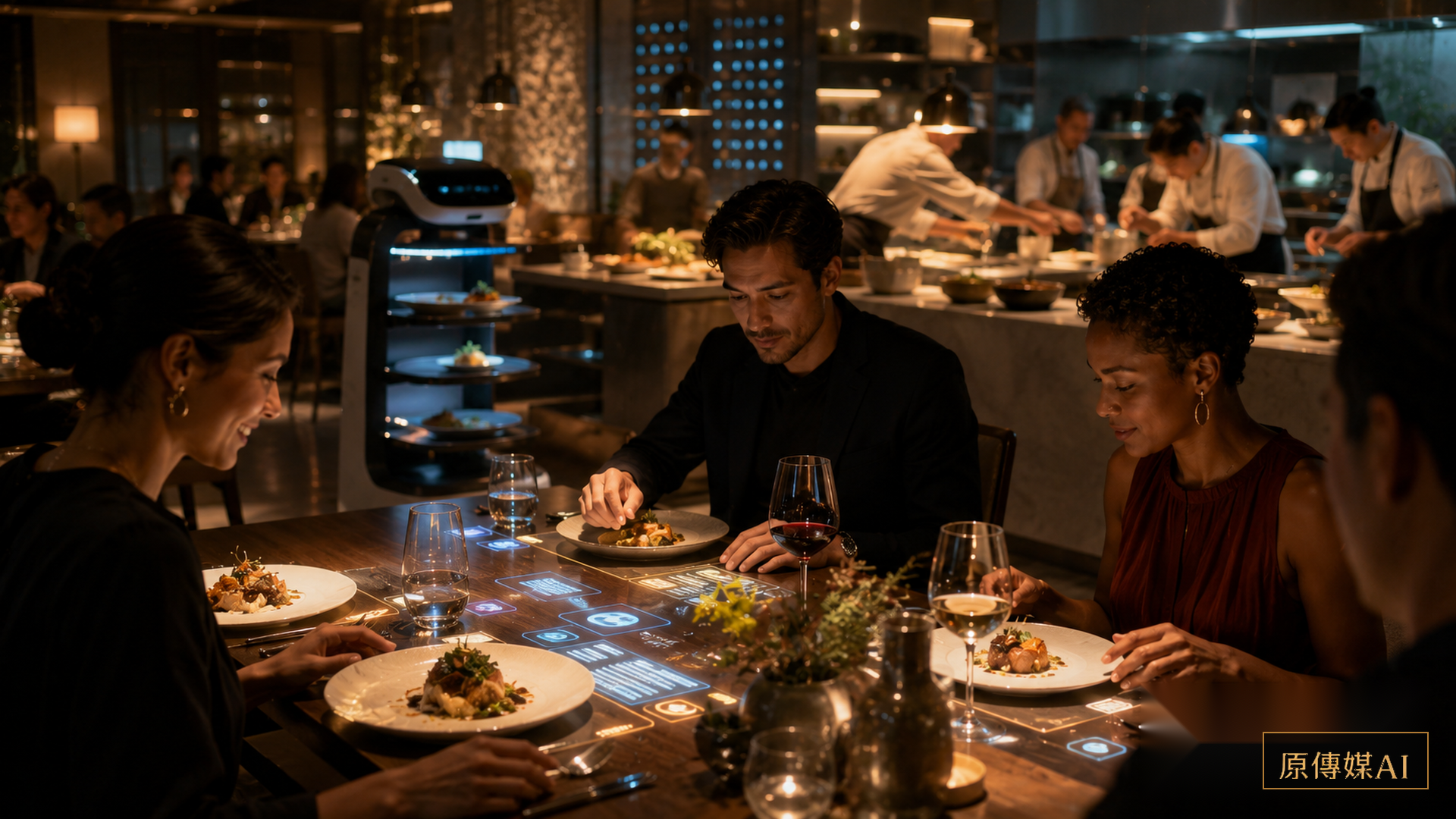
If twentieth-century restaurants placed chefs at center stage, twenty-first-century dining technology is trying to hand the entire stage over to systems. Self-service ordering, recommendation algorithms, cloud kitchens, dynamic pricing, delivery platforms, smart menus, robotic arms, and nutritional-analysis models are collectively shaping a food world that appears convenient. You walk into a restaurant and scan a QR code with your phone to order; the system knows what you ate last time, which flavors you prefer, when you usually place an order, and even how much extra you might be willing to spend today. The food may arrive more promptly and be more consistent and precise—but as the dining table increasingly becomes an extension of back-end computation, are we gaining greater freedom of choice, or are our choices simply being managed in finer detail?
The benefit most often cited when algorithms enter food service is efficiency: faster order routing, more accurate ingredient preparation, less waste, lower labor costs, and standardized service flows. For operators, these are all welcome gains. Since the pandemic, many restaurants have also treated automation as a survival tool. Amid labor shortages, high rents, and pressure to turn tables quickly, any technology that can stabilize output feels like a lifeline. Robotic arms prepare meals, smart ovens regulate temperature, sensors track inventory, and AI forecasts customer traffic. On the surface, these technologies move restaurants away from a traditional labor-intensive model and toward more calculable industrial processes.
But eating has never been only about putting calories into the body. Food involves memory, emotion, class, culture, companionship, and embodied experience. When a restaurant is reduced to the logic of efficiency, the first things to be diluted are precisely those that are hard to quantify. Recommendation systems keep presenting options similar to your past preferences. This may seem thoughtful, but it can also reduce the exploration of taste to a personalized echo chamber. Once a platform decides that you prefer high-protein, low-carbohydrate, mildly spiced food, late-night delivery, and a particular price range, the world it shows you grows ever narrower. You may think you are choosing, but the system has already defined the range of options you can see.
More intriguingly, algorithms arrange not only dishes but hunger itself. Push notifications, limited-time offers, late-night discounts, and minimum-order thresholds reshape when we feel that “it is time to eat.” Hunger gradually stops being only a bodily signal and becomes a rhythm jointly produced by interface design and commercial strategy. You may not have been hungry, but messages such as “recommended for you,” “just right for you tonight,” or “popular item almost sold out” can prompt you to order. Bodily sensations and platform cues become intertwined; appetite no longer belongs entirely to the stomach—it also belongs to the algorithm.
These changes also affect public health and social equity. Platforms prioritize high-margin items, which are not necessarily the healthier choices. Convenient ready-to-eat foods high in salt, sugar, and fat are often easier to market than genuinely balanced meals. And when nutritional information and price discounts are packaged as “health management,” responsibility is often shifted onto the individual: you eat poorly because you lack self-discipline, not because the system makes certain consumption patterns easier to follow. This framing is familiar because, like many myths about technology governance, it repeatedly recasts structural problems as personal failings.
Automated restaurants also transform labor. Supporters emphasize that machines can take over repetitive, dangerous, or high-pressure tasks and reduce the burden on workers. Critics point out that the jobs displaced are often the entry-level, migrant-worker, and low-wage service roles on which many people depend. More importantly, even if people do not disappear entirely, the work may be divided up differently: workers restock machines, clean, handle exceptions, and perform emotional labor, while machines take on the visibly “high-tech” tasks. Beneath the glow of technology, working conditions are not necessarily better; the labor is simply harder to see.
For food culture, there is another often-overlooked question: does standardization sacrifice local character? Food-service technology favors repeatable processes, precisely measurable parameters, and menus broken down into ingredients, time, temperature, and serving speed. This benefits chain operations, but it may weaken those aspects of local cuisine that depend on touch, seasonality, social interaction, and storytelling. Some flavors are precious precisely because they cannot be fully reproduced. Some dining tables stay in our memories not only because the food tastes good, but because they carry ties to a place, a family craft, and a cultural rhythm formed over time.
Still, we need not treat every technology as an enemy. When designed well, algorithms and automation can make food systems more responsible: they can reduce food waste, improve supply-chain transparency, make kitchens safer during peak periods, give consumers clearer allergen and nutrition information, and help older adults and people with special dietary needs obtain suitable meals. The question is not whether technology is present, but who designs it, whom it serves, and which values it prioritizes. If technology is organized only around efficiency and profit, it turns the dining table into an optimization interface. If health, equity, and culture are also built into its goals, it may become a genuine public tool.
Faced with automated restaurants, then, our most important response is neither to exclaim “How cool!” nor to panic that “humans are finished.” We should instead ask: Can the logic behind recommendations be explained? Are nutritional and price rankings transparent? How are personal dietary data stored and deleted? How does kitchen automation affect working conditions? Will local cuisines be pushed to the margins in the competition for efficiency? These questions may attract less attention than a robotic arm plating a meal, but they come much closer to the politics that emerge when food technology enters everyday life.
When algorithms arrange the dining table, we are confronting not just technology but a new system of food governance. It reorganizes hunger, rewrites choice, shapes our sense of the body, and redistributes who is visible in the kitchen and who is legible to the system. Restaurants of the future can be highly intelligent, but if “smart” means only faster orders, higher conversion rates, and more accurate predictions, they are merely better at doing business—not necessarily better at understanding people. Eating deserves a better future: one that combines technological convenience with room for bodies, places, and cultures that cannot be completely calculated.
Dining data are also becoming a new kind of bodily record. What you order, how often you order, which flavors you prefer, whether you add dessert, whether you order late at night, which foods hold your attention, and which labels attract you can all accumulate into an analyzable profile. When these data are linked to payments, location, social media, and health apps, a food platform can infer far more than consumption alone: it can construct a broader picture of your daily rhythms, emotional regulation, and bodily habits. This is why food technology is not only a matter of industrial innovation; it is also a matter of data governance and privacy.
If we truly want better smart dining, policy should set stronger requirements: platforms should clearly explain the basis for their recommendations; consumers should be able to opt out of personalized recommendations; people should have rights to delete and transfer their dining data; and the effects of automation on working conditions should be disclosed. The dining table is not merely a commercial setting—it is connected to public health, family culture, and local economies. Once algorithms begin to shape food, we can no longer treat them only as a product question of “Does it work well?” We must also ask the public-policy question: “What would actually be better for people?”
From the consumer’s perspective, another subtle change deserves attention: when machines and interfaces make service almost frictionless, it becomes easier to forget that food still depends on land, supply chains, and labor. The smoother the system, the more invisible the production process becomes. Food is not only placed on platforms; it is also stripped of context. If future smart-dining systems fail to address traceability, fair trade, and relationships with local ingredients and producers, their “intelligence” will remain distinctly one-sided.
Sources retained from the Chinese original
AI use and content-safety disclosure
AI assisted with research organization, structural drafting, and language refinement. Human editors determined the perspective and fact-checking priorities, with verification considerations retained for item-by-item human review.