Climate Resilience in the Valley: Energy-Efficient Housing in Indigenous Communities Cannot Be Just a Power-Generating Model Home
Original Chinese title: 山谷裡的氣候韌性:原鄉節能住宅不能只是一棟會發電的樣品屋
If energy-efficient housing in Indigenous communities pursues only power-generation efficiency, it risks becoming a showcase. This article considers genuinely climate-resilient housing through mountain terrain, community operations and maintenance, cultural context, and public services.
山海資料庫
Consultant: 廖福德 | Former county government department director.
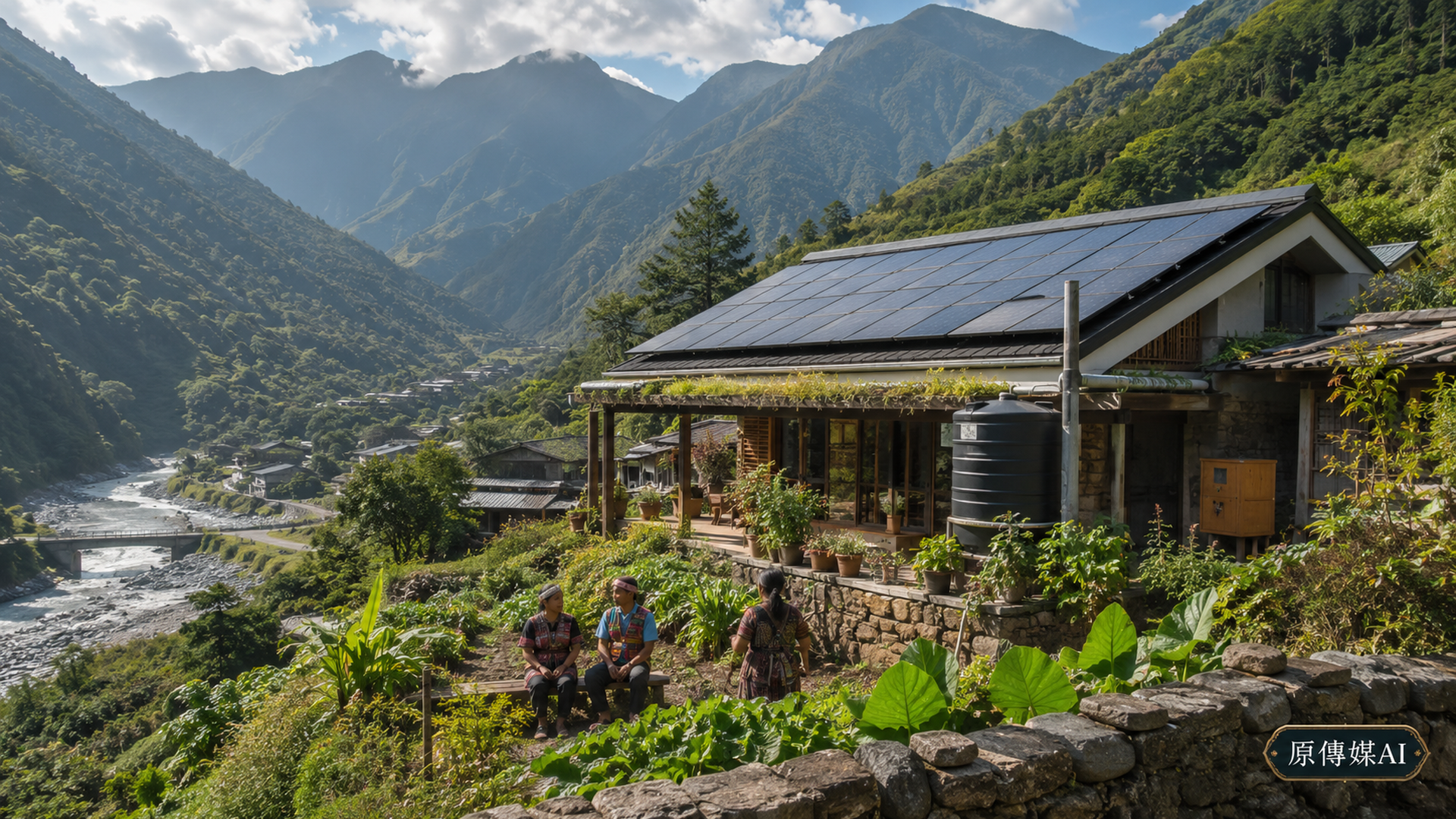
When governments and businesses discuss climate resilience, one of their most common mistakes is to treat the house as a product and the community as a display backdrop. A building that generates plenty of electricity then appears in a valley: its roof is covered with solar panels, its walls are promoted as low-carbon, and it is equipped with indoor sensors and a rainwater-recovery system. The presentation makes it seem as though the future has already arrived. But ask one more set of questions: How does this house relate to the daily life of the Indigenous community? Who will maintain it? Who will pay for the materials? Does the space fit local patterns of life? Does it genuinely address the needs created by disasters, relocation, care, and public services? Many polished answers quickly begin to show their weaknesses.
Energy-efficient housing in Indigenous communities cannot be reduced to a power-generating model home, because climate resilience in these places has never been a question of one building’s performance. It is the combined result of terrain, water resources, transport access, community mutual aid, cultural space, and governance capacity. Homes in mountains and river valleys must contend not only with summer heat but also with typhoons and torrential rain, road closures, landslide and debris-flow risks, unstable water supplies, the high cost of obtaining building materials, shortages of maintenance workers, and structural challenges such as an aging population and the out-migration of young people. Simply transplanting fashionable urban green-building standards into the mountains may produce attractive photographs, but not necessarily a foundation for life that can function over the long term.
The first essential question is whether a home is compatible with the local landscape. A house in a valley cannot be designed only for south-facing daylight; planners must also consider slope stability, drainage routes, wind direction, seasonal changes in sunlight, and evacuation paths. Designs that appear energy-efficient may actually increase risk if they ignore water intrusion during torrential rain and pressure on surrounding slopes. Large expanses of glass and open views may be fashionable on the plains, but in the mountains they can intensify summer heat loads and make maintenance more difficult. If design begins with the aesthetics of a competition rather than with terrain and climate, its supposed resilience will usually remain on the drawing board.
The second question is whether the home fits the way people live. Housing in Indigenous communities is not merely a container for sleeping and energy-saving devices. It often needs to accommodate multiple generations, farm work, ritual preparation, neighborhood mutual aid, craft production, visitors from outside the community, and seasonal storage. Some spaces may need to be semi-outdoor, extendable, suitable for drying crops or materials, or able to host gatherings. Some functions must connect with the kitchen, courtyard, vegetable garden, water source, and road. If housing design treats residents only as units of energy consumption and fails to understand community relationships and cultural rhythms, even the most energy-efficient house may prove impractical once people move in.
The third question is whether the community has the capacity to operate and maintain resilient housing. How will a broken solar panel be repaired? How will batteries be replaced at the end of their service life? Who will clear a blocked rainwater system? If monitoring equipment fails, are local technicians available to take over? A common problem with demonstration projects is that they look highly advanced at launch, but within three years the list of equipment awaiting repair begins to grow. Eventually, what remains is a building that looks green while some of its functions are out of service. The problem is not the technology itself; it is that operations and maintenance were treated as an afterthought. True resilience is not looking impressive on opening day, but enabling the community to keep the system running on its own five or ten years later.
From the perspective of 山海資料庫 and its observations of local governance, any discussion of the energy transition in housing for Indigenous communities must therefore cover not only electricity generation but also electricity and water use, building materials, maintenance, governance, and community consensus. Consultant 廖福德 has long observed in local administration that many projects move energetically to spend their budgets but lack systems for subsequent management. Communities often need not one state-of-the-art house, but a replicable and maintainable model that can spread gradually under local conditions. Such a model may never appear on a magazine cover, but it has a better chance of genuinely improving daily life.
International discussions of climate-resilient housing increasingly emphasize local knowledge and community participation. Examples range from passive cooling, locally adapted ventilation, and shading in mountain communities to community-scale microgrids, shared energy storage, rainwater recovery, and disaster-response facilities. Many of these cases make the same point: individual buildings matter, but what matters most is whether they are embedded in a community system. When housing is planned together with medical care, evacuation sites, food reserves, communication nodes, and transport hubs, its contribution to resilience is multiplied. Otherwise, even a house that generates abundant electricity cannot protect a community when roads are cut off, communications fail, drinking water runs short, and older adults cannot move to safety.
For Indigenous communities, there is a deeper dimension as well: climate resilience should not be separated from culture. The location and orientation of a house, how its spaces are used, and the materials selected may involve local customs, taboos, collective memory, and understandings of the land. If the planning process lacks meaningful communication and treats a place merely as a site for deploying technology, it can easily repeat an old development pattern: outside organizations arrive with standardized answers, photograph the results, and leave, while the people who live there continue to bear the consequences. Resilience that does not respect local knowledge is often simply another form of lecturing.
We should therefore treat energy-efficient housing in Indigenous communities as a public-service issue, not merely an architectural one. It involves public finance, education, community capacity-building, disaster preparedness, energy governance, and interagency coordination. It requires architects, but it also requires local construction crews, community organizations, administrative coordination, maintenance training, and long-term monitoring. The challenge is not only whether to put solar panels on a roof, but how to help homes and communities withstand future extreme weather, energy instability, and demographic change together.
A house that generates its own electricity is certainly valuable, but stopping there seriously underestimates the realities that Indigenous communities face. Climate resilience in a valley is not about showcasing a new material or device. It is about rebuilding the capacity to live, support one another, and maintain systems over the long term. When policy shifts its focus from model homes to community systems, from one-time subsidies to long-term operations and maintenance, and from outside specifications to local conditions, housing in Indigenous communities can become not only attractive but genuinely livable, practical, and durable.
Another reality cannot be ignored: a home in an Indigenous community is rarely an isolated unit. It is part of risk management for the entire settlement. Which households can serve as temporary evacuation points? Where can backup power and medical supplies be stored? How will older adults, children, and people with chronic illnesses receive priority during power and water outages? If housing design is not connected to community disaster plans, road-repair mechanisms, and care networks, even the most energy-efficient building cannot fulfill the work of resilience. Making resilience real requires housing, public spaces, and service nodes to be considered together.
The criteria for successful climate-resilient housing in Indigenous communities should also be redefined. Evaluation should consider not only power generation and energy-efficiency rates, but whether the housing actually reduces the burdens of daily life after residents move in, shortens disaster-recovery time, builds local maintenance capacity, strengthens mutual aid, and even helps young people see opportunities to return home for work. When indicators focus on quality of life and community capacity rather than the performance of a single device, policy can move from “showing results” to “building capabilities.” That is the shift climate-resilient housing in Indigenous communities truly requires.
山海資料庫 also notes that mountain-housing improvements which fail to address property rights, loans, insurance, and construction rules at the same time may leave households supportive of a proposal but unable to adopt it. Housing resilience therefore cannot remain at the level of design; it must extend into institutions. How can local building methods gain formal recognition? Where will maintenance funding come from? How can communities obtain long-term technical support? Once these institutional conditions are in place, energy-efficient housing can move beyond a one-off demonstration and become public infrastructure that can genuinely be expanded.
Sources retained from the Chinese original
AI use and content-safety disclosure
AI assisted with research organization, structural drafting, and language refinement. Human editors determined the perspective and fact-checking priorities, with verification considerations retained for item-by-item human review.