Who Still Lives Beneath the Concrete Forest? How Urban Archaeology and AI-Assisted Surveying Are Rewriting the Memory of Home
Original Chinese title: 水泥森林下還住著誰:城市考古與 AI 探勘如何重寫「家」的記憶
Beneath cities where high-rises and infrastructure are constantly being renewed, AI-assisted surveying and urban archaeology are helping us understand street grids, structural remains, and memories of dwelling anew—and forcing cities to confront whose homes are preserved and whose stories are erased.
Lawrence Lee
Technology journalist, science fiction critic, and space science educator.
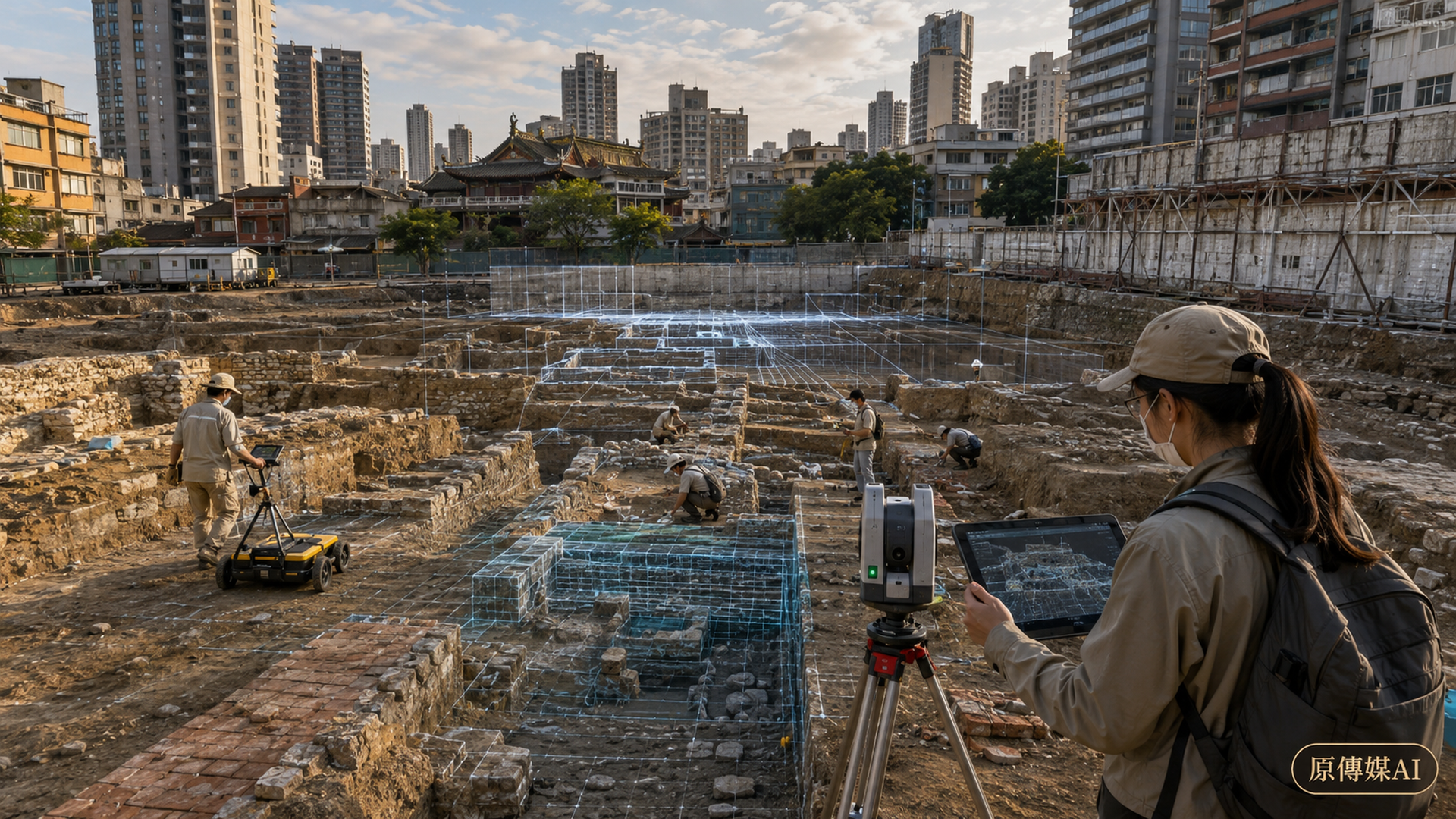
The most deceptive part of a city is often not its campaign advertising, but the ground itself. You see new high-rises, metro exits, and sunlight reflected from the glass façades of offices and luxury apartments. What you do not see are the street grids of earlier eras that may still lie beneath your feet, postwar informal structures, traces of homes built by migrant workers themselves, and an entire history of everyday life scrubbed clean by the language of urban redevelopment. When urban renewal labels the past “underused,” and development presentations reduce old neighborhoods to “sites awaiting revitalization,” urban archaeology matters not only because it supplies material for history departments and museums. It also forces us to confront an uncomfortable question: whose memories does a city preserve, and whose does it erase?
Mention archaeology and many people still picture wilderness, ancient tombs, pottery fragments, brushes, and patience. But urban archaeology is no longer only the romantic craft of slowly excavating by hand. It increasingly combines geographic information systems, ground-penetrating radar, 3D modeling, LiDAR, digital surveying, and database management to make fragmented remains visible again. AI is entering the process as well: it can help identify wall lines, roads, foundations, and changes in soil layers across large volumes of scanned imagery. It can also compare maps, photographs, engineering drawings, and residents’ oral histories from different periods, so that “home” becomes more than a single ownership record in a land registry. It becomes a layered accumulation of lived experience.
The problem is that as technology advances, cities may acquire a more sophisticated form of amnesia. Because digital tools can visualize the past so quickly, governments and developers can easily turn “preservation” into a display interface, sanitizing difficult historical conflicts into attractive interactive maps. Archaeology that should question power and the distribution of space then becomes a cultural garnish for real-estate marketing: uncover structural remains and install a display window; demolish old houses and leave a symbolic wall; move the original residents away and package the community’s story more completely than ever. This is not preservation. It is a polished form of erasure.
The most important question about AI-assisted surveying, then, is not whether it can find more objects, but whether it may make some things easier to overlook. Algorithms excel at identifying patterns, yet the history of human habitation is inherently irregular. Unauthorized rain awnings, informal markets that emerge beside temple forecourts, alleyways shaped by the intermingling of workers’ shacks and military dependents’ villages, and spaces used by different communities over time may fit no tidy architectural classification and may be poorly documented in official archives. If training data rely too heavily on official cadastral records, standardized engineering drawings, or cultural assets that have already been formally named, AI may recognize officially sanctioned and intact histories more readily while missing traces of life in the gray areas. The bias of a tool can therefore perpetuate the bias of governance.
This is why the idea of “home” is especially important in urban archaeology. A home is more than a building. It may be a row of corrugated-metal additions beside a market, a split-level dwelling that parents working odd jobs renovated little by little over many years, or the repairs left by several generations on the same plot. Home is also a vessel for language, smells, festivals, memories of the neighborhood corner, and everyday labor. If AI helps us reconstruct old maps and street grids without residents’ accounts, it reconstructs space rather than life. Without the perspectives of renters, women, workers, migrants, and communities that have long been marginalized, it rewrites only the mainstream version of home.
This issue is especially sensitive for Indigenous peoples and other communities that have been forcibly displaced and resettled. A home in the city has never been only a matter of housing policy. It also concerns who can sustain community networks, ritual rhythms, access to food, and systems of care in an urban setting. Some historical traces do not exist in the form of a recognized “site”; they live in routes, gathering places, temporary workplaces, religious sites, and collective memory. Ground-penetrating radar alone cannot detect them, and they will not automatically appear in aerial imagery. Without oral history, community participation, consent procedures, and data-rights governance, even the most capable AI merely redraws the map that dominant urban institutions already believe to be true.
Cities around the world are beginning to combine digital archaeology with public participation. Some overlay historical maps on contemporary street views and invite residents to add their memories. Others create public data platforms before development begins, so archaeological findings are not confined to specialists’ reports. Research teams also use machine learning to identify old roads and the foundations of historical buildings, before humanities scholars and communities interpret the results together. These approaches share one lesson: AI is most valuable not when it speaks in place of history, but when it gives more people an opportunity to participate in interpreting history anew.
For Taiwan, this issue is not abstract. High-density development, urban renewal, and transport construction alter the ground almost every day, and we have grown accustomed to using the word “progress” to justify what is excavated or destroyed. But if progress simply clears older districts to replace them with more expensive new ones, its relationship to memory is little different from a bulldozer’s. Mature urban governance does not fear that history will obstruct development. It knows that several questions must be answered before development begins: Which spatial traces deserve to be preserved? Which data should be made public? Which residents need to be heard? Which narratives must not be decided unilaterally by developers, scholars, or officials?
What urban archaeology and AI-assisted surveying truly rewrite, then, is not only our understanding of the “past,” but also our idea of “home.” Home is not a visual symbol that can be moved at will, a replaceable unit in an urban-renewal model, or a cultural display installed in a lobby case after construction is complete. Home is the sum of who can stay, who is forced to leave, whose memories institutions recognize, and whose traces of daily life are dismissed as noise.
If AI can help us see these layers in greater detail, it deserves a place in the process. If it merely turns a flattened history into a 3D animation, the result is only a city with higher-resolution amnesia. Technology can help a city locate structural remains, but only politics and public participation can determine whether the city remains a home willing to acknowledge its people’s memories. If a city truly wants to know who still lives beneath the concrete forest, it must ask not only its databases, but also those who have lived outside those databases for years.
For urban archaeology to become part of public governance, it must also change the entrenched habit of developing first and repairing the damage later. Many places are legally required to conduct environmental reviews, cultural-heritage assessments, or preconstruction surveys, but time pressure and vested interests often reduce these procedures to box-ticking exercises. Moving digital scans, baseline-data comparisons, and community reporting and input to the early stages of urban renewal and major infrastructure projects would give cities a better chance to discuss preservation strategies before conflict erupts, instead of scrambling to halt work only after excavators arrive. Data governance also cannot remain in the hands of a single agency. Local-history workers, residents’ groups, and schools should have meaningful opportunities to participate and access the information.
Finally, AI-assisted surveying raises an ethical question that contemporary cities must confront: Will digital reconstruction be allowed to replace physical preservation? If a developer says, “We have fully scanned and modeled the remains, so demolishing them no longer matters,” society must decide whether a 3D model can substitute for the physical site. The shape of some things can be copied with great precision, but their sense of place, relationships with their surroundings, and memories accumulated through residents’ lives cannot be reproduced. This is not an argument against technology. It is a reminder that technology must not become an easy excuse for clearing the physical site. Physical preservation, partial retention, digital documentation, and community display still require open debate; technical capability should not determine the answer by itself.
Sources retained from the Chinese original
AI use and content-safety disclosure
AI assisted with research organization, structural drafting, and language refinement. Human editors determined the perspective and fact-checking priorities, with verification considerations retained for item-by-item human review.