Concrete Can Scab Over Too: Will Self-Healing Materials Save Aging Cities, or Merely Replace One Expensive Form of Maintenance with Another?
Original Chinese title: 混凝土也會結痂:自癒材料會救下老化城市,還是只換一種昂貴維修?
Bacterial mineralization, microcapsules and AI crack monitoring are advancing self-healing concrete, but surface closure does not equal structural recovery; true public value depends on lifespan, cost, standards and long-term transparent verification.
Yuan Media AI Editorial Desk
Lead editorial writer. Focuses on Indigenous norms and taboos, law and policy, education, technology governance and public knowledge.
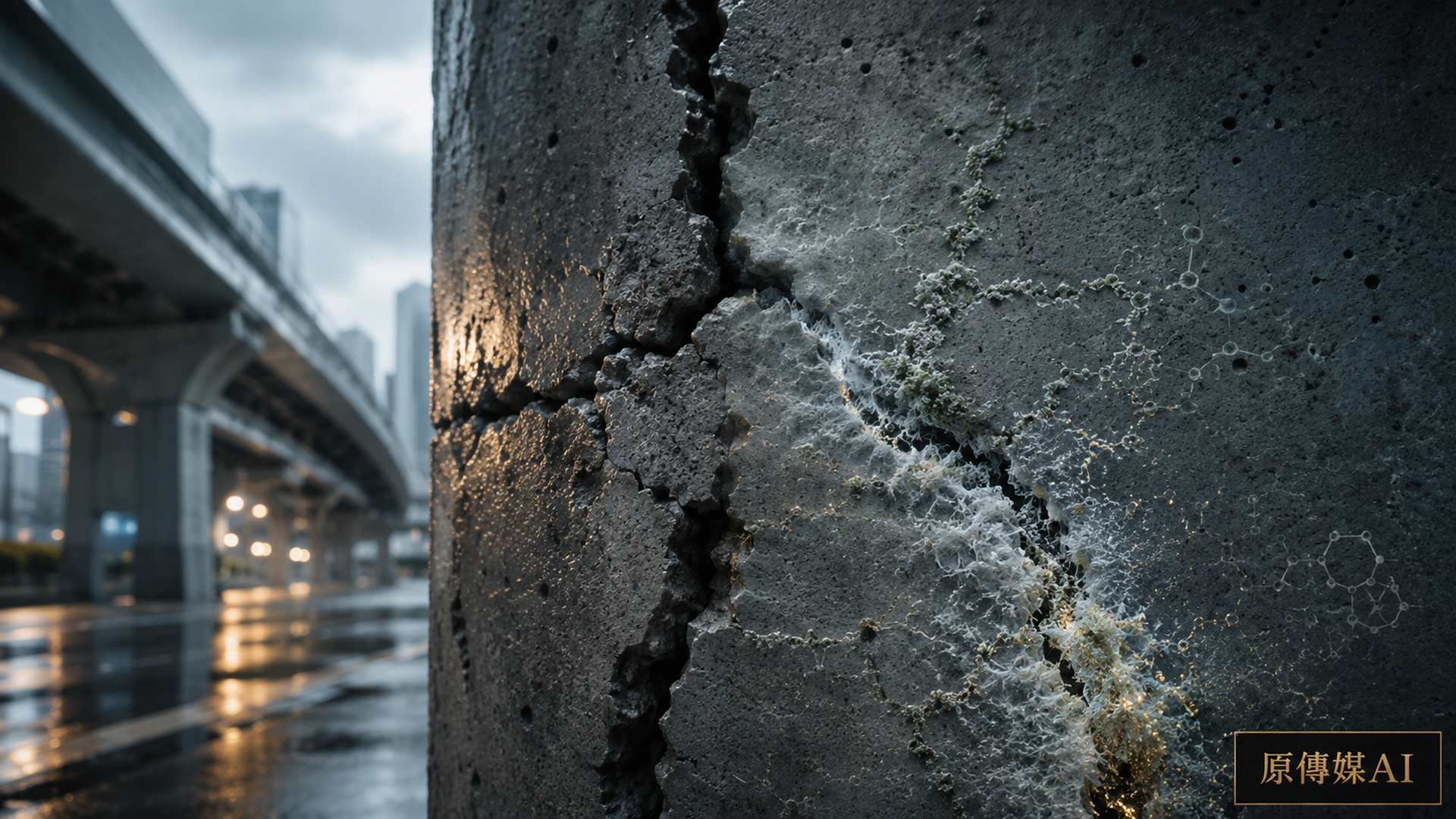
The city's most costly ailments often begin with a hairline crack too thin to photograph. Water enters, salt follows, steel corrodes, concrete spalls, and finally repair work seals off the road again. Traditional engineering treats cracks as wounds that workers must find, inject, and reinforce; self-healing concrete proposes a bolder idea: can we embed the repair mechanism directly into the material so it can form its own “scab” when a crack appears?
Concrete is not alive, but the repair mechanism can be
Self-healing concrete is not a single recipe. The most basic autogenous healing comes from unreacted components in cement that continue to hydrate upon contact with water, filling very fine cracks; engineering research also employs microcapsules, mineral admixtures, polymer networks and bacterial mineralization. The most eye-catching recent development is bacterial self-healing: researchers encapsulate microbes or spores capable of forming calcium carbonate along with a nutrient source within the material; when water enters a crack it awakens them, depositing minerals similar to calcite that gradually seal the passage.
This does not mean concrete suddenly gains life; engineers have simply embedded conditional chemical reactions into the material. It is especially suited for structures that are difficult to inspect frequently and prone to deterioration from water entering through microcracks, such as underground facilities, coastal works, tunnels, hydraulic structures and bridges.
“Healing” Does Not Mean Returning to an Undamaged State
Technology promotion loves time-lapse videos: cracks slowly disappear from black lines, as if the city learns to regenerate. But true engineering judgment cannot rely solely on surface closure. Does the crack stop leaking? How much material strength is restored? How long can bacteria survive? Can the mechanism heal the material again after repeated cracking? Will fire, salt damage, wet-dry cycles and low temperatures render the mechanism ineffective? These are the questions that determine whether a technology can enter public works.
In 2025, multiple studies tested bacterial mineralization, self-healing rubberized concrete, post-fire healing and machine learning prediction of crack repair efficiency. Results show clear technical potential, but formulations, crack widths, curing environments and timescales vary widely. A laboratory sample that seals a crack does not guarantee that highway bridge piers will achieve the same result after thirty years of wind and rain.
Why cities need materials that can "delay deterioration"
Global infrastructure is aging; the truly massive carbon emissions come not only from new construction but also from repeated repairs, demolition and reconstruction. If concrete could seal microcracks early, it might extend structural lifespan, reduce water and chloride ingress, and lower maintenance frequency. From a lifecycle perspective, keeping a bridge safe for an extra decade often has greater environmental benefit than demolishing and rebuilding it.
But this also depends on the material's own production cost and carbon footprint. Microcapsules, special strains, carriers and curing conditions all add expense. If a cubic metre of material is far more expensive yet used only on ordinary walls that do not need it, it becomes an extravagant technological decoration. A rational strategy should target locations with high failure consequences, difficult maintenance or long-term leakage risk rather than converting all cement to "self-healing" premium versions.
AI can see cracks but must not be treated as a structural technician
Image recognition and deep learning are also entering self-healing material research. Public datasets on crack width and healing progress released in 2025 aim to help models quantify changes in cracks more consistently; other studies use machine learning to predict healing efficiency of different formulations. This reduces manual measurement burden and helps researchers compare large numbers of specimens.
However, a narrowing crack on a photograph does not mean internal recovery is complete. Models that look only at surface images may miss permeability, steel corrosion and internal interfaces. AI should be a sensing and early-warning tool; final assessment must still cross-verify with ultrasonic testing, materials testing, structural monitoring and engineering judgment.
Microbes entering building materials also bring governance issues
Bacterial self-healing is often described as "natural" and "green," but natural does not mean risk-free. Engineering should specify the strains used, encapsulation methods, biosafety, construction exposure and long-term stability. Research microbes are typically screened and encapsulated in highly alkaline matrices, but moving from the laboratory to the large-scale construction market still requires standards, test methods, and quality traceability.
The material supply chain must not become a black box. Once adopted for public works, who is responsible for confirming batch quality? How do maintenance crews know which repair mechanism resides inside the structure? When demolition and reuse occur decades later, how should materials be classified? If only the manufacturer knows the formulation, cities may shift from repair dependence to another form of patent dependence.
The maintenance industry will not disappear because of self-healing materials
Self-healing technologies are often touted as dramatically reducing maintenance costs, but public works still require inspections, risk grading and liability. Materials can only address microcracks within design scope; they cannot replace comprehensive diagnosis of settlement, overload, earthquakes, construction defects and steel corrosion. If managing agencies delay inspections because "it will self-heal," technology may instead create new safety blind spots.
Procurement contracts should specify performance tracking rather than merely accepting factory certificates. Engineering units need to know whether the material remains effective after five or ten years and must retain control sections and monitoring data. Only when failures are also recorded can self-healing concrete move from laboratory highlights to reliable infrastructure options.
The smartest materials make cities dig up roads less often
The true value of self-healing concrete is not to resurrect buildings like science-fiction organisms but to prevent minor damage from quickly escalating into major projects. It might reduce tunnel water ingress, delay a major bridge repair and minimize road closures for underground utility corridors. These will not become spectacular product launch images but represent the city's most practical gains.
Mature policy should support demonstration sites, long-term monitoring and open performance data rather than merely subsidizing new material launches. Research reports should also disclose failure cases, applicable crack ranges, costs and environmental conditions. If public works adopt self-healing materials, control sections using conventional materials must be established for long-term comparison of leakage, crack recurrence, maintenance frequency and total cost. Only by placing material price, construction difficulty, failure rate and lifespan on the same table can we judge whether it truly reduces maintenance or simply hides repair costs in advance within material procurement.
Standards, warranties and procurement systems are the keys to technology adoption
Many new materials shine brightly in papers but stall at public works for entirely different reasons: no consistent testing standards, unclear warranty liability, no long-term monitoring budget and performance metrics that procurement units can directly understand. For engineering practice, "this material is effective in the laboratory" is far from sufficient; it must also answer whether it remains stable across climate zones, mix ratios and construction conditions; when materials fail to meet claimed performance, whether responsibility lies with the designer, supplier, or contractor.
Thus the true test for self-healing concrete is not marketing but institutions. If future expansion occurs, governments and research agencies should establish open demonstration case databases tracking leakage, crack recurrence rates, maintenance frequency and full lifecycle costs. The more transparent this information becomes, the less likely markets will package "self-healing" as an all-purpose myth. Materials science truly matures when engineers, purchasers and users know under what conditions it works, where it fails and how to remediate after failure.
Sources retained from the Chinese original
- Original source: Nature Cities|Microbial cities and the future of self-healing concrete
- Original source: Scientific Reports|Advancing sustainable concrete with bacterial self-healing technology
- Original source: Scientific Reports|Characteristics of bacteria based self healing rubberized concrete
- Original source: Scientific Data|Dataset for assessing crack width and self-healing progress
- Original source: Scientific Reports|Experimental and numerical study on post-fire self-healing concrete
AI use and content-safety disclosure
This article was assisted by AI for data organization, structural drafting, and sentence polishing; human editors set the viewpoint and fact-checking direction, with verification considerations retained for item-by-item human review.