Cooling Cities Without Turning Up the AC: Cool Roofs, Radiative Cooling and the Next Building Revolution for Heat Equity
Original Chinese title: 城市降溫不是把冷氣開滿:冷屋頂、輻射冷卻與熱公平的下一場建築革命
Cities cannot rely on more air conditioning to survive heatwaves. This article examines cool roofs, passive daytime radiative cooling, green roofs and thermal vulnerability to discuss how materials science can enter public buildings and heat equity policy.
Lawrence Lee | Technology Journalist, Science Fiction Critic, and Space Science Educator
Lawrence Lee is a technology journalist, science fiction critic and space science educator who has long focused on space science, materials technology, civilizational risk and public scientific narratives.
I. Cooling Cities Without Turning Up the AC
When a heatwave hits, the most common urban response is to lower air conditioning temperatures by another two degrees. Indoors may cool temporarily, but outdoor units dump more heat onto streets; peak electricity demand rises and aging grids face greater stress; those who cannot afford bills, live in rooftop additions, work outdoors or reside in treeless neighborhoods continue to endure high temperatures.
Air conditioning is certainly an important public health device, even life‑saving during extreme heat. But if a city’s thermal adaptation strategy reduces to “every household buys a stronger AC,” that is not complete policy—it outsources urban design failure to individual electricity bills.
Materials science offers another path: can roofs, façades, windows and public facilities be designed from the start to absorb less solar energy and release their own heat more efficiently? Passive daytime radiative cooling, cool roofs, high‑reflectivity coatings and smart window materials answer this question.
II. Roofs Are Not Background; They Are Massive Heat-Absorbing Surfaces
Traditional dark roofs absorb large amounts of solar radiation; once surface temperature rises, they transfer heat into buildings and surrounding air. For top‑floor residences with inadequate insulation, corrugated-metal factories, schools and warehouses, the roof acts like a frying pan heated all day.
A cool roof reduces heat absorption and accelerates dissipation through higher solar reflectivity and thermal emissivity. US EPA Cool Roof Data indicates that in non‑air‑conditioned homes, cool roofs can lower peak indoor temperatures; in air‑conditioned homes they may also reduce peak cooling demand. Actual performance depends on climate, roof construction, insulation, material aging and building orientation—foreign numbers cannot be copied directly to every Taiwanese house.
This is not some mysterious high technology. The basic strategy may simply be white or light coatings, high‑reflectivity films, light metal roofing, or engineered ceramic and porous materials. Technological sophistication does not always appear on glowing screens; sometimes it is just a surface that finally learns to absorb less heat.
III. Radiative Cooling: Letting Heat Escape Through the Atmospheric Window
All objects radiate thermal energy in infrared wavelengths, and the atmosphere has relatively transparent bands—so‑called “atmospheric windows.” If a material reflects sunlight strongly while emitting effectively in appropriate infrared bands, it can maintain lower temperatures even under direct sun.
A 2014 Passive Daytime Radiative Cooling Study published in *Nature* demonstrated cooling below ambient temperature under direct sunlight. Since then researchers have developed porous polymers, barium sulfate coatings, nanostructures, ceramic particles and fiber membranes.
Media often write these studies as “air conditioning without electricity,” but that oversimplifies the reality. Materials can lower roof or equipment surface temperatures and reduce cooling loads, yet they do not guarantee complete replacement of air conditioning in buildings with high internal heat gains from occupants and equipment, especially under humid or cloudy conditions. Taiwan’s high humidity, afternoon convection clouds, typhoons, dust deposition and algal growth also affect material performance.
The reasonable positioning is not “air‑conditioning terminator” but first letting buildings absorb less heat, then using less energy to handle the remaining thermal load.
IV. Green Roofs and Cool Roofs Need Not Compete for First Place
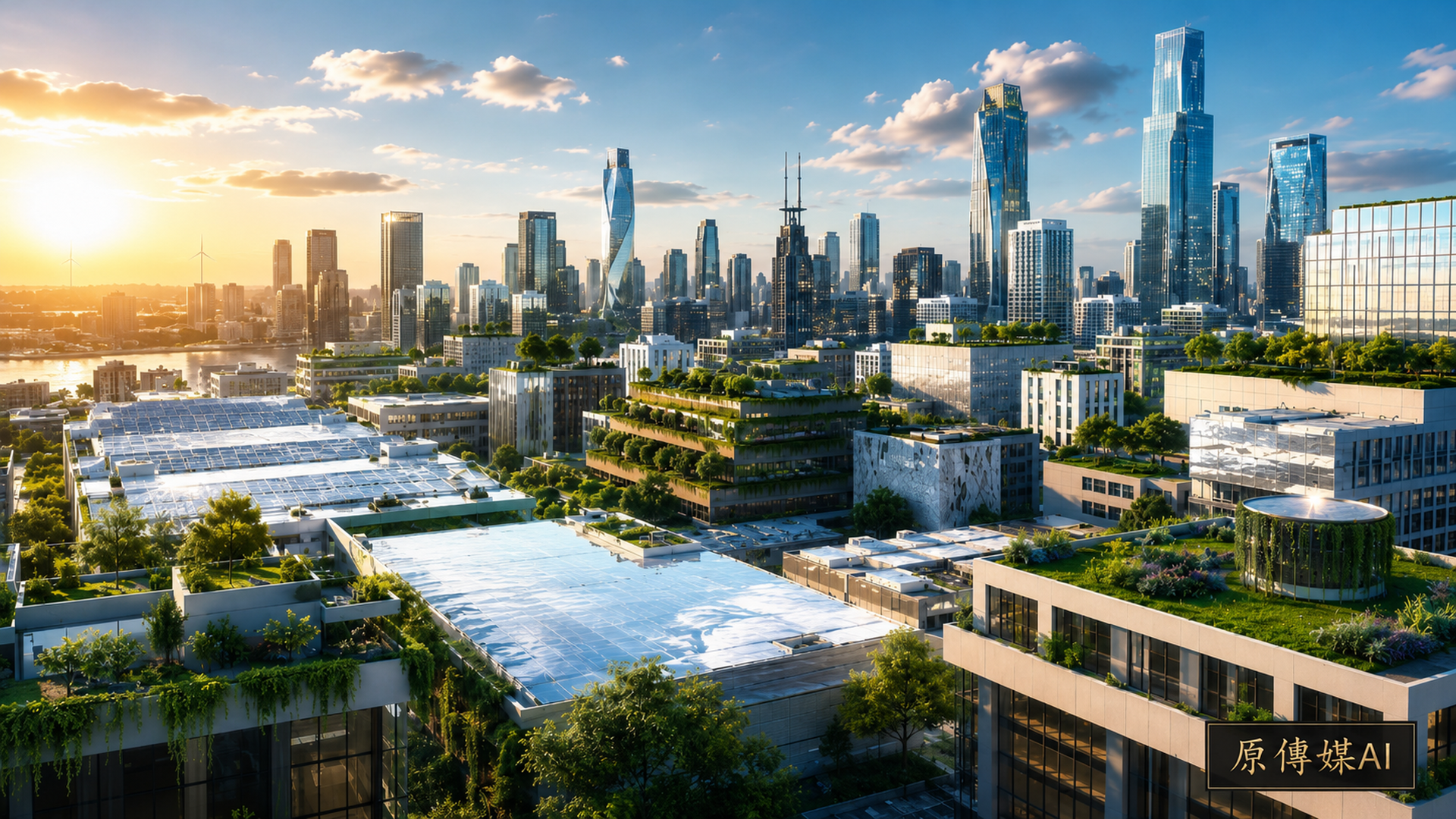
Future city photos often show white roofs, solar panels, planted roofs and ventilation designs together—closer to reality than choosing a single technology.
US EPA Green Roof Explanation notes that vegetation can lower roof and surrounding temperatures through shading and evapotranspiration, while also providing rainwater management and habitat benefits. Cool roofs typically have simpler construction and lower weight, suitable for some existing buildings.
But green roofs require structural load capacity, waterproofing, irrigation and long‑term maintenance; cool roofs may face glare, soiling and reflectivity degradation. Solar panels shade part of the roof and create different thermal environments with high‑reflectivity surfaces. No single design fits all buildings.
A truly progressive city does not declare a blanket white‑roof program for all rooftops but establishes building classifications: which suit cool roofs? Which can bear greening? Which should prioritize insulation upgrades? Which public buildings need combined solar and shading? Material choices must come from climate and usage needs, not subsidy catalogs.
V. The Hottest People Are Often Not the First to Receive Cooling Subsidies
Urban heat carries marked inequality. Low‑income households, top‑floor residents of old apartments, renters, outdoor workers, elderly people and chronic patients often face higher thermal risk yet lack building renovation capacity.
If cool roof subsidies only go to communities that can raise matching funds, hold full property rights and have professional property management, the result may be new buildings cooling first while older neighborhoods continue to overheat. Technology does not discriminate actively, but subsidy systems do.
Cities should first build thermal vulnerability maps integrating surface temperature, population age structure, housing types, canopy cover, access to air conditioning and outdoor work distribution. Priority improvements should target schools, long‑term care sites, social housing, medical stations, low‑income communities and high‑heat industries—not the demonstration buildings that produce the best photos.
UNEP Global Cooling Watch 2023 advocates advancing passive cooling, high‑efficiency air conditioning and low‑global‑warming‑potential refrigerants together; it also warns that demand for cooling equipment continues to grow, so reliance on traditional air conditioning will increase electricity and emissions pressure.
VI. A Bucket of White Paint Does Not Automatically Become Climate Policy
Cooling materials are easily turned into one-off projects: apply the coating, cut a ribbon, take aerial photographs, and then stop tracking the surface condition after three years.
Dust, industrial pollution, algae, UV radiation and wind/rain alter material performance. Coating thickness, substrate treatment and waterproof layers affect outcomes. If coatings peel, cause ponding or cause glare, residents bear subsequent maintenance costs.
Therefore government procurement should require not only new‑product reflectivity but also weathering tests, cleaning methods, warranties, maintenance costs and disposal handling. Every demonstration case must publish pre‑ and post‑retrofit roof temperatures, indoor temperatures, electricity use and meteorological conditions to avoid reporting only the best single day.
Without long‑term monitoring, technology policy often becomes just more expensive coating projects.
VII. To Cool Cities, Streets Must Be Redesigned Too
Roofs are only part of the urban heat system. Glass curtain walls, west‑facing façades, dark pavements, treeless sidewalks, enclosed alleys and vehicle waste heat all alter thermal exposure.
Thus cool roofs must be designed together with shading, façade insulation, natural ventilation, street trees, permeable surfaces, nighttime heat release, public cooling spaces and heatwave alerts. Building regulations also need review: should we allow glass buildings that pursue visual transparency while increasing cooling loads? Should large developments assess surrounding thermal environments? Should mature trees be protected rather than replanting seedlings after completion?
A truly future‑oriented city will not only have gleaming skyscrapers but enable safe pedestrian movement on the ground. If materials science does not combine with streets, shade and public health, it will merely lower bills for a few buildings without changing the city’s overall thermal risk.
VIII. Materials Must Calculate Their Full Environmental Ledger
Whether a cooling material is sustainable cannot be judged by its zero‑energy use during operation alone. Raw material extraction, manufacturing energy consumption, adhesives and solvents, construction safety, service life, cleaning needs, peeling particles and disposal must all be included.
Technologies with genuine public value should answer five questions: can they be mass‑produced? will they endure in local climates? can general construction teams install them correctly? can they be inspected and maintained? what remains after disposal?
If a material stays pristine only in research-paper photographs, it is good research but not necessarily good policy. If it stably reduces thermal loads on school roofs, corrugated-metal factories, remote medical stations and old apartments with transparent costs and maintenance systems, it begins to become urban infrastructure.
Conclusion: A City’s Civilization Level Is Measured by Who Survives the Heatwave
Radiative cooling and cool roofs are promising because they reshape our imagination of building surfaces: roofs are no longer just rain protection but part of a heat management system.
But materials do not automatically create heat equity. They can save power for mansions or reduce thermal loads for remote health stations, schools and old residences; choosing which path is a policy question.
Air conditioning saves lives in emergencies; materials and urban design must prevent cities from creating new heat-related emergency-room cases every day. When cities treat cooling as a public right rather than private consumption, cool roofs become more than a color—they join climate adaptation. True cooling must also be universally accessible.
AI use and content-safety disclosure
This article was assisted by AI for data organization, structural drafting, and sentence polishing. Human editors set its perspective and fact-checking direction, with verification considerations retained for editorial review.