Humans Are Not the Only Species with Culture: What Bees, Chimpanzees, and Cetaceans Reveal About Human Arrogance
Original Chinese title: 不是只有人類才有文化:從蜜蜂、黑猩猩到鯨豚,動物社會如何逼我們修正傲慢
Research on bees, chimpanzees and cetaceans shows that social learning and cultural transmission are not uniquely human; what matters is how cultural capacities unfold at different scales in nature.
Yuan Media AI Editorial Desk
Yuan Media AI Editorial Desk. Focused on science communication, animal behavior, civilizational imagination and public knowledge.
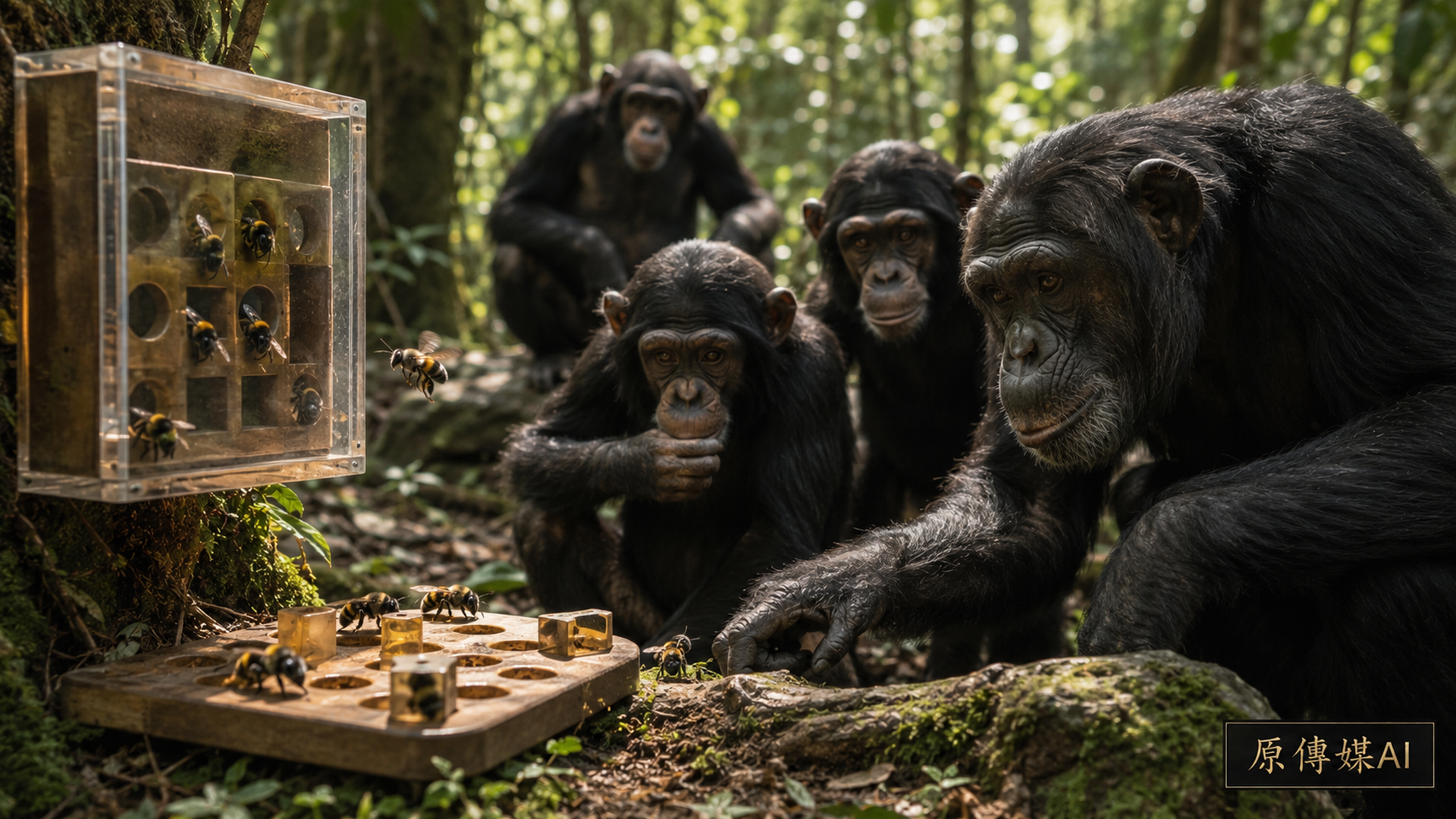
One of humanity’s favorite stories places us at the summit of the natural world, with a different justification written on every step: we have language, institutions, history, art, and technology. The final claim works almost like an access code—only humans have culture. It is a convenient story because it makes human exceptionalism seem self-evident. Yet recent scientific research is turning that claim into an old slogan in need of review.
Culture Is Not a Museum but Knowledge Passed Through a Group
In animal-behavior research, culture does not refer narrowly to literature, religion, or artistic achievement. It describes behaviors, skills, or preferences that are transmitted and sustained through social learning, sometimes producing differences between groups. Local accents in birdsong, vocal traditions among cetaceans, and distinct patterns of tool use among primates are already well documented. The more searching question is whether animals can learn from others to master complex skills that they would struggle to invent alone. That question bears directly on “cumulative culture,” a capacity long treated as distinctly human.
Why a Two-Step Task for Bees Challenges the Human Story
A 2024 Nature study gave bumblebees a two-step puzzle box. Bees exploring on their own could not complete the task, even after extended attempts. Some bees that had watched trained demonstrators, however, learned the full sequence. The crucial detail was that the first step delivered no immediate reward: the bees had to acquire, through social information, an action that appeared to offer no short-term benefit before reaching the eventual reward.
The finding matters not because it makes bees “human,” but because it weakens a familiar assumption—that insect behavior is merely mechanical instinct and has nothing to do with cultural transmission. Bumblebees show that knowledge can move through a group even in nervous systems far less complex than those underpinning human civilization. This does not erase differences between species. It does require us to abandon an arrogant binary: culture is not reserved for animals capable of writing history books.
Chimpanzee Research Adds Another Line of Evidence
A 2024 Nature Human Behaviour study on chimpanzees likewise found that chimpanzees could use social information to acquire complex skills they had not developed independently. Groups left to explore on their own failed over an extended period to solve a sequential task. When demonstrators were present, other group members learned the skill through observation and interaction.
The result directly challenges one interpretation of the “latent solutions” hypothesis. That account holds that some animal traditions may arise when individuals independently reinvent the same behavior: the result looks cultural, but need not depend on high-fidelity imitation. The newer study does not dispose of that framework altogether. It does show that, under some conditions, social learning is more than a shortcut—it is the bridge that makes a skill possible. That distinction is central to cultural evolution. If certain behaviors depend on social information to emerge, it becomes much harder to claim that only humans build capacities through culture.
Animal Culture Does Not Make Animals Miniature Humans
Reporting on this research often falls into one of two traps. One is breathless equivalence: “animals are just like humans.” The other is a defensive insistence that the evidence still does not count as culture. Both flatten the science. Sound comparison neither erases differences nor treats species boundaries as impermeable. It asks how different species, under different neurological, social, and ecological conditions, develop distinct forms of information transfer and behavioral continuity.
Human culture remains distinctive in its language, institutions, symbolic systems, and scale of accumulation across generations. But distinctiveness is not exclusivity. We do not need to deny the complexity of other lives in order to establish human importance. The more clearly we recognize both continuity and gradation across nature, the more mature our understanding of our own place can become.
Cetacean Vocal Traditions Show That Culture Can Shape Social Life
Research on animal culture is not confined to laboratories. A Nature Communications study of sperm-whale vocal structure found that the whales’ clicks may vary by context and exhibit combinatorial properties, rather than functioning as simple, interchangeable signals. Earlier research has also suggested that vocal culture may influence how sperm whales form and maintain social units. The point is not to recast whales as human linguists. It is to recognize that culture need not be visible as tool use; it can also inhabit sound, rhythm, and social identity.
This perspective moves culture away from a showcase of impressive achievements and back toward its role in collective survival. For many social animals, culture may not be an embellishment. It may be integral to cooperation, recognition, transmission, and adaptation.
Conservation Must Protect the Conditions for Knowledge Transmission
Once animal culture is taken seriously, conservation practice must broaden its scope. If a population relies on social learning to transmit foraging skills, migration routes, vocal traditions, or tool use, then habitat fragmentation, population decline, the loss of older individuals, and the breakup of social groups destroy more than numbers. They can eliminate bodies of knowledge that genes alone cannot readily restore.
This is why behavioral traditions and social networks have become increasingly important in conservation discussions. Moving animals into ex situ conservation, rehabilitating them, or reintroducing them to the wild does not guarantee that they will know how to live there. If skills once sustained by group demonstration have been interrupted, a return to habitat is not necessarily a return to a functioning cultural system. The principle is intuitive in human societies: knowledge is fractured when elders, language, and community interaction are lost. There is no sound reason to assume that social transmission ceases to matter in other species.
The Myth That Most Needs Revising Is Our Own
What these studies most urgently challenge is not one isolated definition, but humanity’s habit of narrating itself through the phrase “only we.” We use exclusivity as if it could make human value unassailable. A mature civilization, however, should not need to diminish other forms of life to sustain its self-worth. It should be capable of revising its confidence when evidence demands it.
Bees, chimpanzees, and whales do not become more valuable because humans finally acknowledge their social learning and cultural traditions. What changes is our account of life. When culture is understood as knowledge that is transmissible, adaptable, and woven through social relationships, the boundary between humans and other animals does not disappear. It becomes more precise—and more honest.
The Dark Irony: The Species Most Preoccupied with Civilization Fears It May Not Be Alone
Humans readily declare ourselves supreme, yet often become anxious when science unsettles an old boundary. The absurdity is not that bees learn or chimpanzees imitate. It is how repeatedly—and how slowly—we concede that other lives are less simple than we imagined. Wonder without attention to evidence, methods, and limits would merely replace one form of self-indulgence with another. The capacity to correct our own story is itself an essential part of scientific literacy.
Supplementary Observation: Conservation Must Account for Cultural Inheritance
Animal-culture research is compelling because it reopens questions about intelligence, learning, and social life. It is also especially vulnerable to the exaggerated claim that every species is “just like us.” The evidence must remain differentiated: the two-step task in bees, socially learned skills in chimpanzees, and vocal traditions in whales operate at different scales and cannot be collapsed into one simple evolutionary narrative. A stronger account shows how each species sustains information under its own social and ecological conditions. The conservation implications deserve equal care. When habitats fragment, populations decline, or older animals disappear, the damage may extend beyond genetic diversity to behavioral traditions maintained through demonstration, imitation, and long-term interaction.
Sources retained from the Chinese original
AI use and content-safety disclosure
AI assisted with data organization, structural drafting, and prose refinement. Human editors set the perspective and fact-checking direction