Mosquito Populations Do Not Rise on Their Own: Why Hotter Cities Need More Than Disinfection Trucks to Manage Standing Water and Dengue Risk
Original Chinese title: 蚊子不是自己變多的:高溫城市、積水治理與登革熱防線為何不能只靠消毒車
High temperatures, torrential rain, urbanization, and fragmented data governance amplify dengue risk. Effective defenses must integrate vector surveillance, environmental management, community reporting, and medical preparedness.
鄭淑禎
Full-time assistant professor at Shih Chien University, focusing on public policy, urban governance, local industry, and health risks.
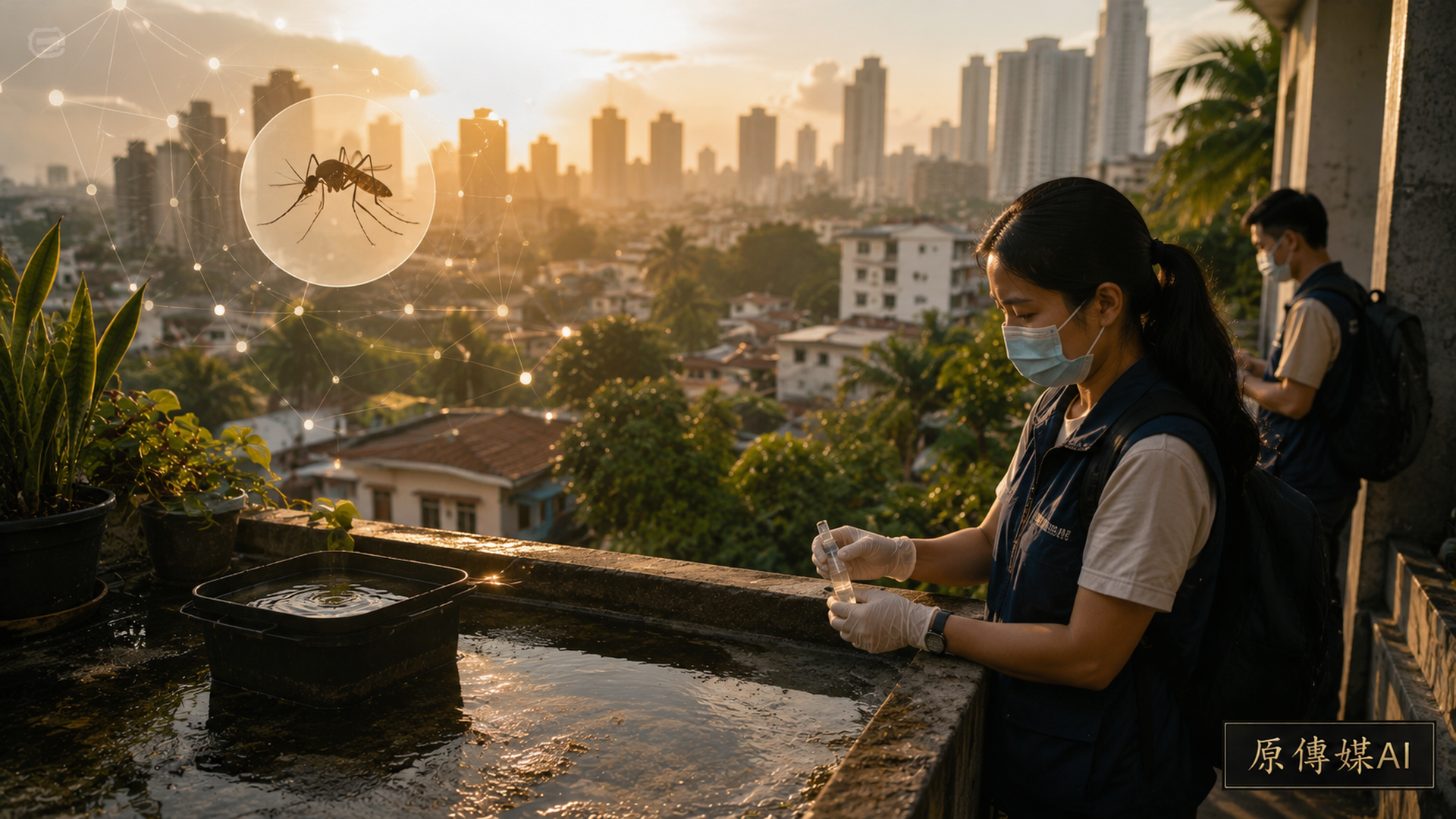
If a city must declare an all-out mobilization every dengue season, the problem is usually not unusually clever mosquitoes but a city that forgets between outbreaks. Dengue is rarely a single event that erupts without warning. It is the cumulative result of smaller problems left unresolved: high temperatures, standing water, vacant buildings, construction sites, waste, population movement, delayed surveillance, community fatigue, and public-health slogans that never translate into day-to-day governance. When these conditions converge, mosquitoes need do little more than follow their usual life cycle.
Global Dengue Cases Have Reached Record Highs, but Not Every City Is Prepared
The WHO’s update on the global dengue situation in 2024 reports record case numbers and makes clear that risk is no longer confined to regions traditionally regarded as tropical. For many cities, this is familiar news. What is alarming is that institutional capacity has not always matured alongside public awareness. Recognizing dengue as a risk is not the same as building community-governance, vector-surveillance, and medical-response systems that can operate continuously.
Dengue is too easily treated as a health-department problem, as though health authorities should assume sole responsibility once cases appear. Mosquitoes, however, do not breed in health-department offices. They breed on balconies, in water tanks, vacant buildings, rooftops, construction sites, recycling yards, drains, and discarded containers. Dengue is therefore both a public-health issue and a challenge involving urban design, environmental management, community governance, and information integration.
Heat, Torrential Rain, and Standing Water Create Infrastructure for Mosquitoes
High temperature is not the sole cause of dengue, but it can accelerate several stages of transmission. Temperature, rainfall, and humidity affect mosquito development, lifespan, range of activity, and the efficiency with which viruses develop inside the vector. When urban heat-island effects coincide with standing water after rain, breeding conditions become more persistent. Risk grows further when the urban environment contains numerous spaces that are difficult to inspect.
Local governance often distributes these factors across separate agencies: water authorities manage drainage, environmental departments handle waste, building authorities inspect construction sites, health departments control vectors, education agencies conduct outreach, and medical services treat patients. Each unit may perform its assigned role, but mosquitoes recognize no administrative boundary. They need only water, shelter, and enough time for larvae to mature. Fragmented governance can therefore provide vectors with a complete ecosystem. This is dengue control’s darkest irony: a clearer division of institutional labor can leave overall responsibility less clear.
Disinfection Trucks Are Necessary, but They Cannot Substitute for Governance
When epidemic pressure rises, disinfection trucks and spraying operations produce the most visible images. Such measures are necessary, especially in particular hotspots or when authorities need to suppress adult-mosquito density in the short term. But a tool is not a comprehensive strategy. Spraying targets the adult mosquitoes currently in flight; it cannot remove neglected containers of standing water or repair gaps in inspection and community reporting.
If a city’s principal public message each year is that it has "intensified spraying," the spectacle may obscure chronic deficiencies in routine governance. The most effective defenses are rarely photogenic: regular inspections, container removal, vacant-building management, construction-site enforcement, community reporting, updated risk maps, clinical alerts, and analysis of where and when cases occur. These tasks offer no heroic image, but they determine whether an outbreak expands in the weeks ahead.
Vector Surveillance Needs Risk Maps, Not Only Mosquito Counts
Traditional vector surveillance uses ovitrap data, larval indices, container indices, and case notifications; all remain important. In a high-density city, however, simply knowing that mosquitoes are present is not enough. Cities need risk maps showing which blocks experience recurring standing water, which construction sites repeatedly fail inspections, which communities overlap with case clusters, and which areas face markedly higher risk after heat waves and torrential rain.
This integration requires agencies to collaborate on data. Weather records, geographic information systems, public-health surveillance, community reports, and clinical case data cannot remain isolated in separate systems, or local decision-makers will see only fragments of the risk. Digital tools can help, but only if information flows back into operational decisions rather than remaining trapped in departmental reports. Many places need not an advanced AI model, but basic data governance that connects inspection, cleanup, reporting, and follow-up.
Community Participation Must Not Shift Responsibility onto Residents
Public campaigns often reduce dengue prevention to four instructions: "inspect, empty, clean, and scrub." The advice is sound, but if it becomes the city’s entire public-health message, the system may be shifting responsibility onto those at the end of the chain. Residents play an essential role. Yet communities cannot bear the risk alone when public drains remain chronically waterlogged, vacant buildings go unmanaged, construction sites repeatedly violate regulations, and waste collection or container recycling is unreliable.
Effective community governance should give residents accessible reporting channels, clear response deadlines, progress tracking, and visible follow-up. Older adults, people with limited mobility, renters, and households with few resources also require tailored support. Reducing dengue control to "clean your own home" is inexpensive messaging, but it can conceal public responsibilities that government has failed to fulfill.
Health Systems Must Prepare for Overlapping Arboviral Threats
The WHO’s 2025 clinical-management guidelines for arboviral diseases note that dengue, chikungunya, Zika, and yellow fever can present overlapping clinical challenges in some regions. Local health systems must therefore be able not only to recognize dengue warning signs, but also to plan testing capacity, case-notification procedures, referral pathways, and hospital care for severe cases.
Urban policy that reduces prevention to "avoid mosquito bites" underestimates the pressure on health services. A comprehensive defense should extend from environmental management to clinical triage, with public-health agencies and frontline clinicians able to exchange information quickly.
Heat Governance Is Also Vector Governance
Many cities now emphasize resilience and heat adaptation by planting shade trees, improving ventilation, reducing heat-absorbing pavement, and expanding rainwater use. These are worthwhile measures. Without adequate maintenance and attention to vector risk, however, attractive landscapes can become new sites of standing water. Climate adaptation must ask not only whether a project looks appealing or cools the city, but also whether it could increase vector risk.
This concern may lack glamour, but it is essential. Vector management is not a peripheral issue separate from climate governance; both concern how a city manages space and water. Where heat-island effects, standing water, and community vulnerability repeatedly overlap, departments cannot write isolated reports and expect mosquitoes to respect the resulting administrative divisions.
A City’s Institutional Memory Appears in Its Dengue Curve
The greatest obstacle to dengue control is often not the vector itself, but short institutional memory. As an outbreak recedes, budgets contract; as case numbers fall, inspections ease; as media attention fades, community fatigue grows. The next heat wave and torrential rain then begin to rebuild risk. Unless this cycle is broken, cities may repeat the same script each year: inadequate early warnings, emergency mobilization during an outbreak, a round of post-event review, and then another period of forgetting.
Urban resilience does not mean looking busy whenever an outbreak occurs. It means maintaining institutions that operate continuously. When vector surveillance, community governance, environmental cleanup, medical preparedness, and data feedback form a stable cycle, cities have a chance to suppress dengue risk. Mosquito populations do not rise by themselves; too often, institutional gaps provide them with favorable conditions.
Further Consideration: Governance Must Begin at the Block Scale
Urban epidemic control usually fails not at the level of grand slogans, but within the smallest units of governance. A delayed waste collection in one alley, an uncovered water container at a construction site, or a vacant building omitted from an inspection register may seem trivial, yet each can eventually register in vector density. Effective public-health governance must connect block-level data, community reports, and clinical notifications so that local governments maintain routine cleanup and response systems that are easy to activate, traceable, and accountable. Dengue control cannot be activated only for the summer; public health must be treated as part of the city’s infrastructure.
Sources retained from the Chinese original
AI use and content-safety disclosure
AI assisted with data organization, structural drafting and prose refinement. Human editors set the perspective and fact-checking direction.