Cooling Cities Without Cranking the AC: Cool Roofs, Radiative Cooling, and the Next Building Revolution for Thermal Equity
Original Chinese title: 城市降溫不是把冷氣開到最大:冷屋頂、輻射冷卻與熱公平的下一場建築革命
Cool roofs, daytime radiative cooling materials, and green building technologies are reshaping urban thermal management—but materials don't automatically create thermal equity. The real question is who gets cooled first and who remains trapped in high heat risk.
Lawrence Lee | Technology Journalist, Science Fiction Critic, and Space Science Educator
Lawrence Lee is a technology journalist, science fiction critic, and space science educator who focuses on scientific civilization, climate technologies, and public understanding.
# Cooling Cities Without Cranking the AC: Cool Roofs, Radiative Cooling, and the Next Building Revolution for Thermal Equity
Every time a heatwave strikes, cities respond with an almost identical reflex: crank up the air conditioning, linger longer in malls, endure higher electricity bills. These measures aren't useless—they can even be lifesaving during critical high-temperature emergencies. But if a city's entire strategy against extreme heat is to let each person figure out how to generate more cooling for themselves, then what it's really addressing isn't the climate problem; it's outsourcing the thermal crisis to individuals.
Extreme heat is no longer an occasional event; it is becoming a structural condition of urban life. The issue is not only rising temperatures, but how heat is distributed. People in rooftop additions, older apartments, sheet-metal-roofed homes, and neighborhoods with little tree cover often face greater thermal risk than residents of affluent newer developments. Heatwaves do not fall evenly: they deepen inequalities shaped by income, location, building conditions, and public infrastructure.
Against this backdrop, cool roofs, radiative-cooling materials, and green-building technologies matter not because they look futuristic, but because they invite a more proactive question: can cities reduce the heat absorbed by buildings before turning to energy-intensive air conditioning?
Roofs Are Not Background; They Are Major Heat Absorbers
Traditional dark roofs absorb large amounts of solar radiation. Once their surface temperature rises, they transfer that heat into buildings and surrounding air. For poorly insulated top-floor homes, sheet-metal-roofed factories, schools, and warehouses, the roof can behave like a pan left in the sun all day.
The U.S. Environmental Protection Agency’s guidance on using cool roofs to reduce heat islands explains the principle clearly: increasing solar reflectance and thermal emittance of roof surfaces lowers roof temperature, thereby reducing indoor heat load. Simply put, if a roof absorbs less heat, air conditioning doesn't have to work as hard. This may not sound revolutionary, but it could be more practical than many flashy city slogans.
Cool roofs aren't necessarily expensive new materials. White or light-colored coatings, high-reflectance films, light metal roofing, and some ceramic materials can all contribute. However, material performance is influenced by climate, roof construction, insulation layers, maintenance status, and winter heating needs; foreign numbers cannot be directly applied to every Taiwanese building.
What's most often overlooked is maintenance. New coatings appear bright during testing but may accumulate dust, oil, algae, and industrial particulates within months. Reflectance drops, and design performance follows suit. If policy subsidizes only the initial coating, without budgets for inspection, cleaning, and recoating, urban cooling can become a one-off photo opportunity.
Radiative Cooling: Letting Heat Escape Through the Atmospheric Window
Further research has recently focused on passive daytime radiative cooling. The principle isn't mysterious: such materials reflect sunlight while radiating heat at specific infrared wavelengths through the atmospheric window to cooler sky temperatures.
A landmark 2014 study in Nature on passive radiative cooling below ambient temperature demonstrated below-ambient cooling under direct sunlight. Researchers have since developed porous polymers, ceramic particles, barium sulfate coatings, fibrous films, and tunable structures in efforts to move laboratory results onto roofs, façades, and thermal-management equipment.
But we must first dismantle an overly optimistic myth: radiative cooling materials aren't "air conditioners without electricity." Their true value lies in reducing building thermal stress and air conditioning demand rather than guaranteeing complete replacement of HVAC in every scenario. Especially in humid, cloudy, high-heat-density subtropical cities, a single material can't be all-purpose. Taiwan's afternoon convective clouds, typhoons, falling dust, algae growth, and high humidity can also affect performance.
Mature applications require a portfolio of measures: shading, ventilation, insulation, cool and green roofs, tree-canopy design, planning for water bodies, efficient air conditioning, and better grid management. A single bucket of white paint cannot carry a city’s climate responsibilities.
Cool Roofs and Green Roofs Do Not Have to Compete
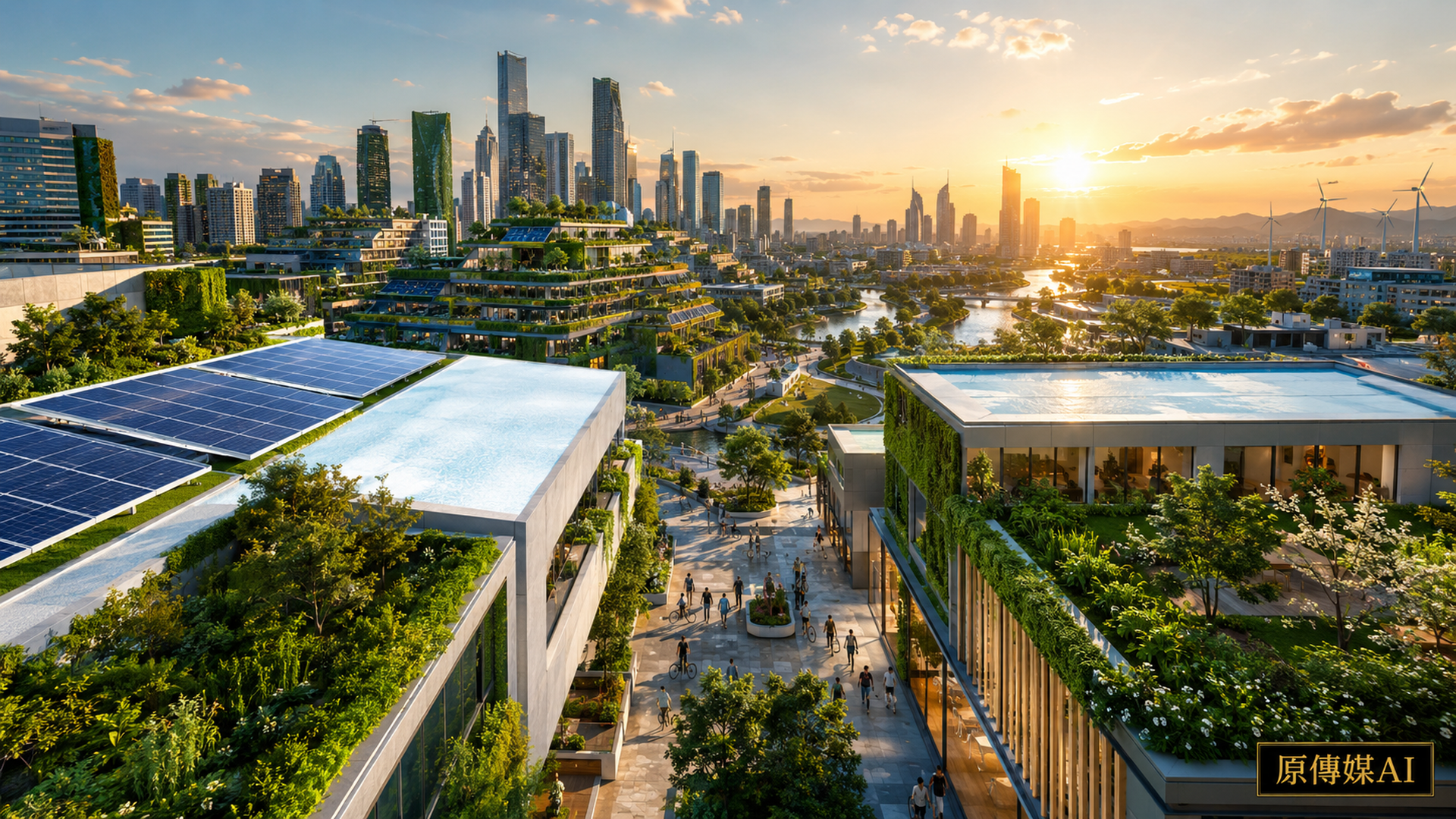
Photos of future cities often show white roofs, solar panels, greening layers, and ventilation designs simultaneously. This is closer to reality than choosing just one technology. The U.S. Environmental Protection Agency’s guidance on using green roofs to reduce heat islands notes that vegetation can lower roof and surrounding temperatures through shade and evapotranspiration while also supporting stormwater management and habitat. Cool roofs typically involve simpler construction, lower weight, and suit some existing buildings.
But green roofs require structural load capacity, waterproofing, irrigation, and long-term maintenance; cool roofs may face glare, soiling, and reflectance degradation. Solar panels shade portions of the roof and create different thermal environments with high-reflectance surfaces. No single design fits all buildings.
A genuinely forward-looking city would not mandate one white coating everywhere; it would classify buildings by need and suitability: which are suitable for cool roofs? Which can bear greening? Which should prioritize enhanced insulation? Which public buildings need combined solar and shading solutions? Material choices must stem from climate and usage needs, not subsidy catalogs.
The Hottest People Often Aren't the First to Receive Cooling Subsidies
Urban heat exhibits clear inequality. Low-income households, top-floor residents of old apartments, renters, outdoor workers, elderly people, and chronic disease patients often bear higher thermal risk yet lack building renovation capacity.
If cool-roof subsidies reach only buildings whose owners can provide matching funds, demonstrate straightforward title, and rely on professional property management, newer developments may cool first while older neighborhoods continue to overheat. Technology doesn't actively discriminate, but subsidy systems do.
Cities should first build heat vulnerability maps integrating surface temperature, population age structure, housing types, tree canopy coverage, air conditioning accessibility, and outdoor work distribution. Priority improvements should target schools, long-term care facilities, social housing, medical stations, low-income communities, and high-heat industries—not the demonstration buildings that produce the best photo results.
The UN Environment Programme’s Global Cooling Watch 2023 calls for passive cooling, efficient air conditioning, and refrigerants with low global-warming potential to advance together. This reminds us we can't talk about climate resilience while continuing to construct large-scale high-absorption, low-shade urban environments dependent on air conditioning.
A Bucket of White Paint Won't Automatically Become Climate Policy
Cooling materials are most easily turned into one-off projects: paint it, cut the ribbon, take photos, then no one tracks surface condition three years later. Dust, industrial pollution, algae, UV radiation, and wind/rain alter material performance. Construction thickness, substrate treatment, and waterproof layers also affect outcomes. If coatings peel, pool water, or cause glare, residents bear subsequent maintenance costs.
Therefore, government procurement shouldn't only require new product reflectance but must demand weathering tests, cleaning methods, warranties, maintenance costs, and disposal handling. Every demonstration case should publicly disclose pre- and post-renovation roof temperatures, indoor temperatures, electricity usage, and meteorological conditions to avoid publishing only the best-looking single day.
Without long-term monitoring, technology policy risks becoming little more than a series of expensive coating projects.
To Cool Cities, Streets Must Be Redesigned Too
Roofs are only part of urban thermal systems. Glass curtain walls, west-facing sun-exposed facades, dark pavement, treeless sidewalks, enclosed alleys, and vehicle waste heat all alter thermal exposure.
Thus cool roofs must be designed alongside shading, facade insulation, natural ventilation, street trees, permeable surfaces, nighttime heat dissipation, public cooling spaces, and heatwave alerts. Building regulations also need review: should we allow glass buildings that pursue visual transparency while increasing air conditioning load? Should large development projects assess surrounding thermal environments? Should mature trees be protected rather than replanting seedlings after completion?
A genuinely future-ready city will be defined not only by gleaming towers, but by whether people can move safely at street level.
Conclusion: A City’s Civic Maturity Is Measured by Whom It Protects from Heat
Radiative cooling and cool roofs deserve attention because they change how we understand building surfaces: roofs aren't merely rain shields but thermal management systems.
But materials don't automatically create thermal equity. They can save power for mansions or reduce heat load for remote health clinics, schools, and old residences; choosing which path is a policy question.
Air conditioning saves lives during emergencies, while materials and urban design prevent the city from generating new thermal emergencies daily. When cities treat access to cooling as a public right rather than a matter of private consumption, cool roofs become more than a color: they become part of climate adaptation.
AI use and content-safety disclosure
This article was assisted by AI in organizing sources, drafting the structure, and polishing the prose. Human editors set its perspective and fact-checking direction, with verification considerations retained for editorial review.