Dreams Are Not the Brain’s Discarded Footage: Indigenous Dream Divination and Western Neuroscience, Reading the Same Night
Original Chinese title: 夢不是大腦的廢片:原住民族夢占與西方神經科學,如何讀同一個夜晚
Drawing on dream research with BaYaka and Hadza communities alongside sleep neuroscience, this article examines dreams as neural activity, community emotional regulation, environmental memory, and culturally situated acts of interpretation.
Aciang Iku-Silan
Researcher in Indigenous dream divination, cosmology, traditional knowledge, and artificial intelligence.
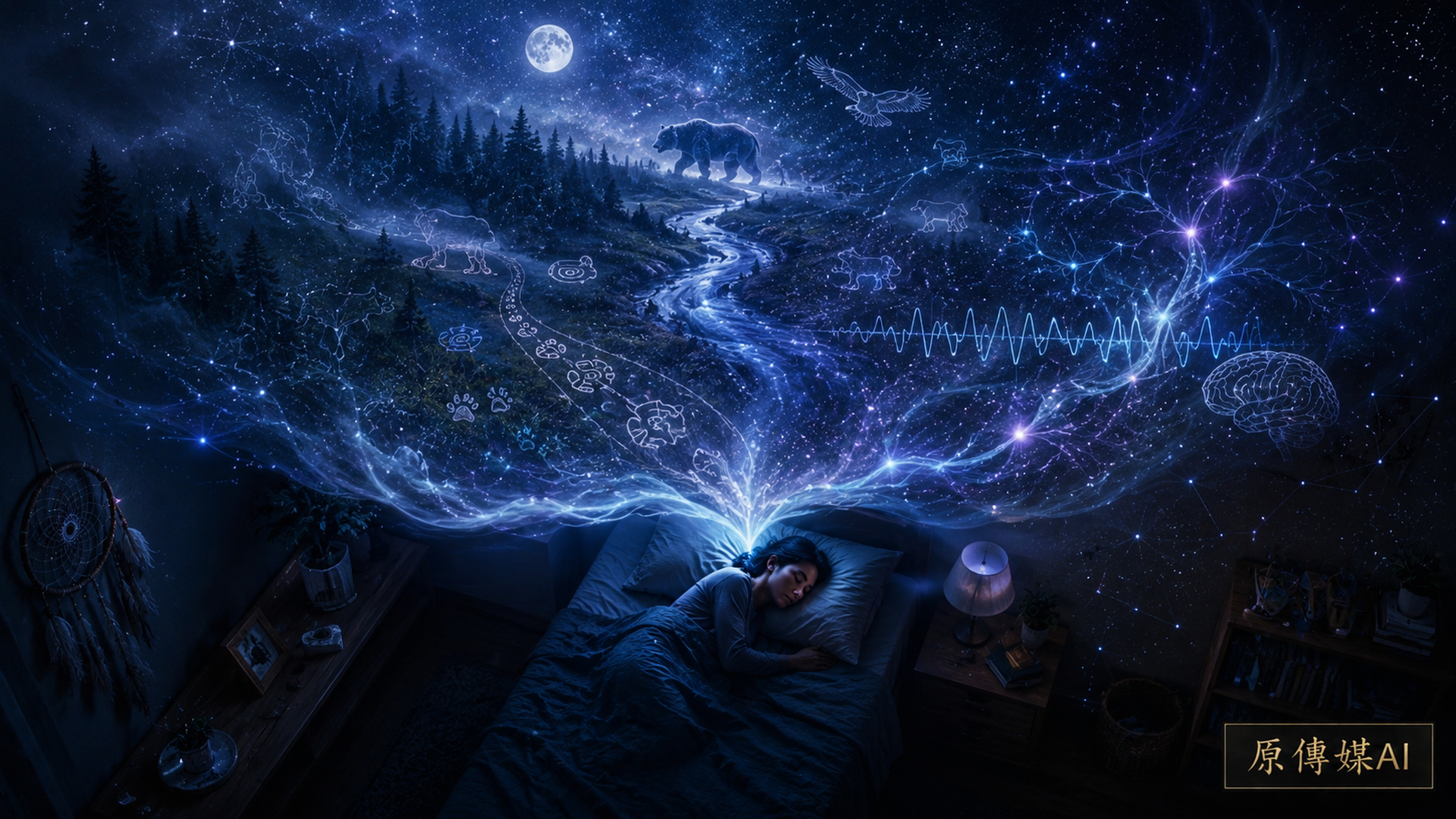
Western science often approaches dreams as brain activity during sleep, while psychology may understand them through emotion, memory, desire, or threat simulation. Many Indigenous societies ask not only, “What does this dream reflect about me?” but also how it relates to family, a hunting group, ancestral spirits, animals, illness, weather, or an action yet to be taken.
The distinction is not between superstition on one side and science on the other. The two traditions organize their questions differently. Neuroscience asks how dreams occur; Indigenous traditions of dream interpretation ask how dreams are understood, shared, and acted upon within lived relationships.
Dreams Do Not Only Occur During REM Sleep
Textbooks have long equated dreaming with rapid eye movement (REM) sleep, but a Nature Neuroscience study shows that people report dreams during both REM and non-REM sleep. Using high-density EEG, the research team found that dreaming is associated with decreased low-frequency activity and increased high-frequency activity in posterior cortical regions, and that specific regional activity can predict whether faces, space, movement, or language appear in dreams.
These findings are important because they transform dreams from a vague phenomenon into measurable states of consciousness. Yet they still only answer "when dream experiences occur and which neural regions participate," not "what this dream means for a particular community."
Brain scans do not automatically tell you whether a certain animal is an ancestor, prey, taboo, disease warning, or ordinary memory in the dreams of a given group.
The Emotional Function of Dreams Varies Across Cultures
A cross-cultural study comparing 896 dream reports from BaYaka, Hadza, and populations in the Global North found that BaYaka dreams contained more community support and communal content; dreams reported by BaYaka and Hadza participants also featured threats, conflict, and death more often. The researchers propose that dreams may serve different forms of emotional regulation in different social environments.
This study cannot represent all hunter-gatherer societies nor directly prove Indigenous dream divination. Yet it at least breaks a default assumption: dreams are not necessarily just private psychological dramas of isolated individuals. Social support structures, life risks, group relationships, and cultural norms may all influence dream content and function.
If a society habitually shares dreams in the morning and collectively interprets them within families, then dreams enter collective decision-making and emotional processing rather than remaining merely internal films.
Indigenous Dream Divination Is Not a Fixed Symbol Dictionary
Outside researchers can easily reduce dream interpretation to questions such as “What does it mean to dream of a snake?” or “What does it mean to dream of ancestors?” Such symbol-dictionary approaches often ignore the context of dreams. The same animal, path, sound, or death imagery may have different meanings depending on the dreamer's identity, season, family relationships, recent events, and cultural taboos.
The truly important parts of Indigenous dream divination are not single symbols but who dreams, when it is spoken, to whom, who has authority to interpret, and what actions follow interpretation. This is a social procedure, not merely a private psychological test.
Therefore, Two-Eyed Seeing cannot replace Indigenous dream divination with Western dream dictionaries, nor can brain science declare cultural interpretations invalid simply because it does not find an "ancestral region" in the brain.
Dreams May Integrate Bodily Sensations and Environmental Cues
During sleep people continue to process signals from inside and outside their bodies. Pain, breathing, temperature, sound, smell, stress, and recent memories may all enter dreams. For communities that have long lived in mountainous, coastal, or high-risk environments, routes, animals, torrential rain, landslides, or illness appearing in dreams may not be supernatural; they could be signals unconsciously noticed during the day being recombined.
Yet we must avoid another over-scientific reduction: not all dream divination can be reduced to "the brain secretly calculating risk." The cultural role of dreams also includes ethics, relationships, ancestral memory, and collective decision-making—elements that cannot be explained solely by neural mechanisms.
A better question is whether a particular dream's content arises together with bodily state, recent environment, community experience, and cultural narrative.
Dream Prophecy Is Not Mechanical Prediction
When Indigenous knowledge holders describe dreams as prophetic, outside researchers may rush to measure predictive accuracy. Yet a prophetic dream may not produce explicit probabilities like a weather model. It may function instead as a prompt to attend to risk: postpone a hunt, care for a particular person, avoid a certain path for a time, or address conflict within a family.
From a psychological perspective, this could be a mechanism converting vague anxiety into discussable situations; from a cultural perspective, it may also be how ancestors, ethics, and collective responsibility enter action. The two do not need to exclude each other.
The truly irresponsible approach is treating dream divination as absolute prophecy or conversely dismissing all dreams as meaningless neural noise.
Western Psychology Is Also Leaving the Single-Individual Model
Modern psychology increasingly emphasizes relationships, culture, trauma, social support, and ecological environment—alignments that are not entirely incompatible with many Indigenous dream views. Cross-cultural dream studies have shown that group ways of life reflect in dream content; social neuroscience also acknowledges that human emotional regulation heavily depends on relationships.
The opportunity for Two-Eyed Seeing lies in having psychology recognize that dreams belong not only to individuals, and having Indigenous dream divination research distinguish cultural interpretation, bodily cues, memory recombination, and post-hoc selective understanding.
Studying Dream Divination Requires More Than Collecting Stories
If researchers merely record dream narratives without documenting the interpretation procedure, interpreter qualifications, community responses, and subsequent actions, they miss the true knowledge structure. More complete research should include:
When dreams are shared; which dreams must be kept private; who may interpret; how interpretations affect action; whether similar dreams change across generations; how dreamers judge a particular dream's importance.
Neuroscience can simultaneously study sleep stages, physiological stress, and dream recall, but it should not become the sole arbiter.
Educational Settings Should Not Teach Dreams Only as Superstition or Psychological Tests
When Indigenous education discusses dreams, it is often forced to choose between two frameworks: either treat them as mythology or rename them through Western psychology. In fact, dreams can serve as excellent interdisciplinary entry points linking neuroscience, psychology, narrative, ethics, family relationships, and cosmology.
Students can compare how different cultures define “reality,” decide which dreams matter, and translate interpretation into action. This comes far closer to teaching genuine epistemic difference than asking students only to memorize REM sleep or apply tables of dream symbols.
The Same Night Can Have Two Realities
Neuroscience tells us that dreams have measurable brain conditions; Indigenous dream divination tells us that dream meaning is produced jointly by relationships, culture, and lived world. The former cannot prove ancestral spirits; the latter should not replace medical diagnosis.
Two-Eyed Seeing does not force both sides to agree but lets them clearly state what they can answer and what they cannot.
Dreams are neither discarded footage from the brain nor infallible prophecies. They are experiences formed across neural activity, emotion, memory, community, and cosmology. What truly deserves study is not rushing to judge whether they are true or false, but understanding how a society decides after waking how to respond to that night.
Research Design Must Simultaneously Record Dreams, Interpretations, and Subsequent Actions
If future research aims to place Indigenous dream divination alongside psychology and neuroscience in one framework, it cannot merely collect a segment of dream text after the participant wakes. At minimum it must record which sleep stage the dream was recalled from, the recent bodily and emotional state of the dreamer, when the dream was shared with family or knowledge holders, who participated in interpretation, and whether interpretations altered hunting, travel, caregiving, or household decisions. Only by placing these layers side-by-side can one distinguish neural activity, personal memory, community emotional regulation, and cultural procedures.
Researchers must also accept that some dreams cannot be made public and that certain content may be interpreted only by people who hold the appropriate identity or responsibility. A decision not to publish is not a loss of data; it is part of the ethical structure governing the knowledge. Clinically, safety boundaries must remain: dream narratives can serve as entry points for understanding stress, trauma, and relationships, but they cannot alone replace diagnosis of sleep disorders, mental illness, or physical disease. True Two-Eyed Seeing does not rewrite Indigenous dream divination into brain-wave language; it allows different evidences to jointly explain how people experience the world at night while responsibly responding after waking.
Sources retained from the Chinese original
AI use and content-safety disclosure
This article was assisted by AI for data organization, structural drafting, and sentence polishing. Human editors set viewpoints and fact-checking directions