Does the Soil Remember Who Walked Through It? Two-Eyed Seeing in Forensic Microbiomics and Indigenous Landscape Interpretation
Original Chinese title: 泥土會記得誰來過嗎:法醫微生物組與原住民族地景判讀的雙向知識
Forensic microbiomics uses soil bacteria, fungi, and decomposition networks to infer environments and timelines; Indigenous landscape knowledge interprets local change through soil color, smell, vegetation, insects, and animal activity.
Yuan Media AI Editorial Desk
Focuses on scientific governance, Indigenous knowledge, public technology and interdisciplinary evidence.
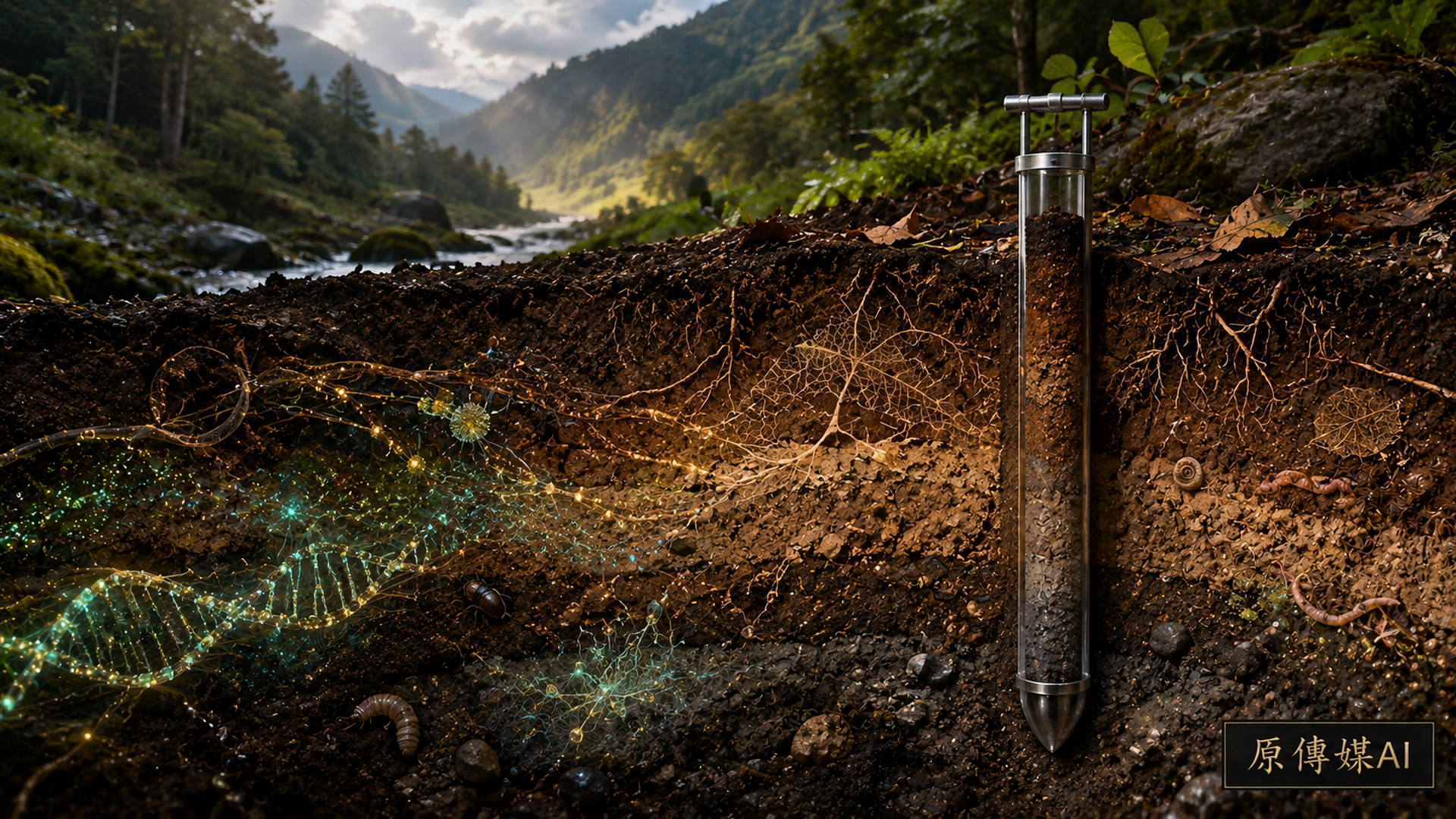
Soil is not a quiet background. It continuously accumulates moisture, plant roots, insects, animal excrement, microbes, decay products and human activity. Forensic science has begun using soil and decomposition microbiomes to infer postmortem intervals, burial environments, and differences among sites; many Indigenous Peoples and traditional knowledge holders have long judged landscape conditions from soil colour, smell, touch, vegetation, insect and animal behaviour.
They are not the same, but may form truly valuable Two-Eyed Seeing.
What Forensic Microbiome Reads
After human or animal death, bacteria, fungi and metabolites in the body and surrounding soil change over time. Nature Microbiology study tracked 36 human bodies across different locations, finding that even with varying sites, climates and seasons, decomposition processes form a stable cross-site microbial network with potential to infer post-mortem interval.
This does not mean every piece of soil will give the same answer. Temperature, moisture, soil pH, vegetation, insects, burial depth, animal disturbance and sampling methods all alter signals. 2024 Scientific Reports study comparing surface versus subsurface decomposed soil bacteria also shows burial environment produces different microbial changes.
Forensic microbiomic evidence is probabilistic; soil does not automatically speak the truth.
Indigenous Landscape Interpretation Is Not Mystical Intuition
Traditional knowledge holders may judge land use, fertility, waterlogging, collapse risk or recent disturbance from soil colour, texture, stickiness, moisture, smell, vegetation and animal activity. Such knowledge has been studied extensively in ethnopedology.
A Geoderma review of ethnopedology worldwide compiled research from 61 countries and 217 ethnic groups, showing place-based soil knowledge includes not only classification but also management, appropriate use and cosmology. Recent Soil Security review emphasizes that such knowledge is long-term, holistic and intergenerational, yet often excluded from university curricula and policy decisions.
This is not knowledge acquired “at a glance,” but expertise developed through repeated engagement with a landscape over time.
Soil Colour, Vegetation and Smell Are Composite Signals
Western soil science often breaks soil into texture, organic matter, pH, minerals, microbes; place-based classification may directly link these features to cultivability, plants, drainage and historical use.
Brazilian Roraima Wapishana ethno-soil study shows Wapishana distinguish soil landscapes by colour, texture, depth, vegetation, land use and crop suitability. Indian Karbi farmer study also demonstrates that place-based soil classification combines water retention, compaction, fertility and indicator plants.
Forensic microbiomics measures bacteria and fungi that cannot be seen directly; place-based knowledge integrates visible, audible, tactile, and other sensory signals into judgments for action.
Two-Eyed Seeing Does Not Turn Trackers into Forensic Scientists
A particularly damaging claim would equate Indigenous tracking with forensic microbiology. This is neither accurate nor respectful to either knowledge system. People who track and read landscapes do not ordinarily use DNA sequencing to identify bacteria; forensic labs do not rely solely on smell and plants for post-mortem interval.
True complementarity lies in research design. Place-based knowledge can help identify sampling areas, seasonal changes, animal activity, recent disturbance and land history; microbial analysis provides invisible community shifts. If results diverge, researchers should re-examine rather than automatically declare one side wrong.
Landscape History Determines How Microbial Evidence Is Interpreted
The same microbial shift may have different causes across landscapes. Agricultural fertilization, livestock activity, wild animal carcasses, river flooding, forest fires, debris flow and human burial all alter soil communities.
Nature study on extreme events and soil microbiome shows drought, flood and freeze cause predictable but distinct microbial responses. Agricultural management and soil depth study also indicates farming practices affect microbial assembly and interactions at different depths.
Thus forensic models ignoring land history risk misreading agricultural, animal or disaster signals as specific case traces.
Place-Based Knowledge Can Fill Gaps Databases Miss
Lab databases require standardization; place environments do not. Past uses—pasture, cemetery, hunting ground, river channel, fallow field—may not appear in modern maps; people familiar with the area know which animals frequent it, where water pools after rain, where soil was turned, which plants grow only on certain soils.
These histories improve sampling and model interpretation. They are not decorative oral stories but crucial environmental information affecting evidence reliability.
Microbes Cannot Be Treated as Absolute Fingerprints
Media accounts often portray forensic microbiomics as proof that “everyone has a unique bacterial fingerprint,” implying that a trace of soil can solve a case immediately. In reality, microbes are influenced by time, environment, sampling, sequencing platform and analysis workflow. Communications Biology study on soil sequencing error warns that reference soils, detection protocols and data quality affect results.
Any forensic application must undergo reproducibility testing, error bounds, cross-validation and legal standards. Otherwise high-tech merely packages uncertainty as colourful charts.
Ethical Issues Extend Beyond Data Sovereignty to Evidence Consequences
When such research occurs in Indigenous areas, soil cannot be treated as ownerless samples. Sampling may involve cemeteries, ritual sites, hunting grounds or sensitive landscapes; results could be used for criminal investigations, land disputes and risk marking.
The discussion must not stop at slogans about “sovereignty”; it must ask concrete questions: who proposes research purposes, who decides sampling locations, whether traditional knowledge holders participate in interpretation, who bears responsibility for model errors, whether results can be repurposed without consent.
From Forensics Back to Environmental Health
Forensic microbiome techniques may also help understand environmental changes on farmland, pasture, rivers and forests. Decomposers, soil microbes and organic cycles are part of ecosystem functioning. Place-based observations of decay, insects, animals and plant change can complement environmental monitoring.
Truly promising Two-Eyed Seeing is not just finding answers after crimes occur, but establishing long-term landscape health baselines: what normal seasonal variation looks like, what abnormal disturbance signals, what disaster or pollution leaves behind.
Soil Remembers But Does Not Testify on Its Own
Soil does leave microbial, chemical, root and activity traces; it does not explain causes. Forensic models need environmental context; place-based knowledge must avoid over-inference.
The value of Two-Eyed Seeing lies in placing "invisible microbial shifts" and "long-term lived landscape interpretation" within the same investigative framework. Each can question and correct the other, producing more credible answers.
Soil may remember who walked through it, but how to interpret that memory still requires science, place-based experience and ethical responsibility working together.
Most Valuable Collaboration May Not Be Solving Cases But Building Landscape Baselines
If forensic microbiome only samples after cases occur, researchers struggle to know a soil's original seasonal variation, livestock activity, flood, fertilization or wild animal decomposition background signals. More reliable Two-Eyed Seeing plans should first establish long-term landscape baselines in non-case contexts: traditional knowledge holders mark land history, indicator plants, water pooling, animal paths and human disturbance; microbial, chemical and soil physical analyses record normal seasonal fluctuations.
Such baselines could support not only justice systems, but also farmland health, assessment of pasture pollution, forest restoration, flood impacts, and post-disaster environmental evaluation. Place observations help researchers identify "why this area differs"; labs point out invisible community shifts. If models enter judicial processes later, error rates, sampling chains, reference materials and alternative explanations must be disclosed—microbial classification maps cannot serve as sole testimony. Soil provides clues, not verdicts; the higher the risk of use, the more place context, reproducible experiments and procedural justice must all hold.
AI use and content-safety disclosure
This article was assisted by AI for data organization, structural drafting and sentence polishing; editorial verification set viewpoint and fact-checking direction