Stars Are Not Decoration: How Indigenous Ecological Calendars Guide Planting, Grazing, Fishing, and the Reading of Storms
Original Chinese title: 星星不是裝飾:原住民族生態曆如何同時指揮播種、放牧、漁撈與風暴判讀
From Amazonian star clusters and Māori lunar calendars to Torres Strait readings of stellar scintillation, Indigenous sky knowledge connects planting, fishing, grazing, winds, and seasonal risk within a living system of knowledge.
Two-Eyed Seeing Lab
Consulting committee member: 陳勝|Former Maolin Township mayor; Maolin elder of the Western Rukai Zhuokou River group; chief adviser and cultural director for the Taiwan Indigenous Medicinal Plant Culture Journey television series; mother-tongue teaching-materials editorial committee member.
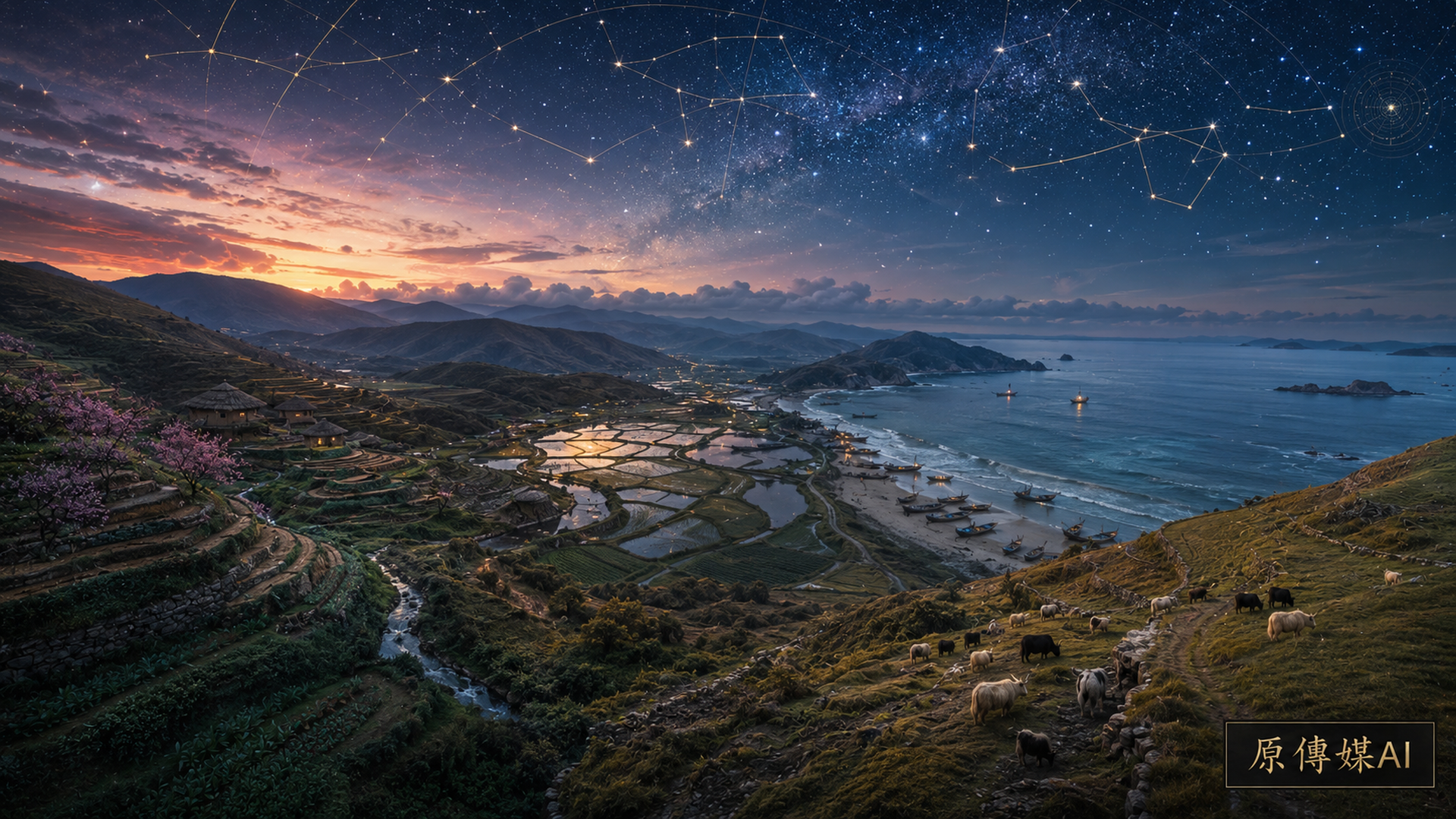
In modern cities, stars are often treated as a romantic backdrop. In many Indigenous societies, however, they form part of a timekeeping system that guides planting, gathering, fishing, grazing, ceremony, and travel. This is not a matter of pasting myths onto the night sky; it connects the sky, wind, tides, flowering plants, fish movements, bird migration, and community work into an actionable network of relationships.
Ecological Calendars Are Not “Primitive Weather Forecasts”
Western calendars divide time into fixed dates; Indigenous ecological calendars often mark it through events. The rising of a particular star, the return of certain birds, a change in river color, a flowering plant, or a shift in the wind can all signal what should be done. This event-based structure is not imprecise; it is closely fitted to a local environment.
Frontiers in Psychology study on event‑based time among Huni Kuĩ, Awetý and Kamaiurá shows that Awetý and Kamaiurá link star cluster positions to cassava and maize planting/harvesting as well as ceremonies and environmental changes. These clusters are not Western constellations; their shapes, names and stories are embedded in their own languages and life contexts.
Reducing these relationships to “this star equals this month” misses the point: stars index environmental relationships rather than merely stand in for fixed dates.
Māori Maramataka: Moon Phases, Tides, and Fishing Are Not Separate Knowledge Systems
Māori maramataka is often rendered as a moon phase calendar but records far more. Different iwi use moon phase, tide, season, stars and local ecology to judge when to plant, gather, hunt and fish. New Zealand government education resources on maramataka note its long‑standing role in timing fishing and food production.
A 2026 study published in Marine Policy further discusses how maramataka is incorporated into pāua fisheries management, indicating that traditional moon phase knowledge may hold practical value for resource sustainability and local governance, though current regulations lack sufficient flexibility to formally integrate it.
The central issue is not which system is “more accurate,” but the different scales at which each observes. Modern marine science provides satellite measurements of sea-surface temperature, tide levels, catch data, and long-term trends. Maramataka preserves fine-grained temporal awareness, rules for conduct, and community practices of restraint in local waters. Two-Eyed Seeing retains both and allows them to inform and test one another.
Stellar Scintillation Can Also Signal Wind and Humidity
Meriam knowledge holders in Torres Strait observe stellar flicker, colour and brightness to interpret wind, moisture, seasonal shifts and impending weather changes. Proceedings of the Royal Society of Victoria study confirms an atmospheric optical basis: starlight traverses layers of varying temperature and density, producing different degrees of scintillation.
Western science can explain how atmospheric turbulence affects starlight, but it cannot claim to “validate” an entire Indigenous knowledge system. Local interpretation may also include wind direction, sea conditions, animal behavior, seasonal experience, and long memory. Physics can explain a mechanism; it does not replace the ways knowledge is transmitted, governed, and put into practice within communities.
Agriculture, Fisheries, Livestock, and Forestry Were Never Separate Departments
Modern governments split agriculture, fisheries, livestock and forestry; many Indigenous ecological calendars treat them as one seasonal system. A star cluster’s appearance may simultaneously signal fish approaching shore, birds beginning migration, mountain rainy season shifting, pasture conditions changing, or crops ready for planting.
This holistic view avoids single‑data bias: focusing only on rainfall ignores insects, birds and soil moisture; focusing only on sea temperature overlooks local wind direction, currents and shoreline species signals. Ecological calendars restore these signals to a unified picture.
Climate change is desynchronizing old cues
Traditional ecological calendars are not immutable. Climate‑driven earlier flowering, altered bird migration, anomalous sea temperatures and delayed monsoons can decouple star signs from phenology. Stars still rise on schedule, but fish, crops, and rain may no longer respond on the same timetable.
This does not mean Indigenous knowledge fails; the environment itself changes. The task is to record which relationships have loosened so local observation and modern monitoring jointly update ecological calendars. Satellites and sensors measure change; communities identify impacts that truly affect livelihoods.
Two-Eyed Seeing Must Not Turn Signs in the Sky into Data Extraction
If researchers simply convert signs in the sky, plants, and animals into a database without understanding seasonality, differences among Indigenous Peoples, or limits on use, they reproduce extraction in a new form. Sound Two-Eyed Seeing projects must determine locally what may be public, what may be used only for teaching, what requires explanation by a knowledge holder, and what must remain within its original context.
A technical project could build a data model linking the sky, seasonal changes in plants and animals, farming, fishing, grazing, and risk. Such a model must accommodate multiple versions, local variation, and uncertainty instead of forcing every Indigenous People in Taiwan into a single calendar.
Taiwan Needs More Than Textbooks of Constellation Stories
Developing Indigenous astronomy education in Taiwan should not merely produce pretty constellation illustrations. It must record: when each star appears, its connections to plants, animals, agricultural/fishing activities, weather or ceremonies; whether these relationships still hold today; how younger generations participate in updating them.
Such materials can integrate with meteorology, geography, biology, agriculture, oceanography and data science. Students should not be asked to choose between “traditional” and “scientific” knowledge. They should learn how two forms of evidence are produced, where they complement one another, and where neither can replace the other.
Stars Tell Time—and Remind Us of Relationships
The greatest advantage of modern calendars is uniformity; its cost is forgetting that time originates from environment. Indigenous ecological calendars remind us that time is not abstract grids but signals—flowers blooming, fish returning, winds shifting, stars rising—that tell people when to begin, stop, wait or restrain.
Stars are not decoration. They are part of a system for interpreting relationships between the sky and living worlds, accumulated over generations. Two-Eyed Seeing does not translate stars into Western terms. It reminds modern monitoring that a season is never only a set of meteorological numbers, but a web of relationships changing together.
From Annual Activity Tables to Updatable Local Observation Systems
Bringing traditional ecological calendars into farming, forestry, fishing, grazing, and education in Taiwan requires more than a poster listing what to do each month. A more practical approach would enable Indigenous communities, farmers, fishers, livestock keepers, Indigenous-language teachers, and natural scientists to build annual observation records together: star positions, moon phases, tides, wind direction, rainfall, flowering, bird and animal activity, and the condition of fish and crops, each recorded with a date, location, and observer’s notes. These records should not be compressed into one standard answer; multiple versions across families, communities, and generations should be retained.
Modern weather stations, satellites and ocean sensors supplement large‑scale trends; local observations point out changes that truly affect planting, gathering, grazing and fishing. When discrepancies arise they become research signals rather than immediate judgments of error. Over time ecological calendars can serve as local climate change archives: which flowers bloom earlier, which fish seasons shorten, which star signs remain punctual while ground responses shift. Such systems are both heritage tools and foundations for agricultural resilience and environmental education.
Observation records must also retain cases in which cues no longer align—for example, when a star appears but fish do not arrive, or flowering begins earlier but planting still fails. Documenting these mismatches allows ecological calendars to remain living, revisable knowledge instead of becoming static cultural specimens.
Sources retained from the Chinese original
AI use and content-safety disclosure
This article was assisted by AI in organizing sources, drafting the structure, and polishing the prose. Human editors set its perspective and fact-checking direction, with verification considerations retained for editorial review.