The Second Face in the Courtroom: How Deepfake Evidence Passes Through Three Defenses—Forensics, Provenance, and Procedural Justice
Original Chinese title: 法庭裡的第二張臉:深偽證據如何穿過鑑識、來源與程序正義三道防線
Beginning with deepfake video, provenance credentials, and courtroom rules of evidence, this article examines how digital content passes through three defenses: forensics, platforms, and procedural justice.
Two-Eyed Seeing Lab
Focuses on technology governance, the ethics of AI evidence, and interdisciplinary science communication.
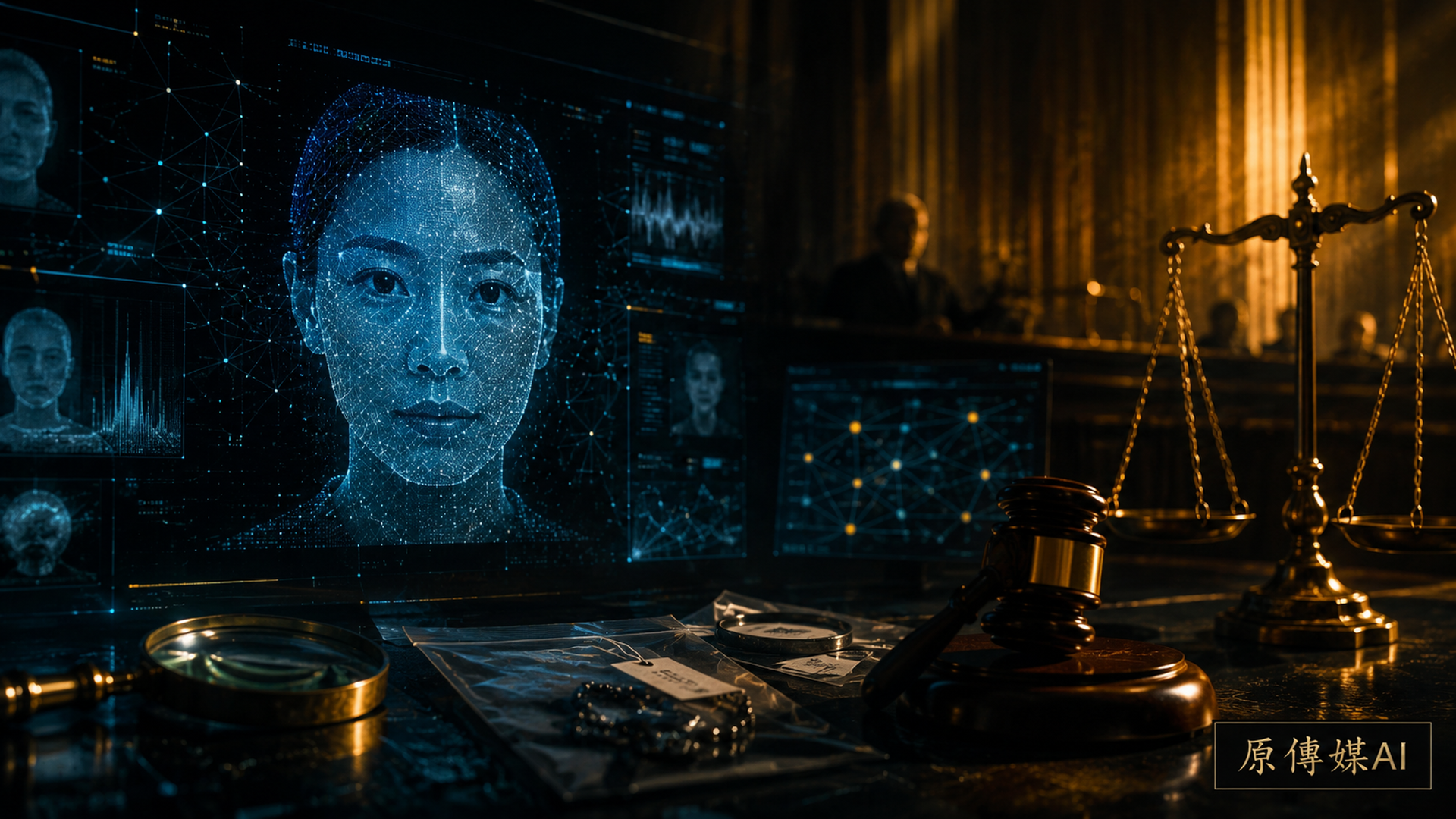
Courts have traditionally trusted what people can see, physical evidence, and witnesses who can be questioned. The AI era is forcing them to confront another situation: the face you see may belong to a real person, but the words may not be theirs; the voice may sound exactly like them, yet have been assembled by a model; and a saved video may carry invisible traces of manipulation from its first second. The greatest problem is not one deepfake video but the way it erodes the wider structure of trust. When any digital image can be challenged, reality must work harder to prove itself.
The First Face Is Content; the Second Is Provenance
When most people discuss deepfakes, their instincts stop at whether the content is genuine: Does the face look right? Are the lip movements smooth? Does the voice sound natural? A court should be especially careful not to remain at this level. Realism can, at most, give grounds for suspicion. What establishes admissibility is the chain of provenance: where the recording came from, who captured it, when it was exported, whether it was altered along the way, whether those changes were recorded, and whether the chain of custody remained intact. This is why C2PA|Content provenance standard has received considerable attention in recent years. It seeks to give images, audio, and documents verifiable provenance information instead of leaving every judgment about authenticity to forensic analysis at the end of the process.
In other words, the important thing in a future courtroom will not be only the face we can see, but a second face—the invisible face of provenance behind the content. Without that second face, anyone can calmly ask in court, “How do you know AI did not make this?” That single sentence may be enough to make even an authentic video appear unstable.
Forensics Matters, but It Is Not a Cure-All
NIST|Evaluating synthetic media and deepfake detection continues to remind researchers and decision-makers that deepfake detection is an arms race. Features that reveal a forgery today may be bypassed by a new model tomorrow. A detector that performs impressively under one set of conditions may become less accurate when compression, language, or facial occlusion changes. Courts therefore cannot place all responsibility on a single detection model, much less treat the output of an AI tool as a new and unquestionable authority.
An old institutional habit is to search immediately for an “expert button” whenever new technology appears. Deepfakes are particularly unsuited to that response. Forensic analysis can answer certain technical questions about suspicious features, but it cannot necessarily prove by itself that an entire recording is true or false. If a court mistakes machine output for a final answer, it merely replaces the old “faith in the naked eye” with “faith in the algorithm.”
Procedural Justice Is Harder than Technology—and More Important
The core issue in deepfake evidence is ultimately not technological spectacle but procedural justice. Can a defendant learn which testing method was used? Can the defense request a new examination? If forensic software is a black box, does that undermine meaningful confrontation? Could judges and jurors be misled by overly visual forensic reports? If these questions are not built into the system, so-called “high-tech evidence” may deepen inequality instead.
Technical documents are not the only useful references here; governance principles matter too. Partnership on AI|Responsible practices for synthetic media and European Commission|AI Act and transparency obligations call, at different levels, for transparent labeling, traceability, and risk governance. Although these frameworks primarily address industry and platforms, they also offer a lesson for evidentiary systems: without transparency obligations, trust cannot be stable; without traceability, procedure will fail precisely where it is most needed.
Platforms and Courts Should Not Speak Past Each Other
One of the most absurd features of the current situation is that deepfake content often explodes first on platforms and then drifts into the news, elections, workplace disputes, or judicial proceedings. Platforms focus on social harm and removal standards, while courts focus on admissibility and probative value. Their logics differ, but in practice they are connected. If a platform preserves no provenance information, the chain of evidence may already be fragmented by the time a case reaches the courts. If courts ignore the technical realities of platforms, they may assume that every piece of material can still be traced back to a pristine original file.
This reveals a broader point: procedural justice in the AI era cannot be achieved solely by changing rules inside the courtroom. It also requires provenance governance across platforms and industries. Otherwise, everyone will voice support for fighting fakes while discarding the metadata and generation traces that matter most at every stage along the way.
A Two-Eyed Seeing Perspective: Technology, Law, and Civic Perception Must Be Read Together
Why is this article bylined to Two-Eyed Seeing Lab? Because deepfakes are a textbook example of a problem seen from different domains. Technical communities focus on models and detectors, legal communities on admissibility and remedies, and civil society on everyday trust and risks to victims. When each speaks only to itself, the familiar fractures appear: engineers believe the detection rate is already high, judges believe expert testimony is sufficient, and the public believes anything could be fake.
Genuine Two-Eyed Seeing does not force lawyers to learn how to code models, nor does it ask engineers to memorize a few rules of evidence. It enables each party to understand what its tools can and cannot address and how they connect to the institutional designs of others. No single profession can claim the deepfake problem as its exclusive domain.
The Most Dangerous Outcome Is Being Unable to Explain
The worst future for deepfakes is not simply one with more fake videos, but one in which society grows accustomed to saying, “We cannot tell.” Authentic videos are challenged, fake videos are shared, platforms provide only vague labels, courts cannot find complete provenance, and the people involved are worn down by disputes over what is real. At that point, deepfakes are no longer merely a technical issue. They become a test of how public institutions face uncertainty.
At least three defenses are needed to escape this predicament. First, content forensics must continue to improve without being deified. Second, provenance credentials and chains of custody must move upstream rather than being assembled only after a case erupts. Third, procedural justice must ensure that the parties can understand, challenge, and reconstruct the examination process. Without all three, even the most powerful AI will only increase the cost of trust.
What Courts Must Protect Is the Ability to Question Evidence
Courts do not exist to worship technology. They exist so evidence can be questioned. That is even more important in the deepfake era. Any promise to “verify authenticity with one click” deserves initial skepticism. A reliable system should not make reality depend on an authority's assurances; it should allow reality to be explained step by step through provenance, process, and examination. When a court protects not a particular model but the space in which evidence can be challenged and answered, procedural justice will not become justice in appearance only when faced with AI-generated images.
Additional Observation: Judicial Education Must Also Advance
If judges, prosecutors, lawyers, police, and investigators understand generative AI only through news headlines, the system can easily become unbalanced in either direction: it may place too much faith in technology vendors' presentations, or it may become cynical about all digital evidence. What is needed is continuing, cross-professional training that helps legal practitioners distinguish tools that can assist, tools that provide only risk signals, and tools whose results must be open to confrontation and reproduction.
The public, too, should avoid treating deepfakes solely as celebrity gossip or electoral combat. They also affect evidence of domestic violence, recordings of workplace sexual harassment, insurance fraud, voice-impersonation payment scams, and child protection. When anyone can be fabricated, falsely accused, or treated with suspicion, provenance governance and procedural justice are no longer matters discussed only inside law schools.
Additional Context
Regional differences, the limits of individual cases, and the conditions under which policies apply must remain explicit, so that cross-national examples are not extrapolated directly into universal answers.
AI use and content-safety disclosure
This article was assisted by AI for data organization, structural drafting, and sentence polishing; human editors set the viewpoint and direction for fact-checking.