A Volcano Is Not Read by Seismometers Alone: How Māori Mātauranga and GeoNet Read Ruapehu Together
Original Chinese title: 火山不是只看地震儀:Māori mātauranga 如何與 GeoNet 共讀 Ruapehu
Beginning with Ruapehu, GeoNet instrument monitoring, and local interpretation through Māori mātauranga, this article reconsiders why volcano governance cannot be reduced to seismometers and alert boundaries.
王振庭
Natural Science Education Teacher.
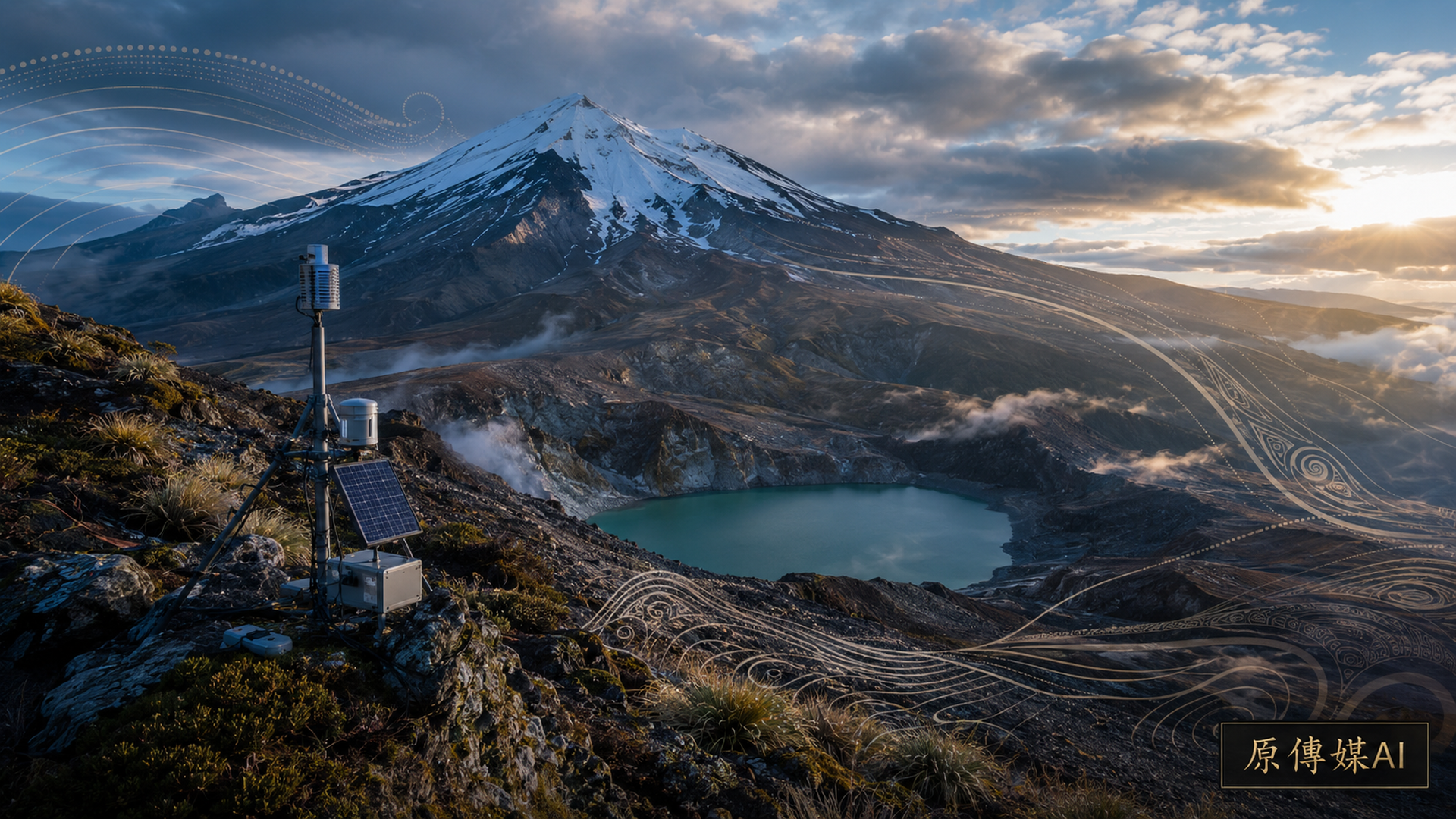
If we imagine volcano governance as a row of instruments that never lie and a set of alert signals that are always clear, Ruapehu will quickly teach us to set aside that arrogance. Modern monitoring is, of course, essential: seismometers, tiltmeters, volcanic-gas measurements, satellite thermal anomalies, crater-lake chemistry, and remote cameras all matter. Yet governance develops blind spots once a volcano is understood only as a data object. How do local communities understand the mountain's temperament? How were roads redrawn after the last eruption? How do visitors decide what to do between “no alert” and “risk remains”? How do schools and Indigenous communities remember the escape routes used by earlier generations? None of this is automatically written into a line graph.
Instruments Speak, but Only in the Languages They Know
GeoNet|Ruapehu monitoring and GNS Science|Volcano monitoring in New Zealand clearly explain the scientific architecture of volcano monitoring in New Zealand: seismicity, deformation, gases, hydrology, and other indicators are used to track volcanic activity. The value of these systems is beyond dispute. They allow governments and scientists to detect anomalies earlier and translate information into alert levels, trail closures, or warnings about lahar risk. The problem is that instruments perform well only within the domains for which they were configured. They can measure amplitude and concentration, but they do not automatically understand why local residents are especially wary of a particular river valley or which stretch of mountain road is most likely to develop secondary hazards after rain.
This is not an argument for using “local feeling” to reject monitoring. It is an acknowledgment that risk always has multiple layers. An eruption is not a binary question of whether a volcano erupts. Tourism, education, transportation, infrastructure, and the governance of memory all lie between those two poles. When institutions reduce a volcano to a scientific report page, their account may appear more precise while becoming narrower in practice.
Mātauranga Māori Is Not Mystical Intuition but Environmental Interpretation Accumulated over Time
Outsiders commonly make two mistakes when discussing mātauranga Māori. One is to romanticize it as mystical prophecy; the other is to marginalize it as mere cultural background. Mātauranga Māori is better understood as a long-duration structure of environmental knowledge encompassing place names, narratives, ancestral routes, relationships among mountains and rivers, seasonal signs, and ways communities respond. The context assembled by Te Ara|Volcanoes and Māori relationships with mountains reminds us that a mountain is not an isolated geological body. It is intertwined with a people's history, sacred relationships, and local ethics.
If these dimensions are treated as museum footnotes, Two-Eyed Seeing becomes decorative. The questions that matter are how local knowledge shapes understanding of hazardous areas, who leaves first and who assists whom, and which routes permit no delay. Modern disaster preparedness often assumes that people will naturally comply if an alert is issued quickly enough. Experience on the ground repeatedly shows otherwise: whether people trust a message and can turn an abstract warning into bodily action depends on the local judgment they have accumulated over time.
Reading Together Is Not Mutual Endorsement
I prefer to understand “Māori mātauranga and GeoNet reading Ruapehu together” as a practice of shared reading, not a contest over who validates whom. Science does not need to certify local knowledge, and local knowledge need not play the miraculous rescuer whenever science falls short. Genuine shared reading allows two evidentiary systems to state their own boundaries clearly: instruments can provide real-time monitoring of anomalies, while local knowledge reconnects those signals to landscape, community, and historical consequences. Volcanic risk is not a single variable. It requires multiple readings to be coordinated at the same table.
This coordination is difficult not because one side is less rational, but because governance systems have powerful habits. Official briefings favor a single pathway: one monitoring center, one announcement system, one alert level, and everyone complying. Conditions on the ground often run on multiple tracks. Schools, tourism operators, Indigenous communities, road-maintenance agencies, and mountain-hut managers do not all care about precisely the same risks. Unless local knowledge becomes part of advance planning, it can only be invoked afterward to say, “Someone had already warned us.”
Volcano Governance Is Also an Educational Question
As a natural science educator, I am especially concerned with another question: how do we teach students to understand volcanoes? If volcano education is reduced to magma, tectonic plates, and eruption types, students learn about a volcano stripped of society. Mature science education should allow students to see at once how instruments work, how alert systems are established, how local knowledge is preserved, and why policy often overlooks the people most familiar with the landscape.
Such a classroom does not weaken science. It returns science to the field. Students learn not only what a monitoring station measures, but also why a community may be particularly sensitive to a certain waterway, bridge, or change in lake color. When a volcano is taught as a public issue requiring interpretation by multiple parties, science no longer becomes inert knowledge useful only for answering exam questions.
When Facing Uncertainty, Honesty Is More Reliable than Omniscience
Nothing invites trouble around a volcano quite like people pretending to know everything. Institutions, too, fear admitting uncertainty. Yet reliable risk communication does not pretend that every event can be forecast to the minute. It honestly explains which indicators show anomalies, which data remain under observation, which local experience deserves consideration at the same time, and which decisions call for caution. Such honesty can increase public trust because it does not treat people as objects who need only obey.
UNDRR|Indigenous knowledge for disaster risk reduction repeatedly emphasizes that Indigenous Peoples and local knowledge are not optional additions but important resources for disaster-risk governance. If they appear only in introductions or on conference posters while institutions continue to operate as closed systems controlled by a single profession, however, “integration” is merely an attractive word.
A Volcano Is Not Read by Seismometers Alone
Ruapehu offers a direct reminder: if volcano governance is reduced to seismometers, monitoring will eventually be mistaken for understanding. Understanding a mountain has always involved more—landscape memory, language, relations among peoples, experience with routes, historical wounds, and educational transmission. Instruments should become stronger, and local knowledge should have a more consequential place. Neither should replace the other, and neither should imagine that it alone adequately represents the entire mountain.
When we say that a volcano is not read by seismometers alone, we mean that a mountain must not be reduced to one language. Governance capable of holding scientific monitoring and Māori mātauranga together is more likely, when the next uncertainty arrives, to help people do more than look at an alert: they can understand it, notify one another, and take the right action.
Additional Observation: Beyond Early Warning Lie Recovery and Memory
Volcano governance has another frequently overlooked dimension: after an event ends, who is responsible for bringing the experience back into the community in an organized form? If institutions are active only while an alert is in effect, leaving recovery, textbook revisions, trail redrawing, and oral records for local communities to manage on their own, society will still scramble as though encountering the hazard for the first time when the next event comes. Bringing local knowledge into volcano governance means more than putting it in meeting minutes; it must enter recovery and long-term education.
Different knowledge systems will not necessarily agree at all times. Mature collaboration must allow disagreements to be voiced. Instrument-based interpretation may be conservative, while local experience may be more sensitive; an official notice may apply the same response to an entire area, while a community knows that one valley is substantially more dangerous. A system that accepts only one version will struggle to use these differences to correct its blind spots.
Additional Context
Regional differences, the limits of individual cases, and the conditions under which policies apply must remain explicit, so that cross-national examples are not extrapolated directly into universal answers.
AI use and content-safety disclosure
This article was assisted by AI for data organization, structural drafting, and sentence polishing; human editors set the viewpoint and direction for fact-checking.