A Seed Bank Is Not a Refrigerator: The Real Conflict over Community Varieties, Global Backup, and Indigenous Genetic Rights
Original Chinese title: 種子銀行不是冰箱:社區品種、全球備份與原住民族遺傳權利的真正衝突
Starting with the Svalbard Global Seed Vault, community seed systems, and genetic-resource governance, this article examines why seed conservation is not merely a refrigeration technology but also a matter of rights, relationships, and benefit-sharing.
鄭淑禎
Full-time Assistant Professor at Shih Chien University.
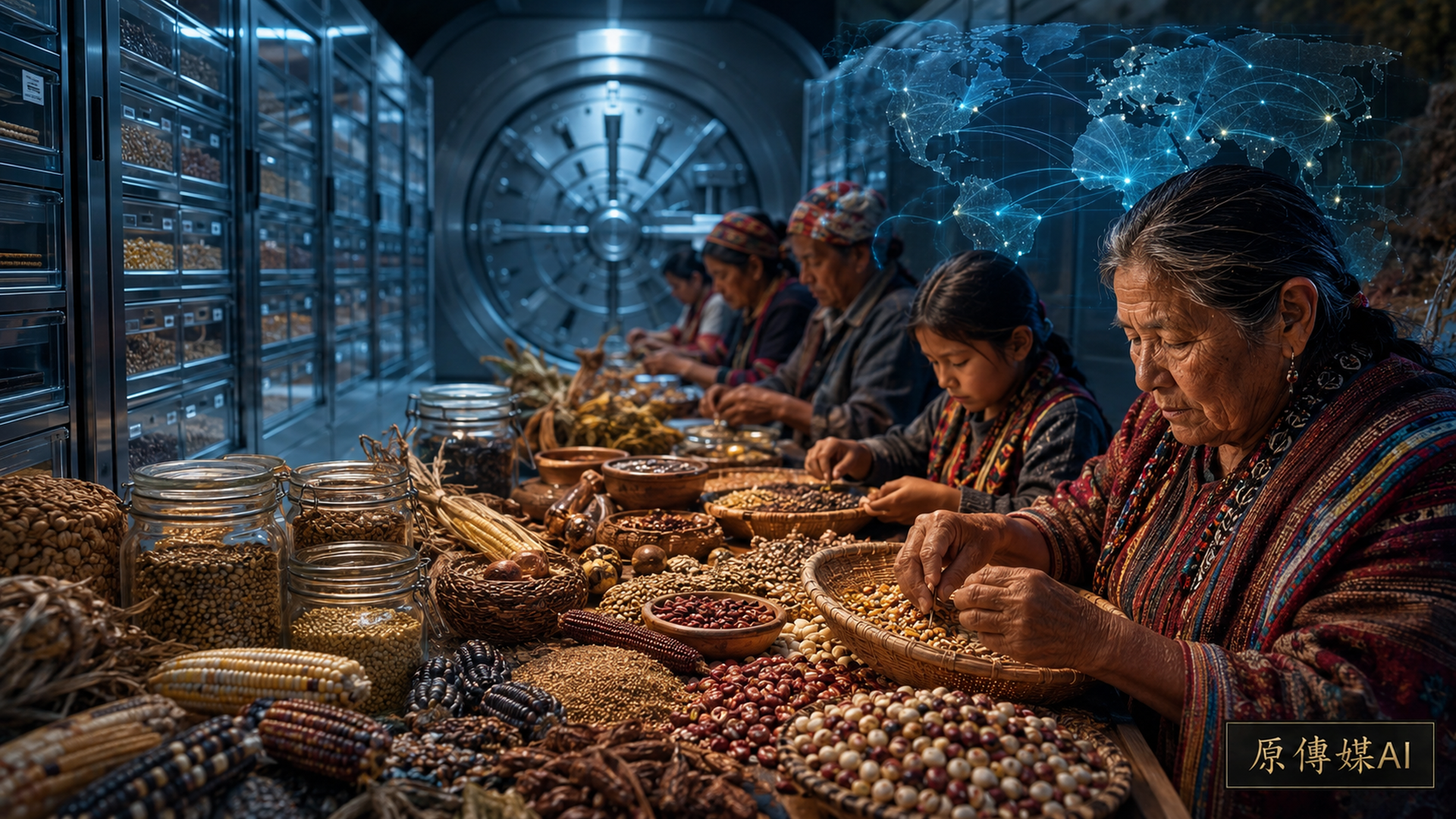
When people hear “seed bank,” they often picture rows of drawers, cold-storage rooms, and metal doors. That image is not wrong. But if it leads us to think that seed conservation is simply a more advanced form of refrigeration, it makes the issue far too simple. Seeds are not merely genetic material. They also condense community history, food cultures, local selection, ceremonial rhythms, and livelihood strategies. Every act of seed conservation therefore raises a sensitive question: who has the right to decide what deserves to be conserved, how it should be conserved, who may use it, and who ultimately profits from it?
Global Backup Matters, but It Is Not Everything
The Crop Trust | Svalbard Global Seed Vault does offer a compelling model of global backup: germplasm from around the world is stored under Arctic permafrost conditions as protection against war, disaster, or genetic erosion. As an insurance strategy, this is unquestionably a rational arrangement for human civilization. The problem arises when global seed governance is increasingly represented by large, centralized, refrigerated infrastructure of this kind. It then becomes easy to overlook that the people truly sustaining crop diversity are often not those managing cold vaults, but communities that continue to sow, select, exchange, and conserve seeds in their fields every season.
The FAO | Farmers’ Seed Systems and Crop Diversity has long emphasized that farmers’ seed systems still supply most planting needs in many regions. This points to a practical reality: if field selection and local exchange networks disappear, even the largest seed bank can preserve only a static backup removed from its context, not agricultural knowledge that remains alive and continues to evolve.
Seed Banks Preserve Material; Communities Preserve Relationships
This is the central meaning of the claim that a seed bank is not a refrigerator. Cold-storage facilities preserve material as it exists at a particular moment. Communities preserve how varieties are understood, named, selected, combined, used in ceremonies, and reproduced within an environment. Indigenous Peoples’ and local farmers’ seed knowledge often encompasses which seeds suit a particular slope, which varieties withstand a specific drought pattern, which flavors are connected to family memory, and which seeds must not be distributed casually. If all of this is reduced to an accession number, conservation has already lost half its soul.
Taking seeds away from a place and then saying, “We will keep them safe for you,” may sound progressive but is not necessarily fair. When conservation fails to consider relationships alongside materials, protection can easily become extraction.
Access and Benefit-Sharing Are the Most Sensitive Questions in Genetic-Resource Governance
At this point, the legal questions cannot be avoided. The central principle of the Convention on Biological Diversity | Nagoya Protocol is that access to and use of genetic resources should involve prior informed consent and fair benefit-sharing. This principle appears reasonable, yet its implementation is extraordinarily complex. Seeds, varieties, and related knowledge frequently cross national borders, generations, and communities. More difficult still, much of the most valuable information lies not in the seed itself but in knowing how it is cultivated, when it is harvested, and which processing methods accompany it.
This is also where Indigenous Peoples are most frequently marginalized. Companies, research organizations, or breeding institutions may be able to identify a “material source” clearly without fully acknowledging the source of knowledge. Innovation then appears to have drawn inspiration from a public resource when it actually rests on generations of local selection and knowledge maintenance.
These Are Not Merely Claims of Sovereignty but Concrete Genetic Rights
This article deliberately avoids abstract rights slogans and returns instead to tangible conflicts. If a local variety enters a large germplasm repository, must future researchers explain their use to the community of origin? If breeders commercialize a trait from that variety, how will benefit-sharing be implemented? If Indigenous Peoples maintain restrictions concerning related names, uses, or combined knowledge, can germplasm databases provide tiered access? These are not hypothetical questions. They are conflicts that will emerge in policy, scholarship, and markets.
Recent work under the WIPO | Genetic Resources and Associated Traditional Knowledge Treaty addresses the relationship between patent applications and disclosure concerning genetic resources and traditional knowledge. It cannot resolve every inequality at once, but it does establish one important point: innovation systems can no longer pretend that materials and knowledge separate automatically.
Community Seed Systems Are the Front Line of Resilience
From the perspective of agricultural resilience, community seed systems are not a form of cultural romanticism; they are practical risk management. Faced with extreme weather, pests and diseases, and market volatility, local seed conservation and diversified cultivation often provide more buffering capacity than a single commercial variety. What matters is not only freezing rare varieties in the Arctic, but ensuring that local farmers still have the room to keep cultivating, selecting, and exchanging them. That is how diversity remains alive rather than merely stored.
This perspective is especially instructive for Taiwan. If Indigenous agricultural knowledge is understood only as a display of ceremonial crops rather than as an ongoing, localized capacity for germplasm management, it will be difficult to develop policy of real depth. From millet and beans to root crops, much of the value lies not in the name of a single variety but in the ways communities have continually adapted it to mountain climates, divisions of labor, and food cultures.
Conservation Must Not Come at the Cost of Silencing Local Voices
Supporting global backup and supporting local control do not have to be mutually exclusive. The question is how institutions set their priorities. If large organizations, global standards, and centralized custody always come first while communities are treated only as the front end that supplies samples, conservation will ultimately come at the cost of silencing local voices. Conversely, if community knowledge, informed consent, shared governance, and benefit-sharing are built into the design from the outset, seed banks can move from one-way extraction toward genuinely collaborative infrastructure.
A seed bank is not a refrigerator because seeds have never been merely objects for cold storage. They are the result of selection within local environments, a covenant between ancestors and descendants, and an insurance policy for agricultural diversity in the future. The question worth asking is not simply whether a seed has been conserved, but how it was conserved and who still retains the authority to decide its future afterward.
Supplementary Observation: Database Design Is Also Political
Many germplasm systems today emphasize digitization, standardization, and federated searching across repositories. These tools certainly improve research efficiency, but they can also flatten knowledge that originally belonged to local taxonomies, local names, and local contexts of use. If a database accepts only one external naming system, communities’ nuanced understandings of crops may become even harder to see.
Future seed governance therefore concerns not only refrigeration and law, but also the design of data architectures. Can local names appear alongside external ones? Can sensitive knowledge have graduated access? Can knowledge holders track subsequent use? These seemingly technical details will ultimately determine whether “conservation” sustains diversity or recentralizes control through a new format.
Supplementary Observation
Regional differences, case limitations, and conditions governing policy applicability should be considered in light of the readership so that cross-national cases are not extrapolated directly as universal answers.
AI use and content-safety disclosure
This article was assisted by AI for data organization, structural drafting, and sentence polishing; human editors set its perspective and direction for factual verification.