Permafrost Is No Longer Permanent: How Iñupiat Underground Food Stores Are Becoming Climate-Resilience Infrastructure
Original Chinese title: 永久凍土不再永久,冰窖怎麼辦?Iñupiat 的地下食物庫正在變成氣候韌性工程
If permafrost is understood as ground that can never thaw, the Arctic is offering a direct correction: the word describes a long-term thermal condition, not a permanent guarantee. For Iñupiat families in Utqiaġvik, that distinction is practical rather than abstract. A traditional underground food store, or sigḷuaq, use
鍾靜蓉
PhD in Digital Education at National Taiwan University of Science and Technology; focuses on digital teaching strategy, metadata, and reasoning analysis.
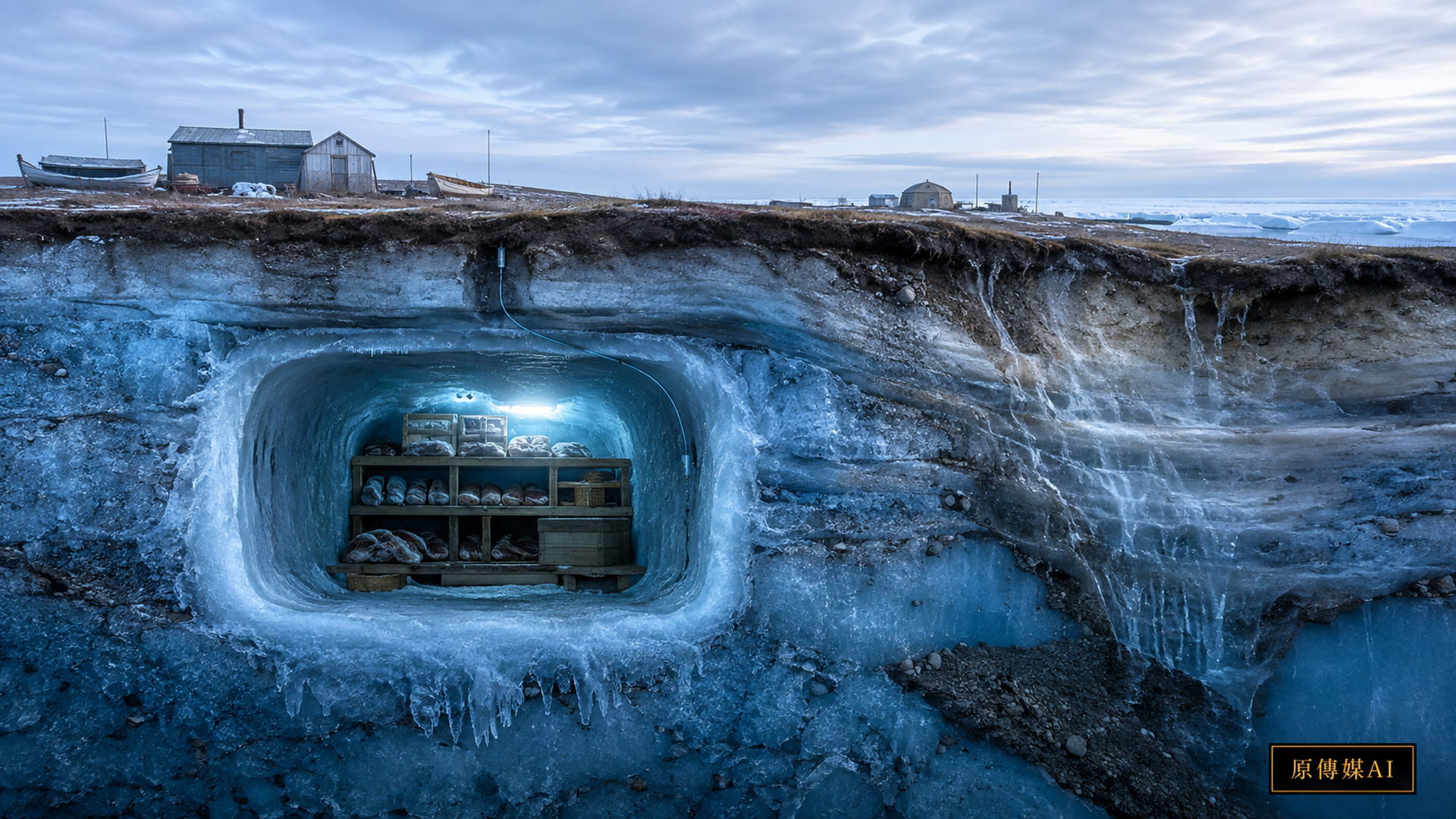
If permafrost is understood as ground that can never thaw, the Arctic is offering a direct correction: the word describes a long-term thermal condition, not a permanent guarantee. For Iñupiat families in Utqiaġvik, that distinction is practical rather than abstract. A traditional underground food store, or sigḷuaq, uses frozen ground and winter air to keep whale, caribou, fish, and other traditional foods cold. As the ground warms and the active layer deepens, seepage, local thawing, wall instability, and changing ventilation can turn a naturally provided cold chain into infrastructure that requires monitoring and maintenance.
A study in ARCTIC assembled a fourteen-year monitoring record for food-storage cellars in Utqiaġvik and turned it into a vulnerability assessment. The researchers did not rely on one annual temperature map. They compared ground-temperature records, cellar structure, location, and community use. Five long-monitored cellars showed stable-to-warming trends, while some experienced flooding, wall collapse, or eventual abandonment. The key finding is not simply another confirmation of Arctic warming. It is that risk is highly local: cellars in the same city can have different futures because of terrain, entrances, soil, snow, drainage, ventilation, and patterns of use. See ARCTIC | Permafrost Food Storage Monitoring and Vulnerability Assessment in Utqiaġvik, Alaska.
That evidence changes what an engineer should ask. A probe placed in frozen ground cannot by itself answer whether a cellar remains usable. Users notice signals that an instrument may not record automatically: the season when an entrance frosts, where snow changes ventilation, which wind direction brings in cold air, when food is moved, and what kind of water, smell, ice crystal, or wall change deserves attention. These are not merely anecdotes. They are a long-running local anomaly-detection system that should influence probe placement, sampling frequency, alert thresholds, and maintenance decisions.
The North Slope Borough | Utqiaġvik Comprehensive Plan 2025–2045 places permafrost and cellar change inside a wider planning frame. The question therefore moves beyond how one household repairs one underground room. Land use, roads, drainage, building foundations, energy, public works, cultural continuity, and food security can affect one another. A cellar is not an isolated hole in the ground. It is part of a thermal and hydrological system, and infrastructure decisions around it may change surface heat, water pathways, and the stability of the surrounding frozen ground.
A useful climate-resilience project keeps two knowledge systems in active conversation. One comes from users: seasons, food, snow, wind, ice, smells, and landscape changes. The other comes from engineering: heat-transfer models, ground temperature, water content, humidity, ventilation, structural movement, and surface settlement. When the two disagree, the first response should not be to declare one side wrong. The team should ask whether the sensor was placed poorly, whether the user described a short event while the instrument recorded a daily average, or whether the model missed snow insulation or an underground water route.
This is a practical form of Two-Eyed Seeing: community observation and engineering measurement remain distinct, but each helps the other become more reliable.
NOAA | Arctic Report Card 2025 emphasizes that the Arctic is changing quickly and that Indigenous-led monitoring is central to keeping observation systems useful over time. This matters for food stores because food-safety monitoring is not an annual academic visit. People open doors, move food, observe conditions, and make decisions every day. If a community is treated only as a source of data, equipment and maintenance capacity may disappear when a research grant ends. Monitoring becomes resilience infrastructure only when local people can operate, interpret, repair, and challenge it.
For Indigenous communities in Taiwan, this case should not be copied as a simple instruction to install permafrost sensors. Its value is methodological. When a cultural practice also performs the work of public infrastructure, adaptation should begin by identifying the users' own judgments and then deciding what needs to be measured. Mountain water storage, traditional granaries, hunting paths, stone-house drainage, stream sources, and hillside farming can all involve a similar question: a sensor is useful when it makes existing judgments traceable and discussable, not when it replaces the people who already know the place.
A practical first phase can be small. Gather cellar users, engineers, public-health workers, and planners to define the baseline together. Record location, season, food type, temperature, humidity, seepage, wall condition, ventilation, maintenance responsibility, warning thresholds, and data permissions. The baseline should state who can stop use, who can authorize repairs, what happens when an alarm is disputed, and how knowledge that should not be public is protected. This makes the project accountable before any expensive retrofit begins.
Food security also requires a distributional test. If one cellar becomes unsafe, the replacement may be a powered freezer, a distant facility, or a new transport pattern, each with different costs, reliability, cultural implications, and access barriers. An adaptation plan that lowers a measured temperature but makes traditional food unaffordable or removes community control is not automatically resilient. Public-health advice should be clear about safety thresholds while leaving room for users and health workers to refine the rules together.
The central question after permafrost becomes less permanent is not whether tradition can resist modern climate change. It is whether a community and its engineering partners can jointly define what counts as abnormal, which risk comes first, and which retrofit preserves the practice's agency. The goal is not to turn a sigḷuaq into an underground refrigerator. It is to preserve the ability of users to judge, manage, and decide how a living food system continues under a moving environmental baseline.
Main reference sources
AI use and content-safety disclosure
This English version is an AI-assisted translation of a Yuan Media AI editorial feature and should be read together with the Chinese source article and cited public references.