Can Demolished Concrete Take CO₂ Back? Waste Concrete Is Becoming a Mineralized Carbon Store
Original Chinese title: 拆掉的水泥牆還能吃回 CO₂?廢混凝土正在變成下一代「礦化碳庫」
When a concrete wall is demolished, it is usually treated as a heavy, low-value construction waste stream. It is crushed, screened, separated from reinforcing steel, and used as fill or recycled aggregate. Materials science is changing the question because old cement paste still contains calcium-bearing phases that can
全明正
Bunun Shuanglong Community; cultural and visual media recorder; follows energy transition, materials technology, low-carbon supply chains, industrial policy, and local environmental governance.
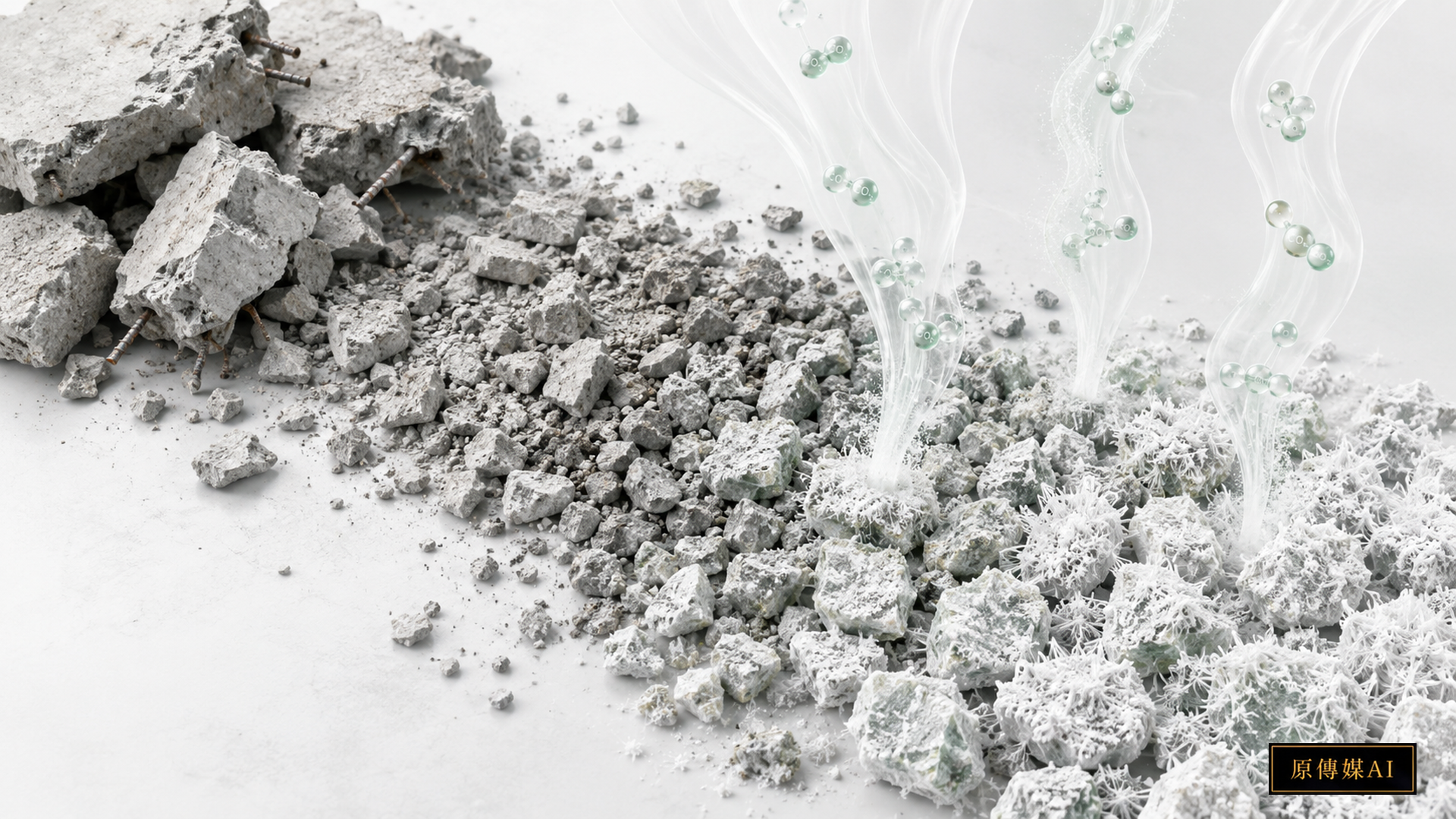
When a concrete wall is demolished, it is usually treated as a heavy, low-value construction waste stream. It is crushed, screened, separated from reinforcing steel, and used as fill or recycled aggregate. Materials science is changing the question because old cement paste still contains calcium-bearing phases that can react with carbon dioxide. Under suitable moisture, particle-size, pressure, and reaction conditions, CO₂ can become a more stable carbonate. That is the chemical basis of accelerated carbonation and mineralized carbon storage.
A U.S. DOE / NETL project treats accelerated carbonation as both a CO₂-storage problem and a recycled-aggregate performance problem. The goal is not to leave a piece of concrete in air and wait for slow natural carbonation. It is to identify particle size, reactor, humidity, and CO₂ conditions that make the reaction faster and measurable, while checking whether physical, mechanical, and durability properties are maintained or improved. The project is described in U.S. DOE / NETL | Resource Assessment for CO₂ Storage via Accelerated Carbonation with Recycled Concrete Aggregates.
The European AGGREGACO2 demonstration moves the idea toward a larger operating scale. As European Commission CINEA | AGGREGACO2: turning waste and CO₂ into sustainable construction materials explains, a Bilbao project connects captured CO₂ with residual material from waste treatment through accelerated-carbonation technology. Its attraction is logistical as well as chemical: one stream needs a destination for CO₂, another stream is difficult or low-value solid residue, and a successful product could move into precast materials, non-structural concrete, bricks, or infrastructure.
The first obstacle at demolition sites is not the reaction equation but the impurity of the feedstock. A truck may contain concrete from different decades and mixes, brick, gypsum, asphalt, soil, wood, steel, coatings, and other contaminants. A laboratory can use clean specimens with a known particle size; an operator receives batches that vary every day. If sorting is too expensive, moisture is unstable, or chloride and sulfate are too high, an impressive carbonation rate may never become a reliable product.
The second obstacle is the difference between CO₂ uptake and net climate benefit. Demolition, transport, crushing, screening, drying, moisture adjustment, CO₂ capture, purification, compression, delivery, and reactor electricity all have emissions. If a process absorbs one kilogram of CO₂ but creates more emissions upstream and downstream, the uptake number alone is misleading. A mineralized carbon store therefore needs a life-cycle boundary, a baseline scenario, a transport distance, an electricity mix, and a clear claim about what natural aggregate or cementitious material is actually replaced.
The third obstacle is the market and the public specification. A recycled aggregate may pass a laboratory strength test and still be limited to low-grade fill if engineers lack durability data, contractors fear liability, or standards do not define an accepted product category. The European Commission JRC | Policy measures to promote reuse and high-quality recycling of construction and demolition waste emphasizes that a high recycling rate is not automatically high-quality circularity. Design rules, quality assurance, traceability, and procurement must change together if the material is to keep value rather than simply move from one low-value use to another.
A 2025 Journal of Building Engineering study examines mechanochemical carbonation of recycled construction-waste fines. It is valuable because it tests how milling and carbonation can increase reactivity, but its results should not be enlarged into a city-scale carbon claim without checking the extra energy and surface-area requirements. The paper's publisher record is Journal of Building Engineering | Transforming recycled construction waste fines into carbon sink material via accelerated mechanochemical carbonation, and its uptake values belong inside the conditions of that experiment rather than outside them.
For local government, the practical first step may be a material-and-carbon map rather than a large mineralization plant. Record how much concrete each demolition project produces, its source and contamination, where it currently goes, the available recycled-aggregate markets, acceptable public-works specifications, and nearby sources of stable CO₂. Once material and carbon flows share one map, planners can compare whether a facility belongs near demolition sites, an aggregate plant, an emissions source, or the eventual user.
A credible carbon account must also be batch-specific. The reactive calcium, moisture, particle size, and actual uptake can vary, so an annual average from a clean laboratory sample should not be applied to every truckload. A stronger system records batch sampling, inorganic-carbon analysis before and after reaction, mass and moisture correction, energy, transport, product destination, and how much virgin aggregate was displaced. It also separates stored carbon, avoided emissions, and material-substitution benefits.
Public works can begin with graded uses whose failure risk is manageable and whose batches are traceable, such as pedestrian-base materials, non-structural precast elements, kerbs, landscape components, or specified fills. Each grade needs performance, source, carbon-boundary, inspection, and stop conditions. This staged approach is more credible than announcing that all demolished concrete can immediately replace all virgin aggregate. It also gives contractors and engineers real construction data for the next specification.
Double counting is another governance boundary. If the source of captured CO₂ has already claimed a reduction under another accounting system, the mineralized product cannot claim the same tonne again without a clear allocation rule. Product lifetime, carbonate stability, end use, and final disposal also need consistent verification. The useful public-procurement document is therefore not a single attractive uptake number, but a traceable environmental record linking feedstock, reaction, transport, product performance, and carbon-accounting boundaries.
Demolished concrete can become a mineralized carbon store, but “it absorbs CO₂” is only the beginning. The claim becomes meaningful when chemistry, sorting, logistics, life-cycle assessment, safety, durability, procurement, and local acceptance check one another. A second life for concrete is not created by a reactor alone. It is created when the material stream, carbon stream, evidence, and responsibility remain visible from demolition to the final public work.
Main reference sources
- U.S. DOE / NETL | Resource Assessment for CO₂ Storage via Accelerated Carbonation with Recycled Concrete Aggregates
- European Commission CINEA | AGGREGACO2: turning waste and CO₂ into sustainable construction materials
- Journal of Building Engineering | Transforming recycled construction waste fines into carbon sink material via accelerated mechanochemical carbonation
- European Commission JRC | Policy measures to promote reuse and high-quality recycling of construction and demolition waste
AI use and content-safety disclosure
This English version is an AI-assisted translation of a Yuan Media AI editorial feature and should be read together with the Chinese source article and cited public references.