Geothermal Wells Bring Up More Than Heat: Direct Lithium Extraction Is Rewriting Critical-Mineral Supply Chains
Original Chinese title: 地熱井抽上來的不只熱:直接鋰萃取正在改寫關鍵礦物供應鏈
California's Salton Sea combines geothermal generation and direct lithium extraction in one supply chain: hot subsurface brine produces energy, yields lithium, and is reinjected. The approach may reduce surface footprint, but industrial performance and local impacts still require long-term evidence.
全明正
全明正 is a cultural and visual recorder from the Shuanglong community of the Bunun people and follows energy transition, materials technology, low-carbon supply chains, industrial policy, and local environmental governance.
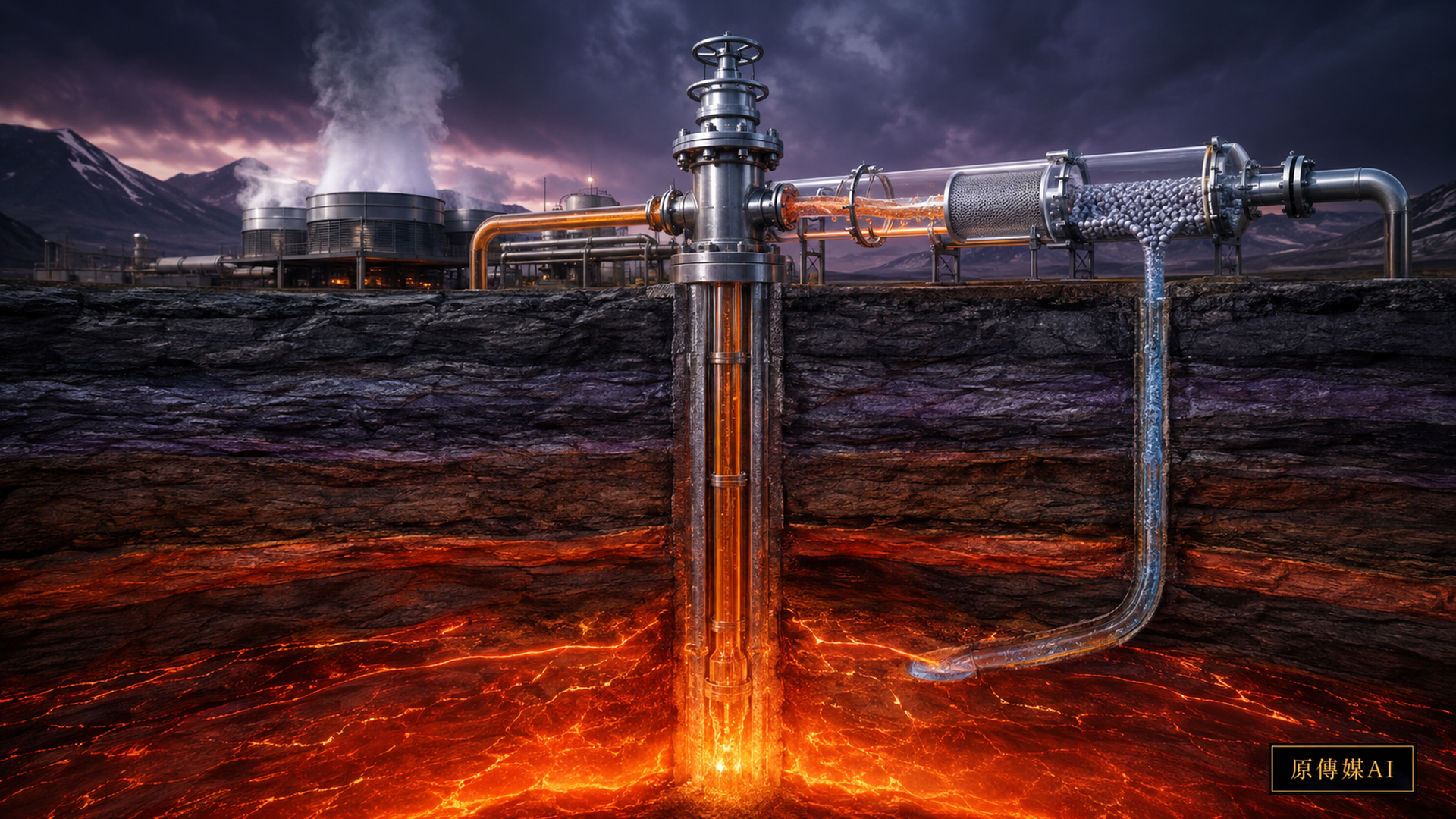
When lithium is discussed through the lens of electric-vehicle batteries, it is often imagined as coming from Australian hard-rock mines or immense evaporation ponds on South American salt flats. Around California's Salton Sea, another supply chain is being actively tested: hot brine brought up by geothermal wells first generates electricity, direct lithium extraction, or DLE, selectively separates lithium from the complex saline fluid, and the treated fluid is then reinjected underground. The attraction is that energy production and recovery of a critical mineral may share well fields and surface infrastructure instead of requiring a separate large open-pit mine.
One common misunderstanding should be resolved first: this lithium is not taken directly from the water of the Salton Sea. The U.S. Department of Energy overview of lithium from geothermal brines explains that the target is hot brine in deep geothermal reservoirs. Long interaction with underground rock leaves the fluid rich in salts and multiple elements. After a geothermal plant brings the fluid to the surface and uses its heat, a DLE system faces a difficult separation problem: capture lithium rapidly and selectively amid much larger quantities of sodium, potassium, calcium, magnesium, silica, and other constituents.
The California Energy Commission FAQ on lithium recovery from geothermal brine describes DLE as a group of emerging chemical-separation processes and explicitly notes that long-duration, large-scale testing is still needed to establish value and performance. That caution matters. A high recovery rate in a laboratory does not prove that an industrial facility can operate continuously for years. In geothermal brine, scaling, corrosion, competition from impurities, sorbent degradation, regenerant consumption, and precipitation during pretreatment can all change costs and environmental performance.
DLE is not one technique. Some approaches capture lithium with a selective sorbent and release it into another solution. Others use ion exchange, solvent extraction, membranes, or electrochemical and chemical processes. Evaluating a project therefore requires more than its lithium recovery rate. Selectivity, throughput, sorbent life, regeneration cycles, reagent demand, pretreatment and post-treatment residues, and the suitability of treated brine for safe reinjection all matter. Commercial viability depends on whether the entire process can continue operating, not on one material's peak performance in a short test.
Resource claims also require precise language. Lawrence Berkeley National Laboratory's Characterizing the Geothermal Lithium Resource at the Salton Sea estimates a substantial dissolved-lithium resource in the better-characterized portion of the Salton Sea Geothermal Reservoir. The report and related work use geology, reservoir models, and historic production and injection records to assess how long-term fluid production and lithium removal may change the system. The point of a resource estimate is not to claim that every unit underground can be produced. It is to distinguish geological resource, accessible resource, technical recovery, and economic output.
DLE is often promoted as having a smaller surface footprint than hard-rock mining or large evaporation ponds because it can share an existing geothermal well field and does not need to leave salt-flat brine exposed for years. That is a potential advantage, but a smaller surface footprint does not mean negligible environmental impact. A commercial plant still requires pumps, pipes, chemicals, electricity, cooling, roads, tanks, and waste management. Expanding geothermal generation and lithium output may also increase the number of wells, construction activity, and regional water demand.
Water cannot be dismissed with the statement that brine is reinjected. A Berkeley Lab analysis of the impact of geothermal expansion and lithium extraction on local water resources examines possible effects around the Salton Sea Known Geothermal Resource Area. Geothermal brine is itself a highly saline underground fluid, but a plant may also need makeup water, cooling water, wash water, and water for chemical processing. Local governance must track the total water balance: external freshwater or treated water per unit of lithium product, recycling rates, consumptive losses, and the constituents transferred into solid residue. The fact that produced fluid is ultimately reinjected does not answer those questions.
Reinjection also affects the subsurface system. Geothermal development already has to manage reservoir pressure, the balance of production and injection, scaling, corrosion, and induced seismicity. If DLE changes brine chemistry through pretreatment or removal of lithium and associated ions, engineers must determine how those changes affect pipes, wells, and reactions with underground rock. The ideal loop is heat recovery, lithium separation, and reinjection, but every arrow in that flow diagram needs long-term data.
Local communities should therefore see more than annual tonnes of lithium and projected jobs in an environmental presentation. A useful monitoring list includes well-field production and reinjection volumes, sources of makeup water, plant water consumption, chemicals and sorbents used, destination of precipitates and wastes, air emissions, noise, traffic, land subsidence, microseismic events, accidental releases, and responsibility during shutdown and well closure. If only the operator possesses these data, a genuinely verifiable social license is difficult to establish.
Community benefits should also be negotiated early rather than appended after construction. Will local people have access to long-term technical and maintenance jobs? Is training reachable? How will new tax revenue or funds return to water, public health, roads, and education? If profits enter a transnational supply chain while traffic, water use, and environmental risk remain around the well field, a national critical-minerals strategy alone cannot justify the local cost. The fact that Berkeley Lab's resource work and related public information include community questions shows that engineering evaluation cannot be limited to ore quantity and process efficiency.
For Taiwan, the immediate lesson is not to assume that every geothermal well can also produce lithium. Fluid chemistry varies greatly among geological environments; only geochemical surveys and resource assessment can show whether lithium or another critical element reaches an economic concentration. If Taiwan eventually evaluates minerals associated with geothermal development, baseline data, archived samples, fluid composition, production and injection volumes, water use, chemicals, and microseismic monitoring should enter the system during exploration rather than being added only after commercialization.
The larger significance is that energy transition and mineral transition are converging. A geothermal plant was once asked mainly how much electricity it could generate. If it also becomes a lithium facility, it must answer where the resource comes from, which substances are retained, which are reinjected, and who bears risk. DLE may offer a more compact supply route than some conventional lithium sources, but “co-production” is more than a marketing term only when long-term operations, a complete water balance, waste, and subsurface risks are transparent.
Geothermal wells may indeed deliver critical minerals as well as heat, but technical maturity and local governance have to grow together. The important contest is not which company first declares a “Lithium Valley.” It is which system can account for the fluid, energy, water, reagents, reinjection, and community benefits behind every tonne of product. A critical-mineral supply chain can become more accountable while pursuing security and decarbonization only when local people can test engineering promises against long-term measured data.
Commercial-scale decisions also require continuous-operation indicators that promotional recovery figures can obscure. In addition to lithium recovery, reporting should cover changes in feed-brine concentration, hourly throughput, product purity, sorbent or separation performance after hundreds or thousands of cycles, reagents and energy per tonne, shutdown and cleaning frequency, and the mass of pretreatment precipitates. A process with high short-term recovery but frequent shutdowns and material replacement may still be commercially unsuitable for a well field.
Local monitoring needs a level at which raw data remain traceable. Monthly averages are useful for public reports, but when there is a major anomaly, spill, microearthquake swarm, sudden change in production or injection, or increase in makeup water, regulators need access to daily or hourly records. Not every record must be published openly online, but independent verification and durable retention are essential so that only operator-produced summaries do not remain years later. If community committees, local government, and research institutions jointly define public indicators, industrial promises become easier to test over time.
Critical-mineral policy must measure resilience at the producing place as well as national supply security. Geothermal lithium may reduce import dependence, but if pressure on water, roads, housing, labor, and public health grows around the well field, supply-chain risk has merely shifted from international to local. A more mature system negotiates community-benefit agreements, local employment training, monitoring funds, closure responsibility, and long-term environmental data retention together, allowing both propositions to stand: the country needs lithium, and local people have a right to know and participate in decisions.
Yuan Media AI | Continue with questions for your role
This feature provides four role-based entry points with five questions each, for a total of 20 follow-up exchanges. Readers can choose a role and explore prepared answers grounded in the article's sources, with research evidence, local governance, and unresolved limits presented separately.
Sources retained from the Chinese original
- California Energy Commission | Lithium recovery from geothermal brine FAQ
- U.S. Department of Energy | Lithium from geothermal brines
- Lawrence Berkeley National Laboratory | Characterizing the Geothermal Lithium Resource at the Salton Sea
- Berkeley Lab | Impact of geothermal expansion and lithium extraction on local water resources
AI use and content-safety disclosure
This English version is an AI-assisted translation of a Yuan Media AI editorial feature and should be read together with the Chinese source article and cited public references.