Cooling Without Conventional Refrigerant Compression: Metals That Cool Under Stress Could Replace the Heart of a Refrigerator
Original Chinese title: 不靠傳統冷媒壓縮,也能做到零下?會「受力降溫」的金屬正在替冰箱換心臟
In 2026, elastocaloric solid-state cooling is advancing through low-temperature demonstrations, fatigue-resistant 3D-printed NiTi, and hundred-watt-scale regenerators. It offers a route beyond conventional vapor compression and high-global-warming-potential refrigerants, but system engineering and long-term reliability remain decisive.
全明正
全明正 | Bunun, Shuanglong Indigenous Community | Cultural and visual recorder | Follows energy transition, materials technology, low-carbon supply chains, industrial policy, and local environmental governance.
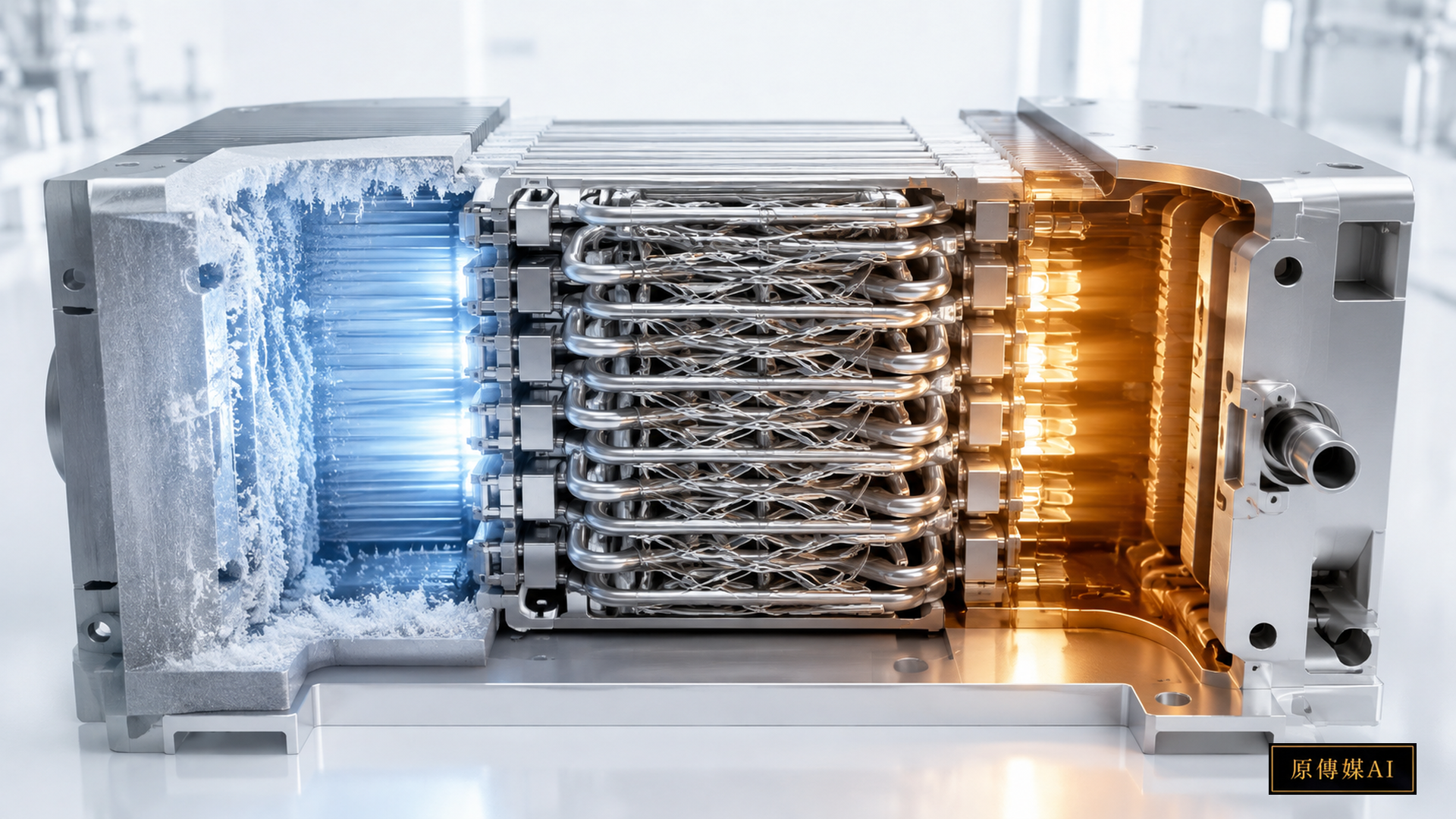
Most refrigerators, air conditioners, and heat pumps use a vapor-compression cycle: a refrigerant moves through compression, condensation, expansion, and evaporation to carry heat. The architecture has improved for decades, but it still carries the warming potential and leakage risks of some refrigerants, along with the material, noise, and maintenance burden of compressors, throttling devices, and heat exchangers. Solid-state cooling is attractive because it asks whether a material itself can absorb and release heat during loading and unloading, replacing the traditional heart of a cooling machine.
Elastocaloric cooling is based on a reversible phase transition in certain shape-memory alloys under mechanical stress. Loading the material raises its temperature; releasing the stress allows it to absorb heat and cool. Combined with heat exchangers, regenerators, and a suitable actuator, the effect can form a new cooling cycle. This is not merely a curiosity that “metal becomes cold.” It is an attempt to redesign refrigeration engineering around a solid material rather than a circulating refrigerant.
The 2026 research progress is notable because it addresses two weaknesses that have long limited practical use: fatigue life and system scale. A material that survives only a few thousand laboratory cycles is unlikely to enter an appliance. A large one-time temperature difference is also insufficient if the system cannot exchange heat steadily. That is why Nature Communications | 3D-printed NiTi alloys for elastocaloric cooling and Nature Communications | Conifer-shaped multi-layer elastocaloric regenerators matter. They advance manufacturability, geometry, and system output rather than only a point measurement of material performance.
The difficult question for a shape-memory alloy researcher is not producing one effective strain. It is maintaining stable performance through hundreds of thousands or millions of cycles. Fatigue cracks, irreversible deformation, or uneven phase transformation can gradually degrade the whole cooling unit. Research on 3D-printed NiTi and layered regenerators is therefore important because it connects material design with geometry, stress distribution, heat-transfer efficiency, and repairable system architecture.
From the refrigeration-engineering perspective, the measures that matter include coefficient of performance, heat-transfer rate, actuator energy, noise, and maintenance. Solid-state cooling does not mean that there are no mechanical parts: the material still has to be repeatedly loaded and unloaded. The difference is that the core is no longer a fluid cycle of evaporation and condensation; it is a phase-changing material and a thermal regenerator. If the actuator is inefficient, the total system may not outperform a mature vapor-compression machine even if it avoids some refrigerant problems.
That is why industry is looking at vehicles and buildings. Fraunhofer IPM’s SMArtCool project shows elastocaloric cooling moving beyond an academic display toward air-conditioning-system validation. Vehicle air conditioning is a useful test because space is limited and both efficiency and refrigerant policy matter. Success there could open paths to small commercial refrigeration, building end uses, and specialized temperature-control equipment.
The technology should not be romanticized. NiTi involves nickel and titanium supply, processing, recycling, and cost. Large-scale use would raise questions about material life cycle and manufacturing carbon. Avoiding some conventional refrigerants does not remove the responsibility of the new material system. If policy treats solid-state cooling as a low-carbon transition route, it must address standards, recovery, durability, spare parts, and repair access rather than only the most impressive temperature difference in a laboratory.
Taiwan has several reasons to watch this field. Refrigeration and air conditioning are major energy users, so improvements in thermal management connect directly to the energy transition. Taiwan also has capabilities in precision manufacturing, heat exchange, metal processing, and electronics cooling. If elastocaloric technology matures, local firms might participate in components and system integration rather than only buy finished equipment. The early policy task is to distinguish temporary demonstrations from progress that is approaching an industrial threshold.
The transition would also change maintenance culture. Conventional service knowledge centers on refrigerants, compressors, pipes, and heat exchangers. A system built around elastocaloric materials and mechanical actuators would require different skills, fault diagnosis, training, and spare-part networks. This change would reach workshops and local service providers, not only laboratories and factories. A new appliance cannot be called resilient if a failed module can be repaired only by a distant original manufacturer at high cost.
For remote communities, repairability is part of climate technology rather than an afterthought. A smaller cooling unit that can be inspected locally, uses documented parts, and has a safe fallback may deliver more public value than a more efficient prototype that becomes unusable after one specialized component fails. Demonstration projects should therefore report maintenance time and downtime as carefully as temperature and coefficient of performance.
The meaningful story is therefore not one headline about reaching below zero. It is whether a complete technical path is accumulating: longer material life, mature regenerator geometry, higher system output, real industrial test sites, and a policy and market answer about when adoption makes sense. If those pieces continue to align, the language of cooling may gradually move from refrigerants and compressors toward stress-driven phase-change metals and solid-state thermal management.
Yuan Media AI | Continue Asking Through Your Role
This article provides four role entrances, with five pre-generated questions for each role, for a total of 20 question-and-answer sets. The front end loads the corresponding JSON through `roleQaPath`; it does not call a model in the browser. Answers retain embedded source links so readers can continue checking the evidence.
AI use and content-safety disclosure
This English version is an AI-assisted translation of a Yuan Media AI editorial feature and should be read together with the Chinese source article and cited public references.