Actually Breaking Down Forever Chemicals: PFAS Governance Moves from Filtration toward Mineralization, Fluoride Recovery, and Verifiable Mass Balance
Original Chinese title: 把「永遠化學物」真正拆掉:PFAS 治理正從濾除走向礦化、氟回收與可驗證質量平衡
PFAS governance is no longer satisfied with moving contamination out of water. It now asks whether PFAS was truly destroyed, whether fluorine can be traced, and whether short-chain by-products or secondary pollution remain after treatment.
山海資料庫
Co-authors: 李文驤
Shanhai Database | Co-author: 李文驤 | Focuses on geographic information, mountain transportation, environmental governance, and public-service resilience.
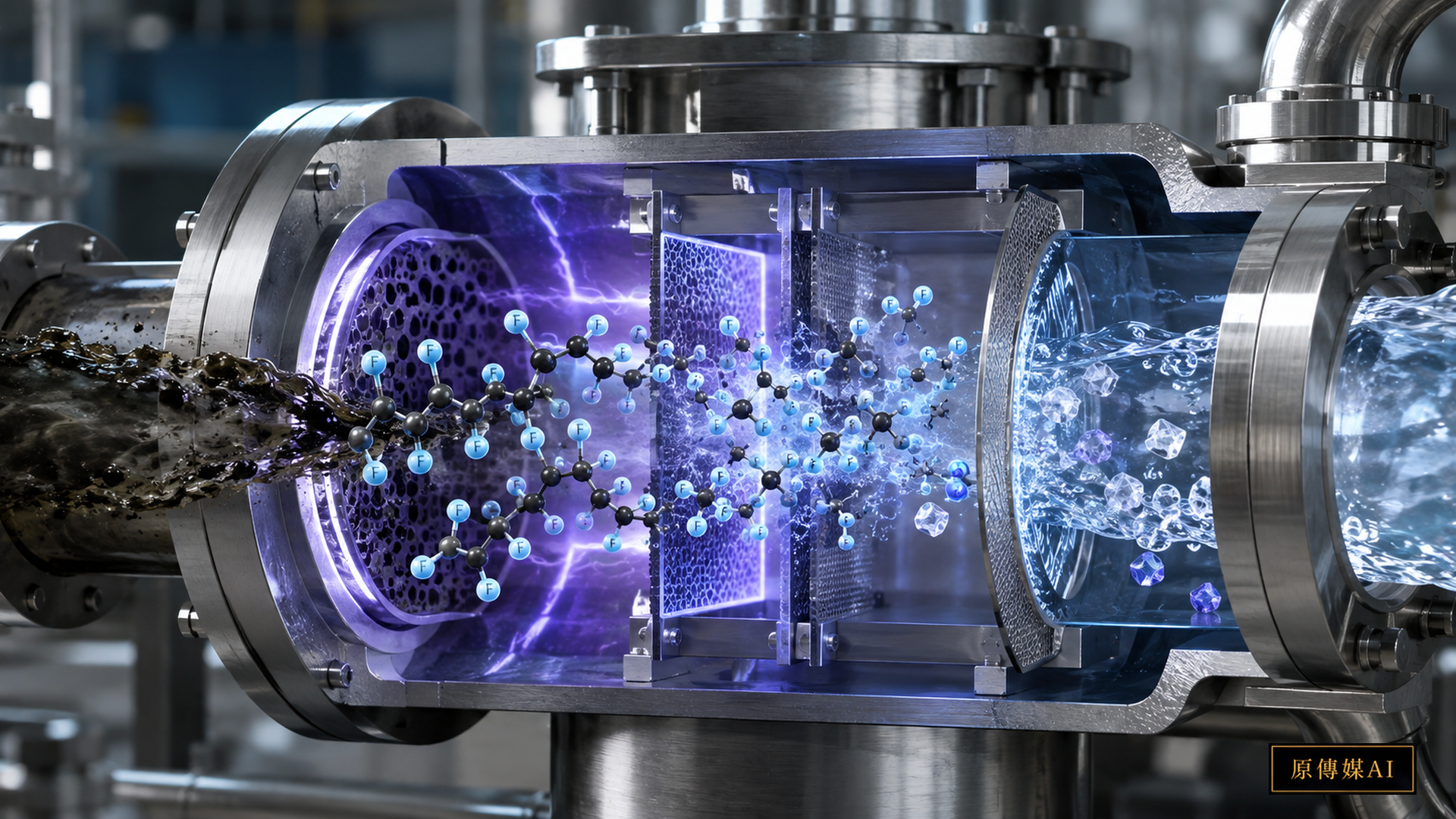
PFAS are called “forever chemicals” not because they can never change, but because their carbon-fluorine bonds are exceptionally stable. Once these compounds enter water, soil, firefighting foam, industrial processes, or consumer products, the natural environment has difficulty breaking them down quickly. For years, many treatment systems focused on moving PFAS out of water through activated carbon, ion-exchange resin, or membrane separation. Those tools are important, but they answer only the first question: can contamination be captured before it reaches drinking water or wastewater? The harder question begins afterward: where did the PFAS go?
In April 2026, the U.S. EPA updated its 2026 Interim Guidance on PFAS destruction and disposal. The importance of this document is not that it declares one technology to be a complete solution. It returns governance to the whole life cycle: collection, concentrate management, control of exhaust and solid residues, post-treatment products, and disposal choices for different settings. PFAS disappearing from water does not mean PFAS disappeared from the environment. Without tracing the final destination, a treatment system may only move contamination from liquid into sludge, filter media, a flue, or another less visible compartment.
The same shift appears in the EPA’s PFAS Innovative Treatment Team. The goal of several emerging routes is not merely to adsorb or retain PFAS, but to break the carbon-fluorine bond and move toward mineralization or a decomposition state that can be verified. Electrochemical oxidation, mechanochemistry, supercritical-water oxidation, pyrolysis, and gasification each have different feed requirements, energy needs, by-products, and safety questions. A system that works for one medium may not work for concentrate, foam, sludge, or high-salt wastewater at full scale.
The central change in the evidence standard is mass balance. If one hundred units of fluorine enter a system, how many leave as measurable inorganic fluoride? How much remains in a filter, enters an exhaust stream, or becomes an unidentified organic by-product? A high removal rate for a short target list does not prove that total fluorine has been destroyed. More persuasive evidence combines target-compound analysis with total fluorine, extractable organofluorine, inorganic fluoride, and by-product identification. The goal is to distinguish destruction from relocation.
This changes procurement language for water utilities and local environmental agencies. A specification that says only “99 percent removal” is incomplete. A serious contract should identify samples from the feed, treated water, concentrate, solid residue, and exhaust; define analytical methods; set an acceptable mass-balance error; and state what evidence supports a claim of mineralization. If a system only concentrates PFAS, the next treatment responsibility must be named. If equipment stops, the temporary storage, monitoring, and public-reporting duties must already be clear.
Scale and energy make the engineering problem more complicated. A destruction process may work well on a small, high-concentration waste stream but be unreasonable for a large volume of low-concentration drinking water. Real systems may therefore combine capture and destruction: first concentrate PFAS with adsorption or membranes, then apply a high-energy process to a smaller volume. That approach is more complex but closer to engineering reality. Decision-makers should compare the whole treatment chain, including energy, consumables, maintenance, residuals, and long-term monitoring, rather than comparing one device at a time.
Residents ask a direct scientific question: if you say the PFAS was treated, where is it now? Could it have moved from household water into ash, sludge, or emissions elsewhere? A technical answer that hides behind specialized language makes monitoring look like a black box. A clearer public report can show how much entered, how much was captured, how much was actually destroyed, what remains, and where each stream went. Stable reporting makes trends checkable and gives communities a basis for asking for correction when a plant, contractor, or policy changes.
Fluoride recovery adds a possible circular-chemistry direction. PFAS has traditionally been treated as hazardous waste to isolate, destroy, and keep away from exposure. Early research is asking whether some destruction routes can release fluorine in a cleaner, measurable form that could be recovered or reused. This is not a license to commercialize every treatment process immediately. It is a reminder that mature pollution governance can reduce risk while also bringing difficult element flows back into a managed material cycle.
The EPA has repeatedly emphasized that many destruction technologies still need full-scale evidence under complex matrices, changing flows, and long operating periods. A laboratory system that breaks bonds may encounter salts, organic matter, suspended solids, corrosion, downtime, and maintenance limits at a water plant, a firefighting-foam waste site, or a landfill leachate facility. The useful conclusion is therefore not that one technology is already mature. It is that every credible PFAS claim must answer four questions: where did the fluorine go, does the balance close, what by-products remain, and who carries responsibility?
Independent verification is especially important when a vendor presents a single favorable number. Local authorities should preserve samples, document operating conditions, and make the uncertainty around detection limits visible. A result that cannot be reproduced or audited should not be treated as proof that a hazardous material has disappeared.
Taiwanese local governments and Indigenous townships can face the same questions through industrial water, firefighting foam, landfill management, and drinking-water monitoring. The safest starting point is not dependence on one vendor or one machine. It is an integrated material-flow plan that connects sampling, procurement, disclosure, residual handling, and independent verification. When a report includes concentrate, filter life, exhaust controls, solid residues, and unexpected products, “cleaner at the front” no longer hides an unresolved problem at the back.
Yuan Media AI | Continue Asking Through Your Role
This article provides four role entrances, with five pre-generated questions for each role, for a total of 20 question-and-answer sets. The front end loads the corresponding JSON through `roleQaPath`; it does not call a model in the browser. Answers retain embedded source links so readers can continue checking the evidence.
AI use and content-safety disclosure
This English version is an AI-assisted translation of a Yuan Media AI editorial feature and should be read together with the Chinese source article and cited public references.